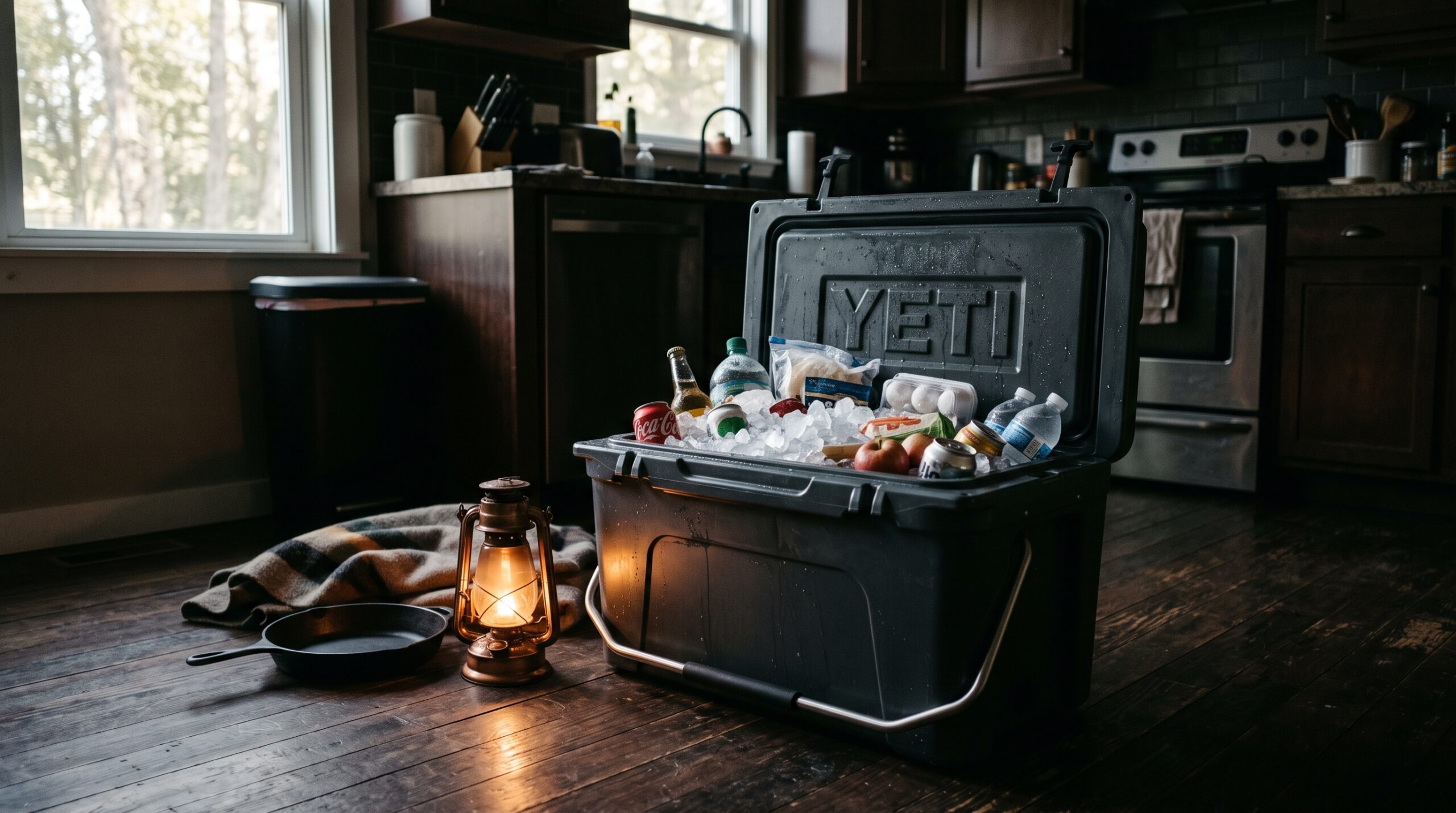
To keep food cold without power, move it to a cooler packed with ice and keep it at 40°F or below; block ice lasts longer than cubes. Before you open anything, though, leave the closed refrigerator and freezer alone, because they hold the cold far better sealed than a cooler does. Open them only once you have a plan and the ice ready to go.
Below is the order to do things in: keep the doors shut first, then move food into coolers with the right kind of ice, add dry ice for a long outage, read the real temperature with a thermometer, and run the fridge on a power station if you want to skip the ice game altogether.
⚠️ Keep it at 40°F or below
Perishable food kept above 40°F for two hours or more is not safe to eat. When in doubt, throw it out, and never taste food to decide whether it is safe. If you use dry ice, handle it with gloves in a well-ventilated space. This is planning guidance built on USDA and FDA recommendations, not a substitute for the official charts linked at the bottom.
Keep the fridge and freezer closed first
The fastest way to lose food is to keep opening the door to check on it. A closed refrigerator keeps food safe for about four hours. A full freezer holds for about 48 hours, and a half-full one for about 24 hours, as long as it stays shut. Every time you open a door, cold air spills out and warm air rushes in, and those hours shrink.
So in a short outage, the move is simple: do nothing. Leave both doors closed and wait. Start moving food into a cooler only when it looks like the power will be out longer than the four hours your fridge can coast on, or longer than a day for the freezer.
Move food to a cooler with ice
When the outage looks like it will run past four hours, pack the things that spoil first into a cooler surrounded by ice: milk and dairy, raw and cooked meat, poultry, fish, eggs, and leftovers. A cooler is smaller and easier to keep cold than a whole refrigerator, and you can top it up with ice as it melts.
The kind of ice matters. A solid block of ice has less surface area exposed to the warm air, so it melts slower and lasts longer than the same weight of cubes. Cubes chill food faster and slip into the gaps around containers, but they melt sooner. The practical answer is to use both: a block on the bottom to hold the cold, cubes packed around the food to chill it quickly.
Aim for more ice than food, not less. A rough target is about two parts ice to one part food by volume, and more if it is hot out. Keep the cooler in the coolest, shadiest spot you can find, out of direct sun, and keep the lid closed. An appliance thermometer tucked inside lets you confirm it is staying at 40°F or below without lifting the lid to guess.
Using dry ice for a long outage
Dry ice is frozen carbon dioxide, and it is much colder than regular ice, so it can keep a freezer or cooler of food frozen through a multi-day outage. As a rough guide, the FDA notes that 50 pounds of dry ice can keep an 18-cubic-foot full freezer cold for about two days. A common planning figure is roughly 2.5 to 3 pounds of dry ice per cubic foot of space you need to keep frozen.
Dry ice needs care. It sits at about -109°F and will give you a frostbite-like burn on contact, so handle it only with thick gloves or tongs, never bare hands. It also releases carbon dioxide gas as it sublimates, which can build up and displace breathable air, so keep the room well ventilated and never store it in a sealed, airtight space or a closed car. Lay a piece of cardboard between your food and the dry ice rather than letting them touch, place the dry ice on top since cold air sinks, and keep it away from children and pets.
Group frozen food together
Whether the food stays in the freezer or moves to a cooler, push it into one tight pile. A cluster of frozen items acts like a single block of ice: each piece helps keep its neighbors cold, and the whole mass coasts longer than scattered packages would. Fill any empty space with bagged ice or frozen water jugs so there is less warm air around the food.
If you have warning before an outage, freeze a few jugs of water ahead of time. They fill the gaps, add cold mass, and later thaw into drinking water.
The 40°F line and a thermometer
40°F is the number that decides everything. Below it, food stays in the safe zone. Above it, bacteria start to multiply, and perishable food held above 40°F for two hours or more should be thrown out. The trouble is you cannot judge 40°F by touch, so keep an appliance thermometer in the fridge, the freezer, and your cooler, and read the temperature instead of guessing.
When the power comes back, check each item. Food in the freezer that still has ice crystals or is at 40°F or below is safe to refreeze or cook, though the texture may suffer. Anything that has warmed above 40°F for more than two hours, especially meat, poultry, seafood, eggs, and dairy, should go. When you are unsure about a particular item, throw it out rather than risk it, and never taste food to check.
| Ice type | How long it lasts | Notes |
|---|---|---|
| Block ice | Longest of the wet-ice options | Less surface area means it melts slower. Best for holding a cooler cold over a long outage. |
| Cubed ice | Shorter than a block | Chills food fast and fills the gaps around containers, but melts sooner. Pair it with a block. |
| Dry ice | Keeps food frozen for roughly two days at ~50 lb in an 18 cu ft freezer | About -109°F. Handle with gloves, keep the area ventilated, and never touch it bare-handed. |
| Frozen gel packs / water jugs | Hours to a day, depending on size | Good for topping up a cooler and filling freezer gaps. Refreeze to drinking water later. |
The longer-term fix: run the fridge on a power station
Ice buys you time, but it runs out. If you want to skip the cooler routine for outages that stretch past a day, a battery power station can run the refrigerator straight through. A typical home fridge draws somewhere around 100 to 250 watts while the compressor is running, with a brief startup surge of several hundred to roughly 1,200 watts, and it only runs part of the time. That on-and-off duty cycle is why a mid-size power station can keep a fridge cold for many hours, sometimes more than a day, on a single charge.
The right size depends on your fridge and how long the outage lasts, not the number on the battery’s box. Find the wattage on your appliance label, then run it through the Appliance Runtime calculator to see how long a given power station would keep your fridge cold, or the Power-Station Sizing calculator to find the capacity you need for a one or two day outage.
Frequently asked questions
How long will food stay cold in the fridge without power?
About four hours if you keep the door closed the whole time. After that, move perishable food into a cooler packed with ice and aim to keep it at 40°F or below.
Is block ice or cubed ice better for a cooler?
Block ice lasts longer because it has less surface area exposed to warm air, so it melts more slowly. Cubes chill food faster and fill the gaps around containers. Using both, a block on the bottom and cubes around the food, gives you the longest, coldest hold.
How much dry ice do I need to keep food cold?
A common guide is about 2.5 to 3 pounds of dry ice per cubic foot of space. The FDA notes that 50 pounds can keep an 18-cubic-foot full freezer cold for roughly two days. Handle it with gloves in a well-ventilated area, and keep a layer of cardboard between the dry ice and your food.
Is dry ice safe to use indoors?
Use it only with good ventilation. As dry ice warms it releases carbon dioxide gas, which can build up and displace breathable air in a small or closed space. Never store it in a sealed container or a closed car, never touch it with bare hands, and keep it away from children and pets.
Can I refreeze food once the power comes back?
Yes, if it still has ice crystals or is at 40°F or below. The quality and texture may drop, but it is safe to refreeze or cook. Throw out anything that thawed and stayed above 40°F for more than two hours, and never taste food to decide.