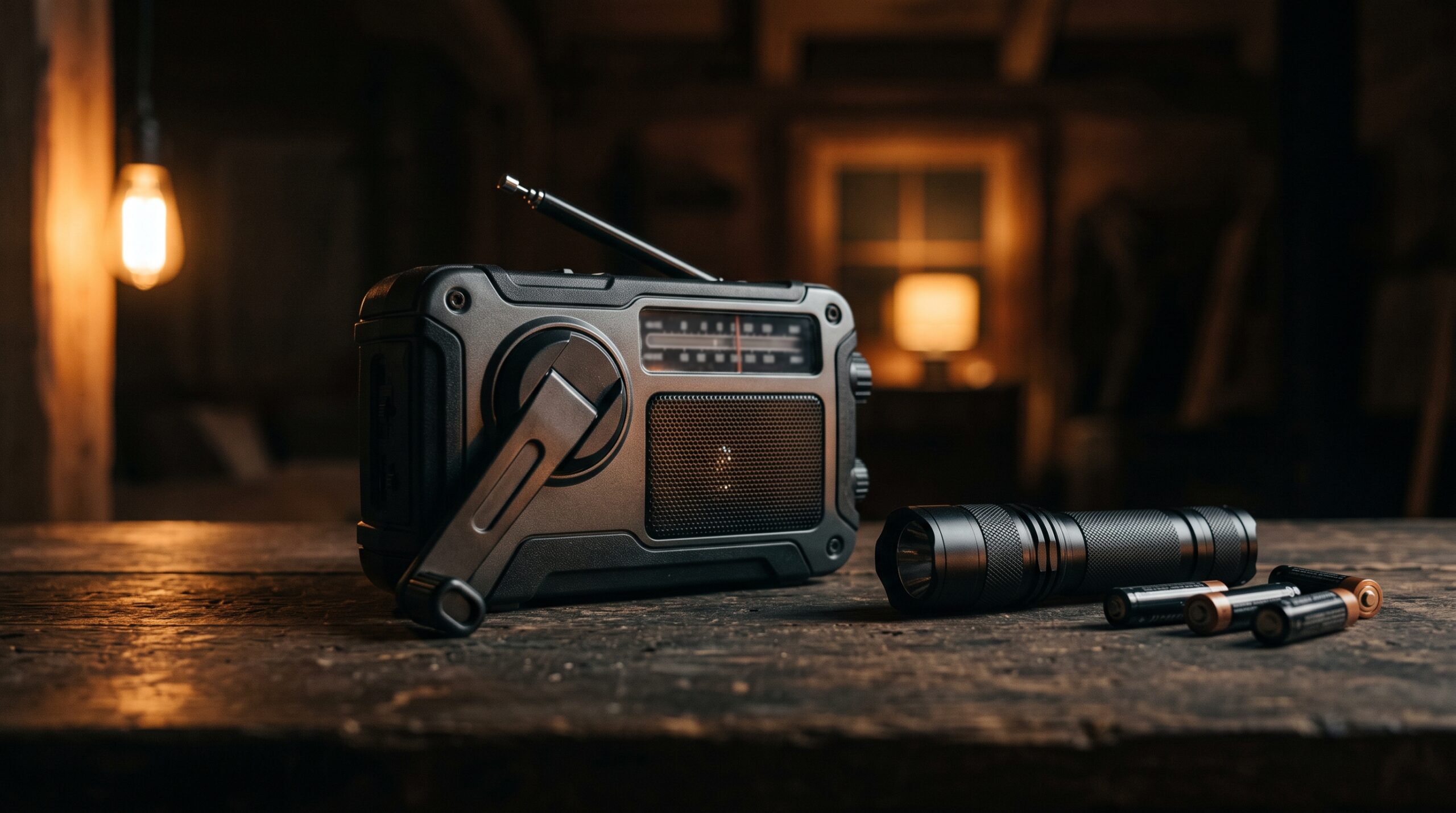
When the power and the cell network both go down, an emergency radio is often the only thing still feeding you real information. The features that matter most are simple: it should receive the NOAA Weather Radio band, run on more than one power source so it never dies at the worst moment, and ideally charge your phone and throw light. Below is how to weigh those features, plus a handful of current models worth a look, sorted by how you plan to use them.
What matters most in an emergency radio
Forget star ratings for a second and judge any radio against five practical questions. Get these right and the brand on the case barely matters.
- Does it receive the NOAA Weather Radio band? This is the non-negotiable one. AM/FM is useful, but the weather band is what carries official warnings 24/7.
- How many ways can you power it? A radio that only takes one battery type is a single point of failure. Hand crank, solar, an internal rechargeable cell, swappable AA/AAA cells, and USB input are all worth having.
- Can it charge a phone? A built-in power bank with a USB-A output turns the radio into a backup for a dead phone. It is slow, but it can buy you a text or a map.
- Does it have a usable flashlight? Most do. A brighter LED, an SOS mode, or a reading lamp adds real value when the lights are out.
- Will it actually pull in a signal? Reception varies. Indoors and in rural areas, a model with a longer telescoping antenna tends to do better on weak weather and AM stations.
A radio is one piece of a larger setup. If you are still building yours, our power outage emergency kit checklist and guide to preparing your home for a power outage cover what should sit alongside it.
NOAA Weather Radio and SAME alerts, explained
NOAA Weather Radio All Hazards (NWR) is a network run by the National Weather Service that broadcasts continuous forecasts and warnings on seven frequencies between 162.400 and 162.550 MHz. Almost every “emergency radio” can tune these channels, and many add a weather-alert function that switches the radio on automatically when the National Weather Service sends a warning tone for your region.
SAME (Specific Area Message Encoding) is the upgrade worth understanding. A plain weather-alert radio reacts to any warning the local transmitter broadcasts, which can cover several counties. A SAME-capable radio lets you program your specific county code so it only sounds for alerts that actually affect you, cutting down on false alarms that train people to ignore the thing. Relatively few portable crank radios support SAME; it is more common on AC-powered desktop “home base” units. If you live in tornado, hurricane, or flash-flood country, SAME is a feature worth paying for.
Power sources: crank, solar, battery, and USB
The whole point of an emergency radio is that it keeps working when the grid does not. The more power paths it has, the better. Here is how the common options actually behave.
- Internal rechargeable battery: The default in modern units. Charge it from USB before a storm and you usually get many hours of listening. This is the source you will rely on day to day.
- Hand crank: Your fallback when everything else is dead. Cranking is slow going, often a minute of winding for only a few minutes of radio, but it never runs out and it works in a windowless basement.
- Solar panel: Good for topping off over a long outage if you can leave the radio in sun. Treat it as a trickle, not a fast charger, since the small panels generate modest power.
- Swappable AA/AAA cells: Underrated. A radio that also runs on standard alkaline batteries lets you swap in fresh cells instantly instead of cranking.
- USB input: Lets you recharge from a wall adapter, a car, or a portable power station.
One honest caveat: rechargeable cells self-discharge and degrade over time. A radio that has sat in a drawer for two years may be flat or weak when you need it. Top it off every few months, and keep a pack of the right disposable batteries with it as a true backup.
Flashlight, phone charging, and reception
Beyond the radio itself, three extras separate a basic unit from a genuinely useful one. A built-in flashlight is standard; look for a brighter LED, an SOS strobe, or a reading lamp if you want one device to do more. Phone charging comes from a USB-A output wired to the internal battery. It is real but limited, a partial top-up rather than a full charge, so it is no substitute for a dedicated power bank. For a fuller picture of charging options, see our guide on keeping your phone charged during a power outage.
On reception, the weather band is line-of-sight from the transmitter, so terrain, building materials, and antenna length all matter. If you are deep inside a house or far from a city, a model with a long telescoping antenna and the ability to manually scan the seven WX channels will serve you better than a tiny pocket unit.
Strong options to consider right now
These are widely sold, well-reviewed models that cover the major use cases, not a tested ranking. Specs come from the manufacturers; prices are approximate and shift often, so confirm before you buy. Use the table to match power sources and features to what you need.
| Model | Power sources | NOAA / SAME | Phone charging | Approx. price |
|---|---|---|---|---|
| RunningSnail (4000mAh crank radio) | Crank, solar, USB, AAA | NOAA alert, no SAME | Yes, USB-A power bank | ~$25–35 |
| Midland ER210 | Crank, solar, rechargeable cell | NOAA scan + alert, no SAME | Yes, USB-A out | ~$50 |
| Midland ER310 | Crank, solar, rechargeable cell, 6× AA backup | NOAA + SAME alerts | Yes, USB-A out | ~$60 |
| Kaito Voyager KA500 | Crank, solar, USB, AA, AC adapter | NOAA alert (adds AM/FM/shortwave) | Yes, USB-A out | ~$50 |
| Eton / American Red Cross FRX3+ | Crank, solar, USB, DC input | NOAA alert, no SAME | Yes, USB-A out | ~$60–70 |
| Midland WR400 (home base) | AC power with battery backup | NOAA + SAME alerts | No | ~$70–80 |
A few notes on the field. The RunningSnail is the popular budget pick: a 4000mAh battery, four power paths, a flashlight and reading lamp, no SAME but everything a basic kit needs. The Midland ER310 is the one most reviewers point to when SAME alerts matter in a portable, and its AA backup compartment is a genuine advantage. The Kaito KA500 adds shortwave and a five-way power setup that prepper-minded buyers like. The WR400 is a plug-in desktop unit for the bedside table, not a go-bag, but its hyper-local SAME alerts make it a strong home base.
How to choose by use case
- Basic crank radio for a kit or car: A budget hand-crank model like the RunningSnail covers the essentials, AM/FM, NOAA alerts, a flashlight, and a small power bank, for around $30. It is the easy default to toss in every emergency bag.
- Full-featured grab-and-go with phone charging: If you want one capable unit, a Midland ER310 or Kaito KA500 gives you multiple power sources, a real flashlight, USB charging, and, on the ER310, SAME alerts and AA backup.
- Home base on the nightstand: A plug-in SAME radio such as the Midland WR400 sits powered and silent until your county’s warning tone wakes it in the night. Pair it with a portable for when you leave the house.
Whatever you pick, the radio works best as part of a plan. Make sure everyone in the house knows where it lives and how to use it; our guide to making a family emergency plan walks through that, and reporting the outage to your utility is usually step one once you are safe.
How to buy without overpaying
A good emergency radio does not need to be expensive. The honest buying advice is short:
- Decide first whether you need SAME. If you do not, you can spend less and skip the home-base unit.
- Prioritize power flexibility over gimmicks. A crank plus solar plus swappable batteries beats a Bluetooth speaker you will never use in an outage.
- Buy from a seller with a real return policy and check that the listing matches the current model, since older revisions of popular radios still circulate.
- Charge it when it arrives, test every band and the flashlight, then store it with spare batteries.
We do not run affiliate links or post “tested” prices here, so treat the figures above as ballpark and shop around. And remember that light is the other half of riding out a blackout, our roundup of the best emergency lighting for a power outage pairs naturally with whatever radio you choose.
The models named above, live prices


Midland ER310
Crank, solar and 2,600mAh battery, NOAA scan + alert, SOS light
$79.99Check price on Amazon →

Midland WR400
Desktop SAME alert radio — silent until your county is warned
$89.30Check price on Amazon →
As an Amazon Associate we earn from qualifying purchases. Prices are pulled automatically from Amazon and may have changed.
Frequently asked questions
Do I really need NOAA weather band, or is AM/FM enough?
AM/FM stations carry news, but the NOAA Weather Radio band broadcasts official National Weather Service warnings continuously, day and night, even when local stations are off the air or playing regular programming. For severe weather, the weather band with an alert function is the feature that matters most.
What is the difference between a weather-alert radio and a SAME radio?
A weather-alert radio sounds for any warning broadcast by your local transmitter, which may cover several counties. A SAME radio lets you enter your specific county code so it only alerts for events in your area, reducing nuisance alarms. SAME is most useful where dangerous weather is common.
How well can a hand-crank radio actually charge a phone?
Cranking produces only a small amount of power, so charging a phone by hand is slow and partial, enough for an emergency call or text rather than a full battery. The internal rechargeable cell does a better job if you charged the radio beforehand. For real phone backup, carry a dedicated power bank.
Should I keep batteries in the radio during storage?
Rechargeable cells lose charge and age over time, so top the radio off every few months. For disposable batteries, store them next to the radio rather than inside it long-term to avoid corrosion from leaks, then load them when an outage looks likely.
Is one radio enough for my whole household?
One good portable covers a single household in most cases, but many people keep two: a plug-in SAME unit at home for overnight alerts and a crank model in a kit or car. If family members may be separated during an emergency, a second radio is cheap insurance.
Sources
- Wirecutter (The New York Times) — The Best Emergency Weather Radio
- CNN Underscored — The best emergency radios, tried and tested
- National Weather Service — NOAA Weather Radio All Hazards (NWR)
- Outdoor Life — Best Emergency Radios, tested and reviewed
- TechGearLab — The Best Weather Radios, tested and ranked