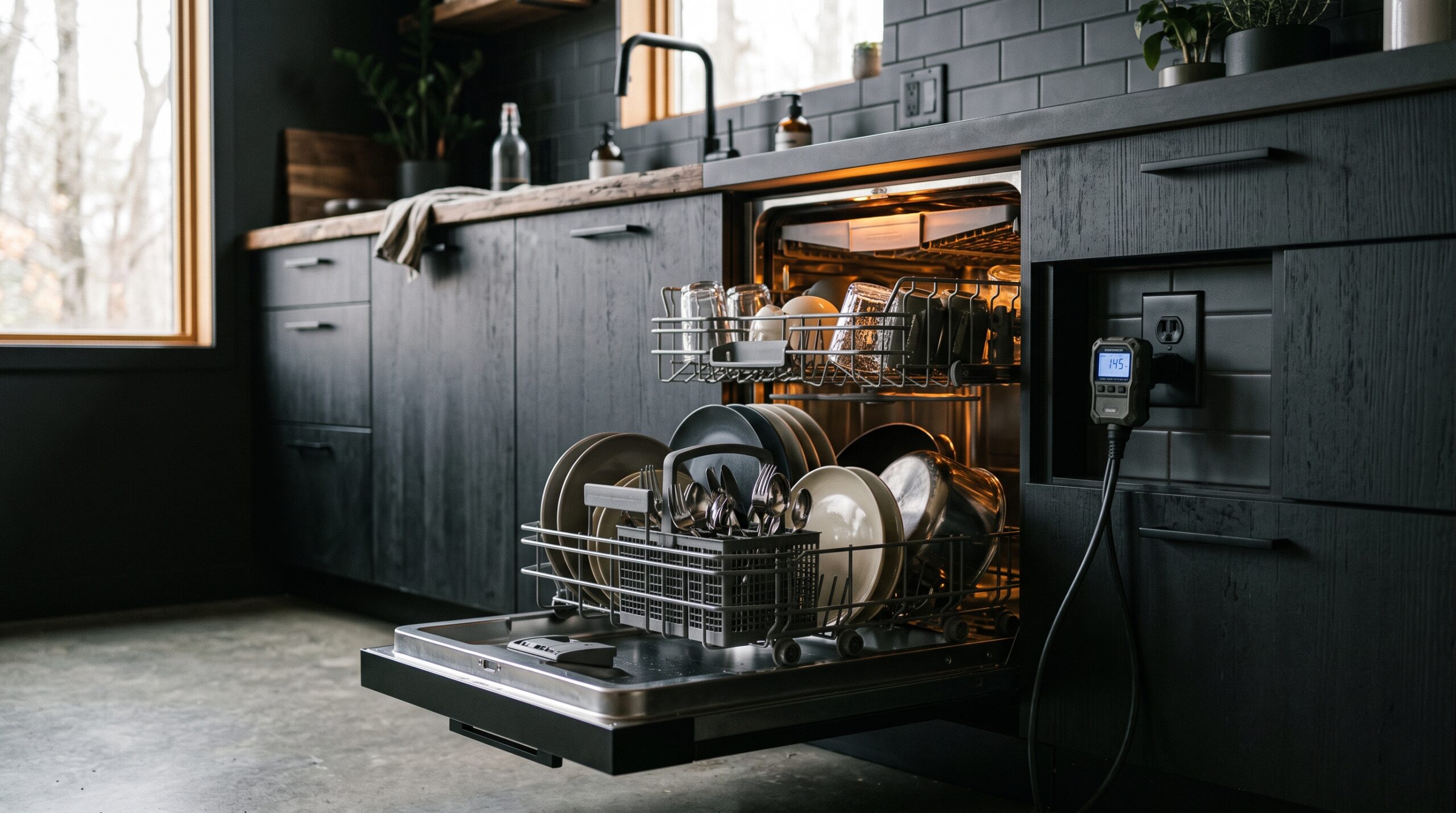
A dishwasher draws about 1,200 to 1,500 watts when its internal heating element is working, which happens while it heats the wash water and again during a heated dry. The rest of the time the machine runs the wash pump and a few small parts, and that pulls far less, often around 100 to 300 watts. So the honest answer depends entirely on which part of the cycle you catch it in.
The short answer on dishwasher watts
Most full-size residential dishwashers in the US run on a standard 120-volt outlet and draw somewhere between 1,200 and 2,400 watts at their peak, with a typical figure near 1,800 watts. That peak only shows up when the heating element is on. During the parts of the cycle where the machine is just circulating and draining water, the draw drops to roughly 100 to 300 watts.
That gap matters. If you size backup power off the peak number, you plan for the heater spike. If you only look at the low pump number, you will undersize whatever has to run the machine.
Why the heating element is the big draw
A dishwasher does two energy-hungry things, and both come from the same part. It heats incoming water to a high wash or sanitize temperature, and on many cycles it runs a heated dry at the end to bake moisture off the dishes. Both jobs use the heating element at the bottom of the tub, and that element is where most of the electricity goes. Industry estimates put the heater at well over half of a cycle’s total energy.
The wash pump, the drain pump, the water inlet valve, and the control board are all small loads by comparison. They keep the machine moving but they do not add up to much. When you see a dishwasher’s nameplate wattage, you are mostly looking at the heater.
Watts by phase
Here is roughly how the draw moves through a normal cycle. Exact numbers vary by model, water temperature, and cycle setting, so treat these as ballpark ranges.
| Phase | What is running | Approx. watts |
|---|---|---|
| Fill | Inlet valve, pump priming | 100–300 W |
| Wash / circulate | Wash pump, no heat | 100–300 W |
| Water heating | Heating element on | 1,200–1,500 W |
| Rinse heating / sanitize | Heating element on | 1,200–1,500 W |
| Heated dry | Heating element on | 1,200–1,500 W |
| Drain | Drain pump | 100–300 W |
| Standby | Control board only | A few watts |
The heater never runs the whole time. It cycles on to hit a target temperature, then shuts off while the pump keeps circulating. That is why the machine’s average draw across a full cycle is much lower than its peak. If you want a refresher on why a short high-wattage spike is different from steady running, see running watts vs starting watts.
Energy per cycle in watt-hours
Watts tell you the instantaneous pull. To know what a full wash actually costs you, you need energy, measured in watt-hours (Wh) or kilowatt-hours (kWh). One kilowatt-hour is 1,000 watt-hours. If the idea is new, what is a watt-hour walks through it.
A modern Energy Star dishwasher uses roughly 0.8 to 1.0 kWh (800 to 1,000 Wh) for a normal load. Older machines and heavy or sanitize cycles with heated dry push toward 1.5 to 2.0 kWh. Eco and light cycles that skip the heated dry land lower.
| Cycle type | Energy per load |
|---|---|
| Eco / light, air dry | ~0.6–0.9 kWh |
| Normal, Energy Star model | ~0.8–1.0 kWh |
| Normal, older model | ~1.0–1.5 kWh |
| Heavy / sanitize + heated dry | ~1.5–2.0+ kWh |
For reference, Energy Star certifies standard dishwashers at 240 kWh per year or less, rated over 215 cycles a year. That works out to a little over 1 kWh per cycle on average, including standby and water heating losses. The federal minimum for a new dishwasher sits higher, around 307 kWh per year.
How to cut the watts
Because the heater drives the bill, the savings live there too. A few changes make a real difference:
- Skip the heated dry. Turn it off or use the air dry or energy saver option. Many machines also let you crack the door open at the end to vent steam. Dropping heated dry can cut a cycle’s energy noticeably.
- Use eco or light cycles. These run cooler water and shorter times, so the element works less.
- Run full loads. The energy per load is close to fixed whether the rack is half empty or packed, so fewer, fuller loads waste less.
- Let your water heater do the heating. If hot water reaches the machine, the element has less work to do. Some efficient models still heat internally, but warm incoming water shortens the heating phase.
Running a dishwasher on backup power
A dishwasher is a demanding load for portable backup because of that heater. To run one, an inverter or power station has to handle the roughly 1,500-watt spike the moment the element switches on, not just the lower pump draw. A unit rated below that ceiling will trip or shut off as soon as the water heating kicks in.
In practice that means a 2,000-watt class power station is the realistic entry point for a full cycle, and even then you need the battery capacity to feed 1 to 2 kWh of energy across the wash. You can see what that size of unit handles in what a 2000W power station can run, and you can estimate how long your specific battery would last with the runtime calculator. To match a unit to your appliances from the start, the sizing calculator works backward from your loads.
For most outages, a dishwasher is a low priority next to the fridge, lights, and phones. But if you do plan to run one, size for the heater spike and the energy per cycle, not the gentle pump number.
Frequently asked questions
How many amps does a dishwasher use?
On a 120-volt circuit, a 1,200 to 1,500-watt dishwasher draws about 10 to 12.5 amps while the heater runs. Most are wired to a dedicated 15-amp circuit, sometimes 20-amp, with GFCI protection. The pump-only phases draw closer to 1 to 3 amps.
Does a dishwasher need a dedicated circuit?
Yes. Electrical code calls for a dishwasher to have its own dedicated 120-volt branch circuit, typically 15 or 20 amps, so the heater’s draw does not overload a shared line. The outlet should be close to the unit, and extension cords are not safe for this load.
How much does it cost to run a dishwasher?
At roughly 1 kWh per normal cycle and an average US electricity rate, a load costs somewhere around 15 to 30 cents in electricity. Heavy cycles with heated dry cost more, and that figure does not include the cost of heating the incoming hot water.
Does skipping heated dry really save much?
Yes. Heated dry runs the full-power heating element with no washing benefit, so turning it off removes one of the cycle’s biggest energy chunks. Air drying or popping the door open at the end gets dishes dry with no extra electricity.
Can a power station run a dishwasher?
Only a larger one. The station has to cover the roughly 1,500-watt heater spike and store enough energy for the whole cycle. A 2,000-watt class unit with a sizeable battery can do it, but smaller power banks and stations will not handle the heating element.