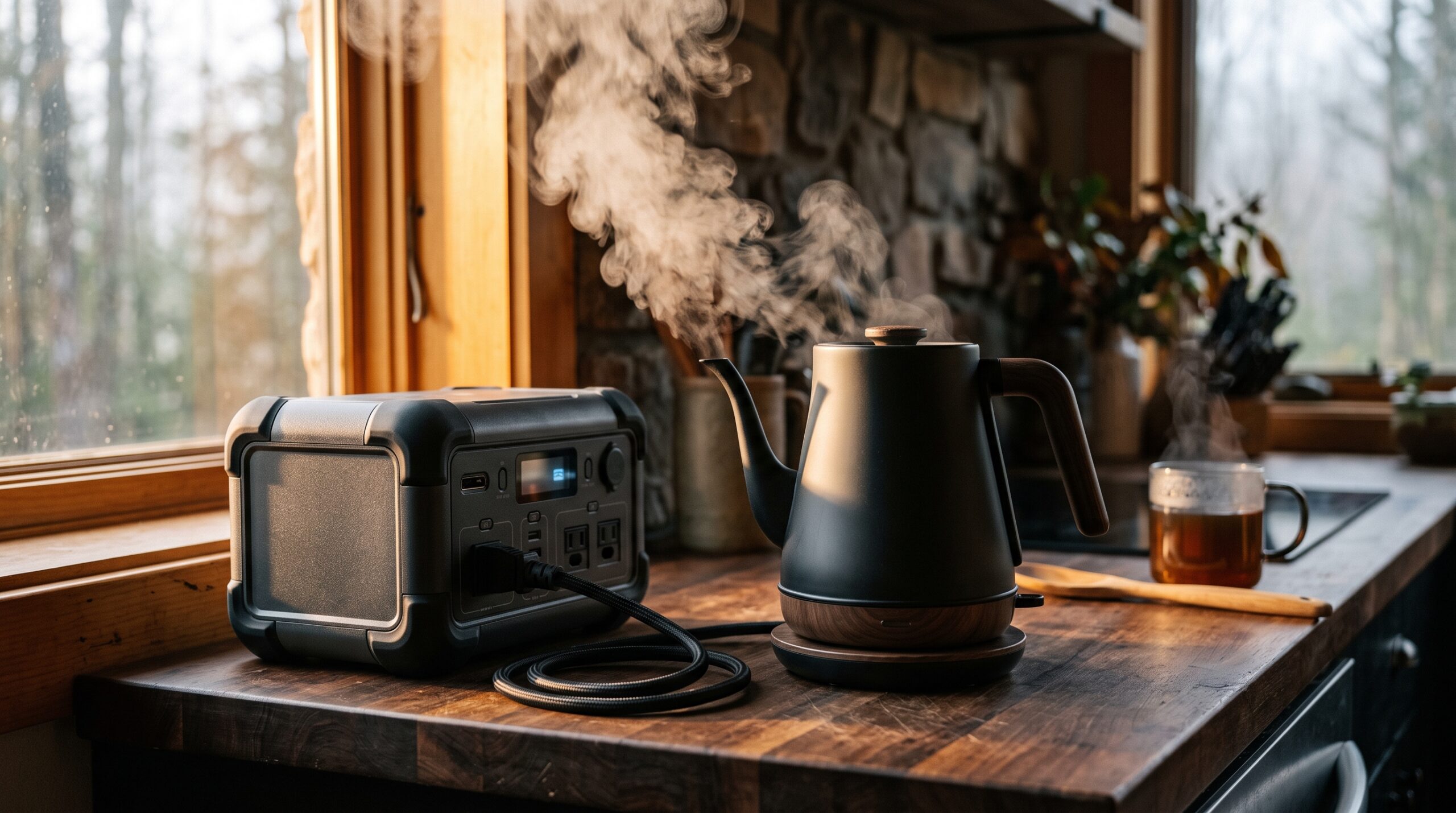
An electric kettle is one of the higher-wattage things in a typical US kitchen, pulling roughly 1,000 to 1,500 watts, with most plug-in models landing right around 1,500 watts on a standard 120-volt outlet. The good news for backup power is that it only draws that much for the short time it takes to boil, usually 2 to 4 minutes. So the energy used per boil is small, often 30 to 80 watt-hours for a mug or two, but your generator or power station still has to deliver that full ~1,500-watt load the whole time the water is heating.
How many watts a US electric kettle uses
Most countertop electric kettles sold in the US are rated between 1,000 and 1,500 watts, and the popular full-size models cluster near 1,500 watts. Travel kettles and small single-cup units can be lower, around 600 to 1,000 watts, which makes them boil slower but easier on a small battery. The wattage is usually printed on the bottom of the kettle or on a label near the cord, so check the actual rating before you plan around it.
- Small / travel kettle: about 600 to 1,000 watts
- Standard full-size kettle: about 1,200 to 1,500 watts
- Maximum a 120V / 15A outlet allows: about 1,800 watts
Why US kettles cap out near 1,500 watts
Power equals voltage times current. A standard US wall outlet runs at 120 volts on a 15-amp circuit, which works out to a hard ceiling of about 1,800 watts, and manufacturers stay below that for safety headroom. That is why almost no US kettle is rated above 1,500 watts. In the UK and most of Europe, outlets run at 220 to 240 volts, so kettles there can pull 2,500 to 3,000 watts and boil water in about half the time. Same kettle job, very different draw, purely because of the voltage behind the outlet.
Energy per boil is small, the wattage is the catch
Heating water takes a fixed amount of energy no matter how fast you do it. A higher-wattage kettle just gets there quicker. Boiling about a liter (roughly four cups) of room-temperature water takes close to 0.1 kilowatt-hour, or about 100 watt-hours, after normal heat losses. Boil only a mug or two and you are down in the 30 to 80 watt-hour range. The table below boils about two cups of cool water, enough for one or two drinks, so you can see how kettle wattage changes the boil time but barely changes the energy used.
| Kettle rating | Time to boil ~2 cups | Energy per boil | Boils from a ~500Wh station | Boils from a ~1,000Wh station |
|---|---|---|---|---|
| 1,000 W | ~3.5 min | ~58 Wh | ~8 | ~17 |
| 1,200 W | ~3 min | ~57 Wh | ~8 | ~17 |
| 1,500 W | ~2 to 2.5 min | ~55 Wh | ~9 | ~18 |
Energy per boil scales with how much water you heat, not with the kettle’s wattage. Rough numbers for a 1,500-watt kettle starting from room-temperature water:
- 1 cup (8 oz): about 25 to 30 Wh, under a minute
- 2 cups (16 oz): about 50 to 60 Wh, around 2 to 2.5 minutes
- 4 cups (~1 liter): about 100 to 110 Wh, around 4 minutes
- Full carafe (~1.7 liter): about 170 to 190 Wh, around 5 to 6 minutes
If you want to map this against other kitchen loads, a microwave lands in a similar range for short bursts. See how many watts a microwave uses and our explainer on what a watt-hour is for the math behind these numbers.
Will your power station run an electric kettle?
This is where kettles trip people up. The energy per boil is tiny, but the kettle pulls its full rated wattage the entire time it heats. A kettle is a plain resistive heating element, so it does not have a big motor-style startup surge like a fridge or pump. The problem is the steady draw: the station’s AC inverter has to put out more than the kettle’s wattage continuously, or it shuts off.
That means a 1,500-watt kettle will not run on a station whose AC output is rated below it, no matter how big the battery is. A 300-watt or 500-watt unit, and many 1,000-watt-output stations, will refuse to start a 1,500-watt kettle or trip into overload the moment the element switches on. Watch two separate numbers on the spec sheet: the watt-hours (Wh) tell you capacity, and the watts (W) tell you the most it can deliver at once. For a kettle, the watts number is the gatekeeper. A station needs continuous AC output above the kettle’s rating, so a 1,500-watt kettle generally wants a station rated 1,500 watts output or more. Because the load is sustained rather than a brief spike, the surge rating does not bail you out here, as covered in running watts vs starting watts.
To check your own gear, drop your kettle’s wattage and your station’s capacity into the runtime calculator and confirm the station’s output rating clears the kettle first.
Electric kettle vs stovetop for backup cooking
If your goal is hot water during an outage, an electric kettle is the efficient choice when you have the power to run it. The heating element sits in the water, so an electric kettle is usually around 80 to 90% efficient at putting energy into the water. An electric coil stovetop is closer to 70 to 75%, and a gas burner is only about 40 to 60% because a lot of the flame heat goes around the pot and into the air.
The trade-off is what powers it. A 1,500-watt electric kettle leans hard on a battery’s output rating, while a gas stovetop, camp stove, or propane burner boils water without touching your electricity at all. During a long outage many people keep an electric kettle for when the generator or a large station is running, and fall back to a flame source the rest of the time. For methods that need no electricity, see how to boil water without power.
Tips to use less power when boiling on backup
- Only fill the kettle with the water you actually need. Heating extra water is wasted energy.
- Boil once and store hot water in an insulated thermos instead of reboiling through the day.
- Start with the warmest safe tap water you have so there is less temperature to climb.
- Descale the kettle. Mineral buildup on the element slows heating and wastes energy.
- If your battery is small, use a lower-wattage travel kettle that fits under its output limit, even though it boils slower.
Frequently asked questions
How many watts does an electric kettle use?
Most US electric kettles use between 1,000 and 1,500 watts while heating, and full-size models are usually around 1,500 watts. They draw that full amount only for the few minutes it takes to boil, then shut off.
How much energy does one boil cost?
Boiling a mug or two uses roughly 30 to 80 watt-hours, and a full liter is closer to 100 watt-hours. On grid power that is about a penny per boil. The wattage is high, but the run time is short, so the energy bill stays small.
Can a small power station run a 1,500-watt kettle?
Only if its continuous AC output is rated above 1,500 watts. A 300-watt, 500-watt, or many 1,000-watt-output stations will not start a 1,500-watt kettle and will trip into overload. Check the watts (output), not just the watt-hours (capacity).
Why does my US kettle boil slower than ones in Europe?
US outlets run at 120 volts, which caps a normal kettle near 1,500 watts. European outlets run at 220 to 240 volts and allow 2,500 to 3,000 watts, so the same volume of water boils in about half the time.
Is an electric kettle or stovetop better during an outage?
An electric kettle is more efficient if you have the power to run it, since it puts about 80 to 90% of its energy into the water. A gas or propane burner is less efficient but needs no electricity, which makes it the safer fallback during a long outage.
Sources
- EnergyBot – Electric Kettle Energy Calculator: Watts and kWh
- ElectricRate – Calculate Your Electric Kettle Wattage and Power Consumption
- Inside Energy – What Is the Most Energy Efficient Way to Boil Water?
- Fellow – Are Electric Kettles More Energy Efficient?
- MrReid.org – Why Kettles Boil Slowly in the US