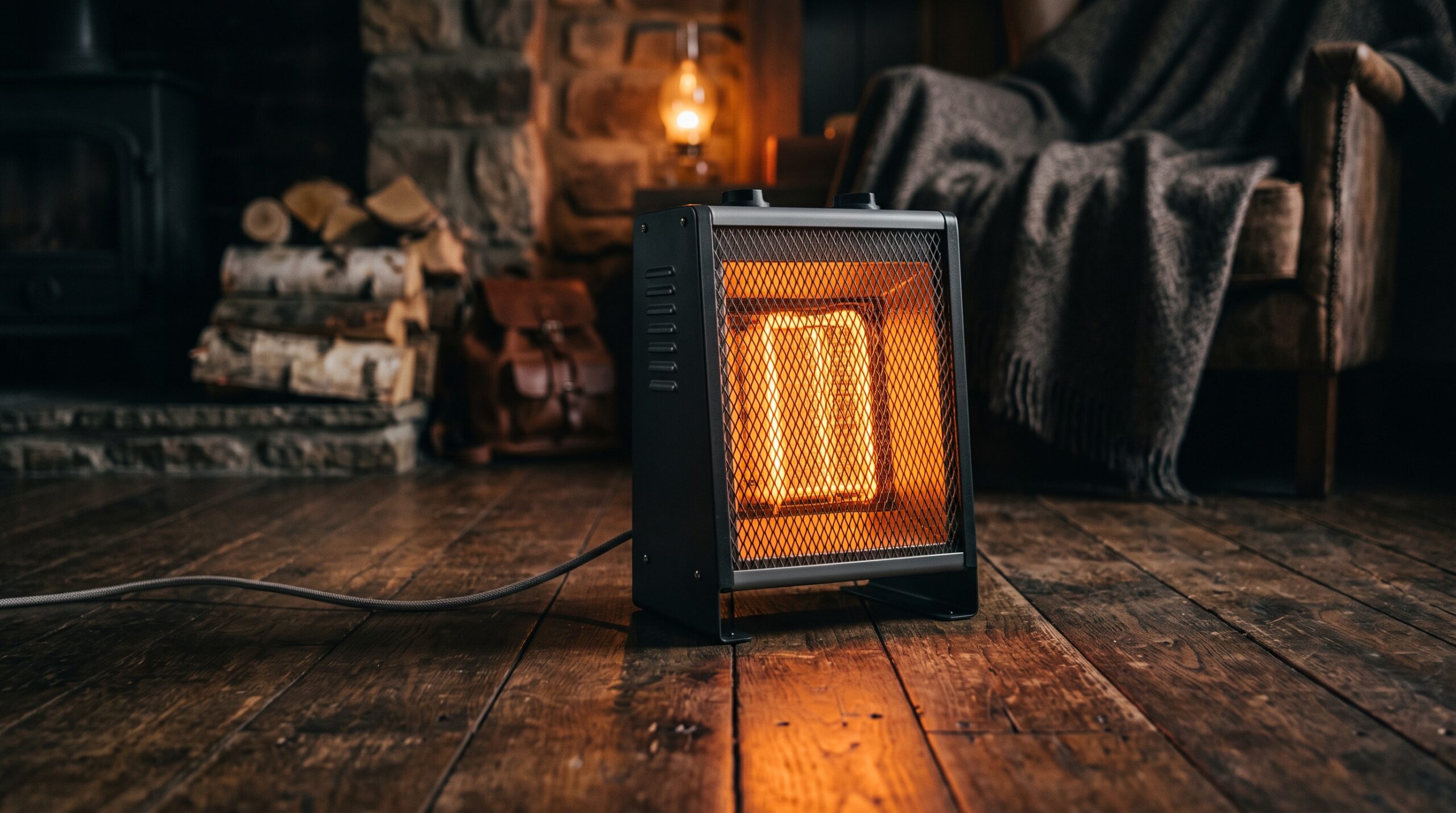
Most electric space heaters draw between 750 watts on low and 1,500 watts on high, and 1,500 watts is the near-universal ceiling for a plug-in heater on a standard 120-volt US outlet. The catch for anyone planning backup power: a resistance heater pulls close to its full rated watts the entire time it runs, with none of the on-off cycling a fridge does. That makes it one of the heaviest, most relentless loads you can put on a portable power station, and a 1,500W heater will flatten a 1,000Wh station in well under an hour.
How many watts a space heater uses
Look at the label on almost any portable electric heater sold in the US and you will see a wattage rating in this range:
- Low setting: roughly 600 to 900 watts (often listed as 750W)
- Medium setting: around 1,000 to 1,200 watts on models that offer it
- High setting: 1,500 watts on the vast majority of units
The heating type barely changes the math. Ceramic, fan-forced, oil-filled radiator, and infrared heaters are all resistance heaters, which means nearly all the electricity they pull turns directly into heat. A 1,500W ceramic heater and a 1,500W oil-filled radiator use the same 1,500 watts. The difference is how the heat is delivered, not how much power is consumed. (Energy.gov notes radiant and infrared models can feel more efficient because they heat you directly instead of the whole room, but the wattage on the dial is what hits your battery or your bill.)
Why 1,500 watts is the ceiling on a US outlet
The 1,500W limit is not a coincidence. A standard US household circuit is 120 volts and 15 amps, giving it 1,800 watts of theoretical capacity. The National Electrical Code says a load that runs for three hours or more (a “continuous” load, which a heater is) should use no more than 80% of the circuit, or 1,440 watts. Manufacturers round that to 1,500 watts and stop there. A 1,500W heater already pulls about 12.5 amps, so it is sitting near the safe limit of the circuit by itself.
That is also why fire-safety guidance says to plug a heater directly into a wall outlet and never into a power strip or thin extension cord. The current is high enough to overheat an undersized cord. If you want the full picture on how watts convert into stored energy, see what a watt-hour is.
Why space heaters are brutal on battery backup
A refrigerator might be rated at 150 watts, but its compressor only runs part of the time, so over an hour it averages far less. A resistance space heater has no such mercy. When it is on, it draws its full rated watts continuously. There is no duty cycle to save you. That single fact is what separates a heater from almost every other appliance you would plug into a power station.
Two things follow. First, your station needs a continuous AC inverter rating at or above the heater’s watts. Many 500Wh and entry-level 1,000Wh stations cap output at 500 to 1,000 watts, so they cannot run a 1,500W heater at all, and some struggle even on the 750W low setting. Always check the inverter watt rating, not just the battery capacity. Second, even a station that can run the heater will not run it for long. The energy math is unforgiving, which is the heart of whether a power station can run a space heater at all.
Space heater runtime on common power stations
The table below shows roughly how long a fully charged power station will run a heater on low (750W) versus high (1,500W). Figures assume about 85% real-world inverter efficiency, so usable energy is a little below the rated capacity. Your numbers will vary with temperature, the exact heater, and the station’s condition.
| Power station capacity | Runtime at 750W (low) | Runtime at 1,500W (high) |
|---|---|---|
| 500 Wh | ~35 min | ~15 min* |
| 1,000 Wh | ~1 hr | ~35 min |
| 1,500 Wh | ~1 hr 40 min | ~50 min |
| 2,000 Wh | ~2 hr 15 min | ~1 hr 10 min |
| 3,000 Wh | ~3 hr 20 min | ~1 hr 40 min |
The honest takeaway: even a large 2,000Wh station gives you barely an hour of full-heat backup, and overnight heating from a battery is simply not realistic. To model your own gear and setting, run the numbers through our runtime calculator, and if you are buying a station to cover heat, size it deliberately with the sizing calculator.
Lower-watt ways to stay warm
Because a space heater is such a heavy load, the smarter outage strategy is usually to heat your body instead of the room. These options sip power and let a battery last for hours instead of minutes:
- Heated blanket or throw: roughly 100 to 200 watts. A 1,000Wh station can run one for 5 to 8 hours, versus about 35 minutes for a 1,500W heater.
- Electric mattress pad: around 60 to 120 watts, low enough to run most of a night off a mid-size station.
- Heated jacket or hand warmers: single-digit to low-double-digit watts, often USB-powered straight from the station.
- Close off one room, layer up, and use blankets so any heat you do produce is concentrated where you are.
For the full game plan when the heat is out, including non-electric tactics, see how to stay warm during a power outage.
Run a space heater safely
Space heaters earn their reputation as a fire risk. The National Fire Protection Association attributes a large share of home heating fires, and the majority of related deaths, to portable and stationary space heaters. If you do run one, follow the basics:
- Keep at least 3 feet of clearance on all sides, away from bedding, curtains, furniture, and anything that can burn.
- Never leave it running unattended or while you sleep. Turn it off when you leave the room.
- Plug it directly into a wall outlet, not a power strip or light-duty extension cord.
- Choose a unit with a tip-over switch and overheat shutoff, and look for a UL or similar safety-lab label.
- Place it on a flat, hard, non-flammable surface, never on a rug edge, bed, or countertop.
Frequently asked questions
How many amps does a 1,500-watt space heater use?
About 12.5 amps on a 120-volt circuit (1,500 watts divided by 120 volts). That is most of a standard 15-amp circuit, which is why heaters should have a circuit mostly to themselves and be plugged straight into the wall.
Does a space heater use more electricity than other appliances?
Yes, among the most. At 1,500 watts running continuously, it draws more than a microwave, a TV, and a refrigerator combined, and unlike the fridge it never cycles off. Consumer Reports estimates a 1,500W heater costs roughly $2 for an 8-hour day at average US electricity rates, or about $64 a month.
Can a portable power station run a space heater overnight?
Realistically, no. Even a 2,000Wh station gives only about an hour at 1,500W or a bit over two hours on low. For overnight warmth from a battery, switch to a heated blanket or mattress pad, which uses a fraction of the power.
Why are US space heaters limited to 1,500 watts?
Because of the standard 15-amp, 120-volt circuit. Electrical code limits a continuous load to 80% of the circuit (1,440 watts), and manufacturers round to 1,500W. A higher-wattage plug-in heater would risk tripping the breaker or overheating the wiring.
Does a lower heat setting save battery and money?
Yes. Running on 750W low instead of 1,500W high roughly doubles your runtime on a power station and halves the running cost per hour. It produces less heat, but for a small, closed-off space it is often enough.