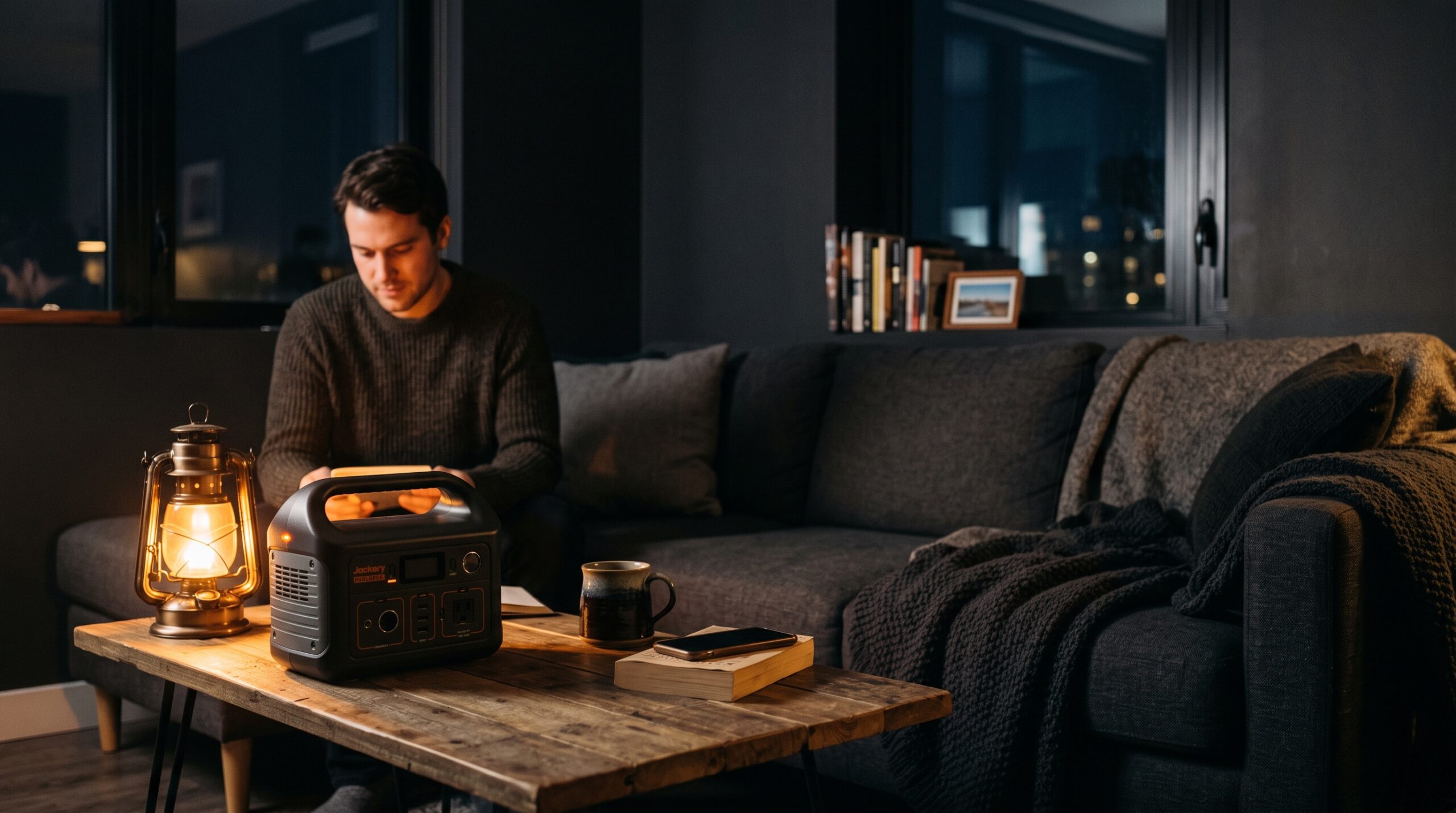
The safest backup power for an apartment is a battery power station, not a gas generator, since generators release carbon monoxide and can’t be run indoors or on a balcony. Renting changes the whole plan: you can’t bolt anything to the building, gas engines are off the table, and in a tall building you also have to think about water pressure and the elevator. This guide walks through what actually works in a unit, from sizing a battery to keeping food and medicine safe.
⚠️ No gas generators indoors or on balconies
Portable gas and propane generators give off carbon monoxide, a gas you can’t see or smell that can be deadly within minutes indoors. Safety agencies say never run one inside a home, a garage, or on a balcony, even with windows open, and to keep it outside at least 20 feet from any door, window, or vent. In an apartment that is rarely possible, so use a battery power station for indoor backup power and keep a working carbon monoxide alarm.
Backup power: a battery power station, not a gas generator
A battery power station is a large rechargeable battery with normal wall outlets and USB ports built in. It runs clean and quiet, makes no exhaust, and is safe to use inside a closed room, which is exactly why it fits apartment life. You charge it from a wall outlet ahead of time, and when the power drops you plug your devices into it. Many leases and most fire codes also forbid running fuel-burning engines on balconies or in units, so a battery is usually the only backup that is both safe and allowed.
Size the battery around the few things you truly need rather than the whole apartment. For most renters that short list is phones, a lamp, the Wi-Fi router, and any medical device such as a CPAP machine. Keeping the refrigerator running is a bigger job and needs a larger unit, because fridges draw a brief surge of power each time the compressor starts. Capacity is measured in watt-hours (Wh): roughly speaking, watt-hours divided by a device’s watts gives you the hours it will run, minus some loss. A small station might be a few hundred watt-hours, enough for many phone charges and hours of light, while a larger one in the 1,000 watt-hour range can keep a fridge cycling for a while or run a CPAP overnight.
| Device | Approx. running watts | Notes |
|---|---|---|
| Phone or tablet charging | 5–20 W | A small station gives many full charges |
| LED lamp or string light | 5–15 W | Hours of light per charge |
| Wi-Fi router and modem | 10–30 W | Keeps you online if the line still works |
| CPAP (no heated humidifier) | 30–60 W | Check your machine; the humidifier raises the draw a lot |
| Mini-fridge | 50–100 W running | Cycles on and off, with a higher surge at startup |
| Full-size refrigerator | 100–200 W running | Larger startup surge; needs a bigger station |
Not sure what capacity you need? Use the Power-Station Sizing calculator to match a battery to your must-run devices, then check the Appliance Runtime calculator to see how many hours a given station will keep them going. That takes the guesswork out of the watt-hour math above.
Water: pressure can drop fast in a high-rise
In a low-rise building the tap usually keeps flowing during a short outage because city water pressure reaches the lower floors on its own. Tall buildings are different. They rely on electric booster pumps to push water to the upper floors and roof tank, so when the power goes out those pumps stop and pressure to higher units can fade within a short time. If you live on an upper floor, treat running water as something that may not last.
Store some water before you need it. Emergency guidance is to keep at least one gallon per person per day for several days, half for drinking and half for cooking and basic hygiene. Children, nursing mothers, and anyone sick may need more, and hot weather can roughly double what you use. A practical apartment stash is a few cases of bottled water plus a couple of filled jugs. Fill a clean container or two at the first sign of a long outage, and keep a little extra set aside to flush the toilet by pouring it into the bowl.
Light: use battery, not candles
Reach for flashlights, headlamps, and battery lanterns, not candles. Open flames are the single most avoidable hazard during an outage, and the Red Cross specifically warns against candles because of the fire risk in a dark, crowded home. A headlamp keeps your hands free, a small lantern lights a whole room, and your power station can recharge them or run a USB lamp directly. Keep a flashlight where you can find it in the dark and a spare set of batteries with it.
Food safety: the four-hour rule
Keep the refrigerator and freezer doors shut. An unopened fridge holds food safely for about four hours, a full freezer for about 48 hours, and a half-full freezer for about 24 hours. Once the power is back, throw out any perishable food such as meat, poultry, fish, eggs, or leftovers that sat above 40°F for two hours or more. Don’t taste food to decide if it is safe. When in doubt, throw it out. An inexpensive appliance thermometer in the fridge takes the guessing out of it. A cooler with ice or a few frozen gel packs is a simple way to protect a small amount of food and any temperature-sensitive medicine.
If you take refrigerated medication, make a plan with your pharmacist or doctor before an outage. General guidance is to discard refrigerated medicine after the power has been out for more than a day unless the label says otherwise, then ask for guidance on a replacement. For any medicine that is critical, ask in advance how long it can sit at room temperature.
Staying warm or cool without power
With the heating or air conditioning off, your apartment will slowly drift toward the outdoor temperature. In winter, close off one room, layer up with blankets and warm clothing, and keep the curtains shut at night to hold heat. In summer, pull shades during the day, open windows after dark if it is cooler outside, and use a battery or USB fan from your power station. Drink water steadily in the heat. If the unit becomes dangerously hot or cold, or if you depend on a powered medical device, plan to leave for a friend’s place or a public cooling or warming center rather than ride it out.
Communication: stay reachable
Phones are your lifeline during an outage, so protect their charge. Keep at least one charged power bank on top of your power station, and switch phones to low-power mode early to stretch the battery. A small battery-powered or hand-crank radio lets you follow official updates if cell networks get congested. Save the building manager’s number and a couple of out-of-area contacts in writing, since a person two states away is often easier to reach than someone across town when local lines are busy. If your building has a callbox or intercom that runs on power, assume it may be down and arrange another way for people to reach you.
A small apartment outage kit
You don’t need a closet full of gear. A compact kit that lives in one bin covers nearly every short outage:
- A battery power station, charged, plus its wall charger
- One or two power banks for phones
- A flashlight and a headlamp with spare batteries
- A battery lantern for area light
- Bottled water, plus a jug or two you can fill quickly
- Non-perishable food that needs no cooking, and a manual can opener
- A small cooler with frozen gel packs for food and medicine
- A battery or hand-crank radio
- A working carbon monoxide alarm and a smoke alarm
- A first-aid kit, any daily medications, and copies of key documents
Frequently asked questions
Can I run a gas generator on my apartment balcony?
No. Portable gas and propane generators release carbon monoxide, which can build to deadly levels in minutes in an enclosed or partly enclosed space. Safety agencies say to keep a running generator outdoors and at least 20 feet from any door, window, or vent, which a balcony cannot provide. Most leases and fire codes also ban fuel engines on balconies and indoors. Use a battery power station instead.
What size battery power station do I need for an apartment?
It depends on what you want to keep running and for how long. Phones, a lamp, and a Wi-Fi router need only a small unit, while a refrigerator or a CPAP machine running overnight needs a larger one. The simplest way to get an honest number is to list your must-run devices and put them through the Power-Station Sizing calculator, then confirm the hours with the Appliance Runtime calculator.
Will my water still work during a power outage in a high-rise?
Maybe not on the upper floors. Tall buildings use electric pumps to lift water to higher units and a roof tank, and those pumps stop when the power fails, so pressure can fade after a short time. Lower floors often keep some flow from city pressure. Store bottled water in advance and fill a clean container early in a long outage, including a little extra to flush the toilet.
How long will the food in my fridge stay safe?
About four hours in the refrigerator if you keep the door closed, about 48 hours in a full freezer, and about 24 hours in a half-full freezer. Discard perishable food that has been above 40°F for two hours or more, and never taste food to check it. When in doubt, throw it out.
Should I use candles if the power is out?
No. Candles are a leading cause of fires during outages, and the Red Cross advises using flashlights instead. A headlamp or battery lantern gives more usable light with no flame, and you can recharge them from a power station.