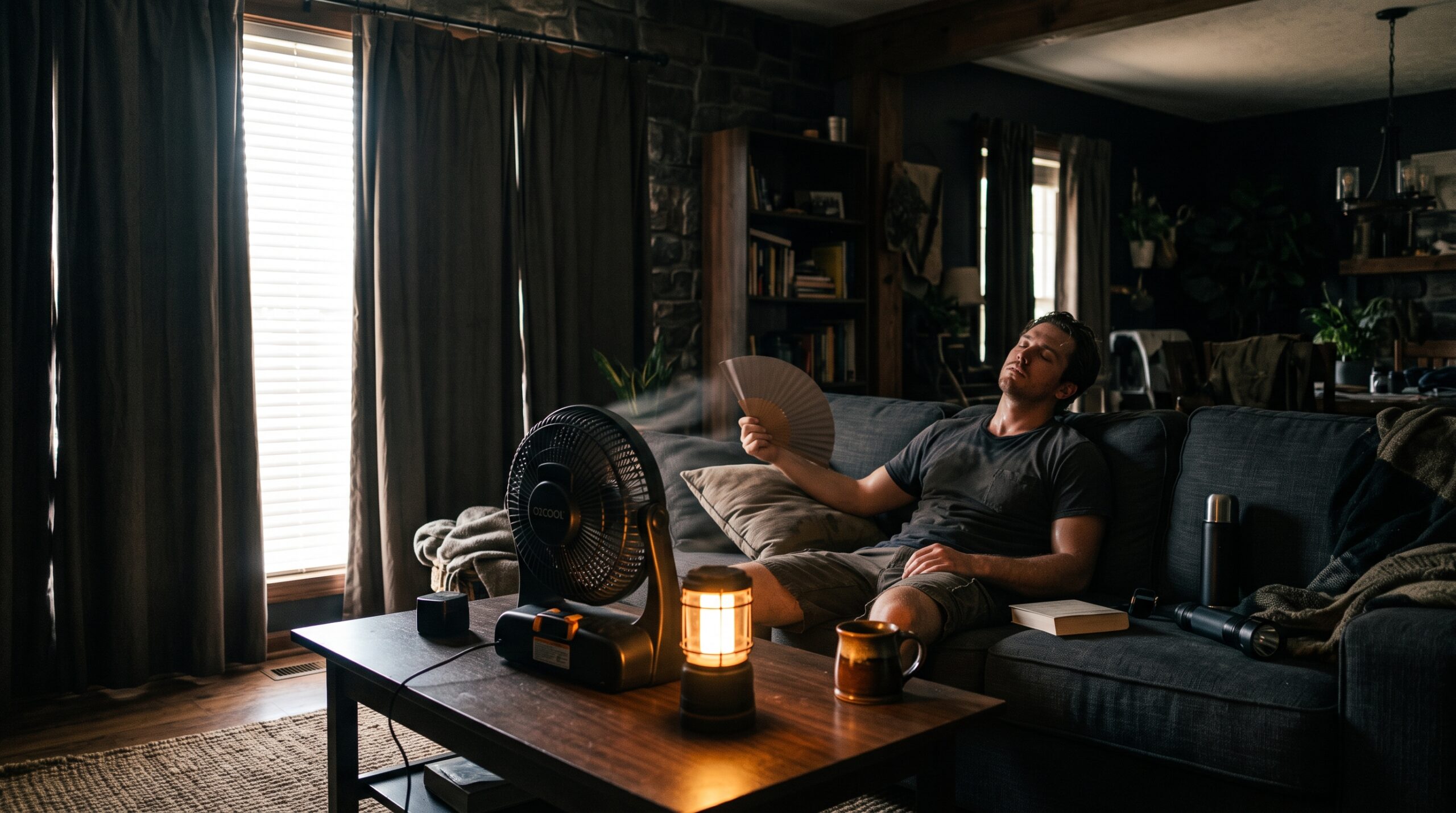
Summer storms and record electricity demand often knock out the grid on the hottest days of the year, and a heat wave power outage quickly turns a home into a slow-building hot box. Air conditioning is the single most effective protection against heat-related illness and death, according to the CDC, so when the power fails the real emergency is staying cool and hydrated, not staying lit. This guide covers how to keep cool without AC, how much to drink, how to spot the warning signs of heat illness, who is most at risk, where to find a cooling center, and how to use a backup battery for fans rather than whole-home air conditioning.
⚠️ Know the signs of heat illness
Heat exhaustion (heavy sweating; cool, clammy skin; weakness; dizziness; nausea) can progress to heat stroke (hot, red skin; a temperature of 103°F or higher; confusion; slurred speech; fainting), which is a life-threatening emergency. If you suspect heat stroke, call 911 right away and cool the person while you wait for help. Check on older adults, young children, and anyone with a health condition at least twice a day during a heat wave (CDC, NWS).
Why heat waves cause power outages
The outage and the heat are connected. When temperatures climb, millions of air conditioners run at the same time and push electricity demand toward its yearly peak, usually in the late afternoon and early evening. That strain falls on equipment that is also running hotter than usual, so transformers and power lines are more likely to fail. To keep the wider grid from collapsing, utilities sometimes cut power to areas in rotating blocks, often called rolling blackouts or load shedding. The practical result is that outages are most likely on the hottest days, exactly when cooling matters most. Ready.gov warns plainly that heat waves may cause you to lose power, so it is worth having a plan before one hits.
Stay cool without AC
With the AC off, your goal is to block heat from getting in and to cool your body directly:
- Close up during the day. Shut windows, blinds, shades, and curtains on the sunny side of the house to block solar heat. Open windows at night only if it is cooler outside than in.
- Move to the coolest part of the home. Heat rises, so a lower or shaded floor stays cooler.
- Wear loose, lightweight, light-colored clothing (CDC, Ready.gov).
- Cool your body, not just the air. Take a cool shower or bath, or put cool, wet cloths on your neck, wrists, and forehead (CDC).
- Rest and avoid heavy activity or hot cooking during the hottest part of the day.
- Use a fan to feel cooler, but read the warning below: in very high heat a fan is not enough on its own.
For a full room-by-room routine, see our guide on how to stay cool during a power outage.
Drink water before you feel thirsty
Heat illness is closely tied to dehydration, and thirst is a late signal. The CDC and Ready.gov both advise drinking fluids regularly during a heat wave even if you do not feel thirsty.
- Make water your main drink, and sip it throughout the day rather than waiting until you are thirsty.
- Avoid alcohol and very sugary drinks, which can make dehydration worse (Red Cross).
- Skip very cold drinks, which can cause stomach cramps (Red Cross).
- If your doctor limits how much you drink, or you take water pills, ask how much fluid is right for you in hot weather (Ready.gov).
- Plan ahead for an outage: store extra drinking water and freeze a few bottles before the heat wave so you have cold water and ice when the power is out.
Recognize the signs of heat illness
Knowing the difference between heat exhaustion and heat stroke can save a life. Heat exhaustion is a warning sign; heat stroke is a medical emergency.
Heat exhaustion. Watch for heavy sweating; cool, pale, clammy skin; weakness or tiredness; headache; dizziness; nausea; muscle cramps; and a fast, weak pulse. Move the person to a cooler place, loosen tight clothing, have them sip water, and apply cool, wet cloths or a cool bath. Get medical help if the symptoms last longer than an hour, get worse, or the person starts vomiting (NWS).
Heat stroke (call 911). Warning signs include hot, red, dry or damp skin; a body temperature of 103°F or higher; confusion or slurred speech; a throbbing headache; a rapid, strong pulse; and fainting or loss of consciousness. Call 911 immediately, move the person somewhere cooler, and cool them with wet cloths or a cool bath while you wait. Do not give fluids to anyone who is confused or unconscious (NWS, CDC).
Who is most at risk
Heat affects everyone, but some people are far more vulnerable and need closer attention during an outage:
- Adults 65 and older (Ready.gov, CDC, NWS)
- Infants and young children, up to about age 4
- People with chronic conditions such as heart disease, diabetes, or mental illness, or who take certain medications
- People who live alone
- Pregnant people
- Outdoor workers and athletes
- Anyone without working air conditioning
Check on older neighbors and relatives at least twice a day during a heat wave, and ask someone to check on you (CDC). Never leave children, older adults, or pets in a parked car, even for a few minutes (NWS). If you are caring for an older relative, our checklist on power outage prep for seniors covers medications, medical devices, and a cooling plan.
Find a cooling center
If your home is getting too hot and the power is not coming back soon, the safest move is to go somewhere with electricity and air conditioning. Even a few hours in a cool space helps your body recover.
- Head to a public library, shopping mall, community center, or an official cooling center (Ready.gov).
- Call 2-1-1 or check with local officials to find cooling centers open near you (Ready.gov).
- If you rely on a power-dependent medical device or refrigerated medicine, plan ahead of time how you will keep it running or where you will relocate (Ready.gov).
Backup power for a fan, not whole-home AC
A portable power station or battery is a real help in a heat-wave outage, but it has limits. It can keep fans running, charge phones, and power a few lights for hours. It cannot run central air conditioning, and most units can only run a small window AC for a short time before the battery is drained.
| Cooling device | Typical running watts | On a portable power station? |
|---|---|---|
| Box or tower fan | About 40 to 100 W | Yes, often for many hours |
| Small window AC (5,000 to 6,000 BTU) | About 450 to 600 W, with a higher startup surge | Sometimes, but only briefly |
| Central air conditioner | Several thousand watts | No |
Keep one limit in mind: in extreme heat a fan alone may not be enough. The CDC and NWS warn that when the heat index is very high, roughly the upper 90s and above, a fan mostly moves hot air and may not prevent heat illness. Use it together with hydration, cool water on your skin, and a cooler space, and leave for a cooling center if you cannot bring your body temperature down. Curious whether a bigger battery could power a window unit? See our breakdown of whether a power station can run an air conditioner.
To see how long your battery can keep a fan going, run your fan’s wattage through the Appliance Runtime calculator. If you are shopping for a battery and want it sized for fans, lights, and phone charging through a multi-day heat wave, start with the Power-Station Sizing calculator.
Frequently asked questions
Can a portable power station run my air conditioner during an outage?
Most portable power stations can run fans, lights, and chargers, but not central air conditioning. A large battery may run a small window unit for a short time before it drains. Plan to use a fan plus the cooling steps above, and see our guide on running an AC on a power station for the full picture.
Is a fan enough to stay safe in a heat wave?
A fan helps you feel cooler in moderate heat, but the CDC and NWS warn it may not prevent heat illness when the heat index is very high. Use a fan along with drinking water, putting cool water on your skin, and moving to a cooler location.
How much water should I drink during a heat-wave outage?
Drink fluids regularly even if you are not thirsty, and make water your main drink. Avoid alcohol and sugary drinks. If you have a medical condition that limits your fluids or you take water pills, ask your doctor how much to drink in hot weather.
When should I call 911 for heat illness?
Call 911 immediately for signs of heat stroke: hot, red skin, a body temperature of 103°F or higher, confusion or slurred speech, fainting, or loss of consciousness. Heat stroke is a medical emergency, and delay can be fatal. Cool the person while you wait for help.
Where can I go to cool down if my power is out?
Go to a public library, shopping mall, community center, or an official cooling center. Call 2-1-1 or check with local officials to find one open near you. Even a few hours in air conditioning can help your body recover.
Sources
- CDC, Extreme Heat and Your Health: https://www.cdc.gov/extreme-heat/about/
- CDC, Preventing Heat-Related Illness: https://www.cdc.gov/extreme-heat/prevention/
- CDC / NIOSH, Heat-Related Illnesses: https://www.cdc.gov/niosh/heat-stress/about/illnesses.html
- Ready.gov, Extreme Heat: https://www.ready.gov/heat
- Ready.gov, Power Outages: https://www.ready.gov/power-outages
- American Red Cross, Extreme Heat Safety: https://www.redcross.org/get-help/how-to-prepare-for-emergencies/types-of-emergencies/extreme-heat-safety.html
- National Weather Service, Heat Safety: https://www.weather.gov/safety/heat
- National Weather Service, Heat-Related Illnesses: https://www.weather.gov/safety/heat-illness