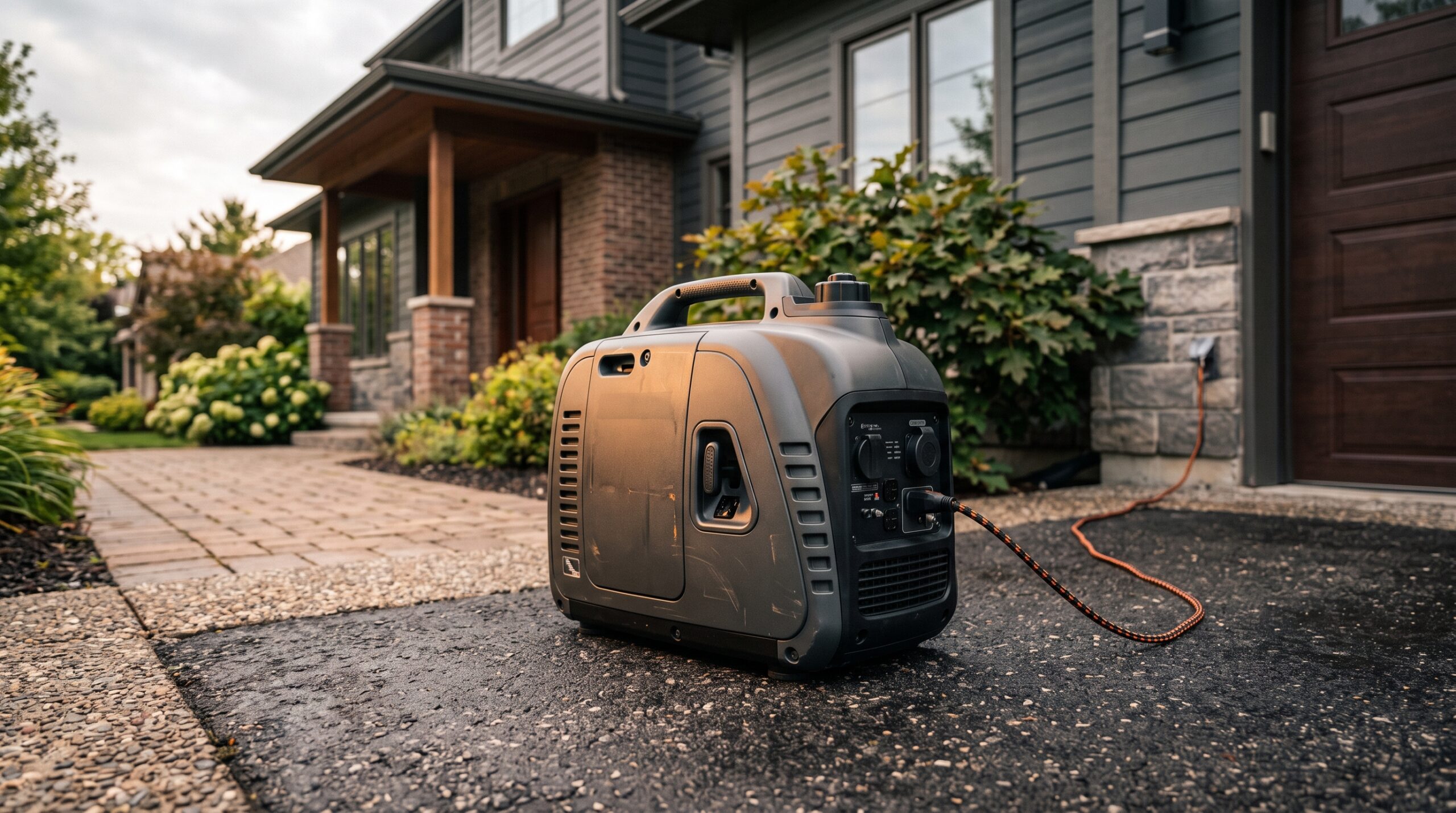
The best portable generator for your home is the one sized to the watts you actually need to keep running, not the brand with the loudest reputation. For just the essentials during an outage, a quiet inverter in the 2,000 to 3,500-watt range is plenty. To run most of a home, look at 5,000 to 7,500 watts, and for near-whole-home coverage, 7,500 to 10,000 watts or more. Below we walk through how to choose, then list genuinely popular current models by size tier so you can match capacity to your home.
Start with watts, not the brand name
Every buying decision flows from one number: how many watts you need at once. Generators are rated two ways. Running (or rated) watts are what the unit delivers continuously. Starting (or surge) watts are the brief spike some appliances pull when their motors kick on, like a refrigerator compressor, well pump, or air conditioner. A fridge might run on 150 to 200 watts but surge to 800 or more for a second or two. If your generator can’t cover that surge, the appliance won’t start.
Add up the running watts of everything you want on at the same time, then make sure the generator’s running rating comfortably exceeds that, with surge headroom on top. We go deeper on this distinction in our guide to running watts vs. starting watts. To get a real number for your specific appliances, run them through our generator sizing calculator before you shop. It will tell you which tier below you belong in.
Inverter vs. conventional: clean power and quiet
Portable generators come in two broad designs, and the difference matters for both your electronics and your neighbors.
- Inverter generators produce clean, stable power (low total harmonic distortion) that is safe for laptops, phones, TVs, and modern appliances with sensitive circuit boards. They also throttle the engine up and down with demand, so they are markedly quieter and more fuel-efficient. The trade-off is a higher price per watt. A small inverter like the Honda EU2200i runs around 48 to 57 decibels, closer to a conversation than a roar.
- Conventional generators run the engine at a fixed speed. They are cheaper per watt and often available in higher wattages, but they are louder (frequently in the 70s of decibels) and their power is less clean unless the model specifies otherwise. They are fine for motors, pumps, and resistive loads like heaters.
For most homeowners who want to power electronics and sleep at night, an inverter is worth the premium. For a detailed breakdown, see inverter generator vs. conventional generator. If clean power specifically is your concern, our piece on pure sine wave vs. modified sine wave explains why it matters.
Dual fuel, run time, and the features that matter
A few features separate a generator that’s pleasant to live with from one that’s a headache during a long outage:
- Dual fuel (gas and propane). Dual-fuel models let you run on gasoline or propane. Propane stores indefinitely and stays available when gas stations lose power, while gasoline gives slightly higher wattage. The flexibility is genuinely useful in a multi-day event. See dual fuel vs. gas generator for the full comparison.
- Run time and tank size. Manufacturers quote run time at 25 to 50 percent load, so real-world numbers under a heavier home load are shorter. A larger tank means fewer refuels overnight. Mid-size units commonly run 8 to 18 hours per tank depending on load.
- Electric or remote start. Convenient, especially in cold weather, but keep a manual recoil backup in case the battery dies.
- Outlets. If you plan to wire into your panel, you want a 120/240V outlet (often a 30A L14-30 or a 50A plug) to feed a transfer switch.
Carbon monoxide safety is non-negotiable
This is the part to take seriously. A running generator produces carbon monoxide, an odorless gas that kills people every year during outages. Never run a generator indoors, in a garage, in a basement, or on a covered porch, even with doors and windows open. Run it outdoors only, well away from the house with the exhaust pointed away from doors, windows, and vents. A common guideline is to keep it a good distance from the home; our guide on how far a generator should be from the house covers the specifics.
Many current models now include an automatic CO shutoff sensor that kills the engine if carbon monoxide builds to dangerous levels nearby (sold under names like CO Sense, CO Watchdog, and similar). This feature is worth prioritizing, but treat it as a backstop, not a license to place the generator unsafely. The placement rules still apply. Read our full guide to using a generator safely before your first start.
Connecting to your house: transfer switch or interlock
Running extension cords from the generator to individual appliances works for the essentials. But to power hardwired things like a furnace, well pump, or your whole panel safely, you need a transfer switch or an interlock kit installed by a licensed electrician. Never “backfeed” by plugging a generator into a wall outlet; it’s dangerous to you and to utility workers.
A transfer switch isolates selected circuits and is the cleaner, code-friendly solution. An interlock kit is a less expensive alternative that lets you power your existing panel while mechanically preventing the generator and grid from being live at the same time. Both generally call for a generator of 5,000 watts or more with a 240V outlet. We explain the wiring options in how to connect a generator to your house.
Strong options by size tier
These are widely sold, well-regarded current models grouped by what they can realistically power. This is not a tested ranking, and prices are rough ballparks that shift with retailer and fuel type. Treat each as a strong option in its class, then confirm the spec sheet for the exact unit you buy.
Essentials (about 2,000 to 3,500 running watts)
Enough for a fridge, lights, phones, a modem, and a few small loads, one or two at a time. Quiet inverters dominate here. The Honda EU2200i (about 1,800 running / 2,200 surge watts) is the benchmark for quiet, clean power. The Champion 4500-watt dual-fuel inverter (about 3,500 running / 4,500 surge on gas) adds propane flexibility and an RV-ready outlet. Budget-friendly WEN dual-fuel inverters in this range often include a CO sensor and USB ports.
Most of a home (about 5,000 to 7,500 running watts)
Enough to feed a transfer switch and run the fridge, furnace blower, well pump, and several circuits, often at the same time. The Westinghouse WGen7500 family (7,500 running / 9,500 surge, dual-fuel versions available with a CO sensor) is a popular transfer-switch-ready workhorse. Conventional units in this tier are louder but cost less per watt.
Near-whole-home (about 7,500 to 10,000+ running watts)
Enough to cover a larger home’s major systems with surge headroom for a central AC or a big well pump. The Westinghouse WGen9500DF (9,500 running / 12,500 surge, dual fuel, transfer-switch ready) is a common pick. The gas-only Predator 9500 inverter (about 7,600 running / 9,500 surge) offers clean inverter power at a sharp price. DuroMax dual-fuel units round out this tier for buyers who want maximum capacity.
| Model (class) | Running / surge W | Fuel | ~Noise | Approx. price |
|---|---|---|---|---|
| Honda EU2200i (inverter) | 1,800 / 2,200 | Gas | ~48–57 dBA | ~$1,000–1,200 |
| Champion 4500 (dual-fuel inverter) | 3,500 / 4,500 | Gas/propane | ~61 dBA | ~$900–1,100 |
| Westinghouse WGen7500 (conventional) | 7,500 / 9,500 | Gas (DF avail.) | ~74 dBA | ~$800–1,100 |
| Predator 9500 (inverter) | 7,600 / 9,500 | Gas | ~67 dBA | ~$1,800–2,000 |
| Westinghouse WGen9500DF (conventional) | 9,500 / 12,500 | Gas/propane | ~70s dBA | ~$1,000–1,400 |
How to actually buy one
Size it first, then shop. Run your must-have appliances through the sizing calculator to land on a running-watt target, then pick the smallest generator that clears that number with surge headroom. Buying too big wastes fuel and money; too small leaves you in the dark. If you’re still weighing a generator against a battery system, our comparison of a generator or power station lays out the trade-offs for quiet, fume-free indoor backup.
A note on honesty: we don’t link to retailers or quote live prices here, and the figures above are ballparks to set expectations, not deals. Confirm current specs and pricing on the manufacturer’s page and a couple of major retailers, and check that the model includes a CO shutoff sensor and the outlets you need for a transfer switch. If you think your needs are closer to backing up the entire house, read what size generator to run a whole house next.
Home-use picks, live prices


Champion 4500W Dual Fuel Inverter
Gas or propane, electric start, RV ready
$988.62Check price on Amazon →

Champion 9375W Dual Fuel
Home-backup open frame, electric start, gas or propane
$874.99Check price on Amazon →

Generac GP8000E
8,000 running / 10,000 starting watts, electric start
$1,299.00Check price on Amazon →
As an Amazon Associate we earn from qualifying purchases. Prices are pulled automatically from Amazon and may have changed.
Frequently asked questions
What size portable generator do I need for my house?
It depends on what you want running at once. For just the essentials (fridge, lights, phones, internet), 2,000 to 3,500 running watts is enough. To power most of a home through a transfer switch, plan on 5,000 to 7,500 watts. For near-whole-home coverage including central AC or a large well pump, look at 7,500 to 10,000 watts or more. Add up your appliances’ running watts and leave surge headroom on top.
Is an inverter generator better for home backup?
For most people, yes. Inverters produce cleaner power that’s safe for electronics and run much quieter and more efficiently than conventional units. The trade-off is a higher price per watt. If you only need to power motors, pumps, and heaters and want maximum watts for the money, a conventional generator can make sense.
Do I need a generator with a CO shutoff sensor?
It’s strongly recommended and now common on current models. An automatic CO shutoff cuts the engine if carbon monoxide builds to dangerous levels nearby. Treat it as a safety backstop, not a substitute for correct placement: always run a generator outdoors, well away from the house, with exhaust pointed away from doors, windows, and vents.
Can a portable generator power my whole house?
A large portable unit (9,000 to 10,000+ watts) wired through a transfer switch or interlock can power most or all of a typical home’s critical circuits, though usually not everything simultaneously the way a permanent standby unit can. You’ll manage loads by turning some circuits on and off. For true hands-off, whole-home backup, a standby generator is the better fit.
Gas or dual fuel, which should I choose?
Dual fuel is the safer bet for outage backup. Propane stores indefinitely and remains available when gas stations are down, while gasoline delivers slightly more wattage and is easy to top off. Having both options is a real advantage in a multi-day event, which is why dual-fuel models dominate current home-backup lineups.
Sources
- Consumer Reports — Generator Buying Guide
- Consumer Reports — Why a Portable Generator Needs a Transfer Switch
- Honda — EU2200i Inverter Generator Specifications
- Westinghouse — WGen9500DF Dual Fuel Generator
- The Home Depot — Portable Generators with CO Shutoff