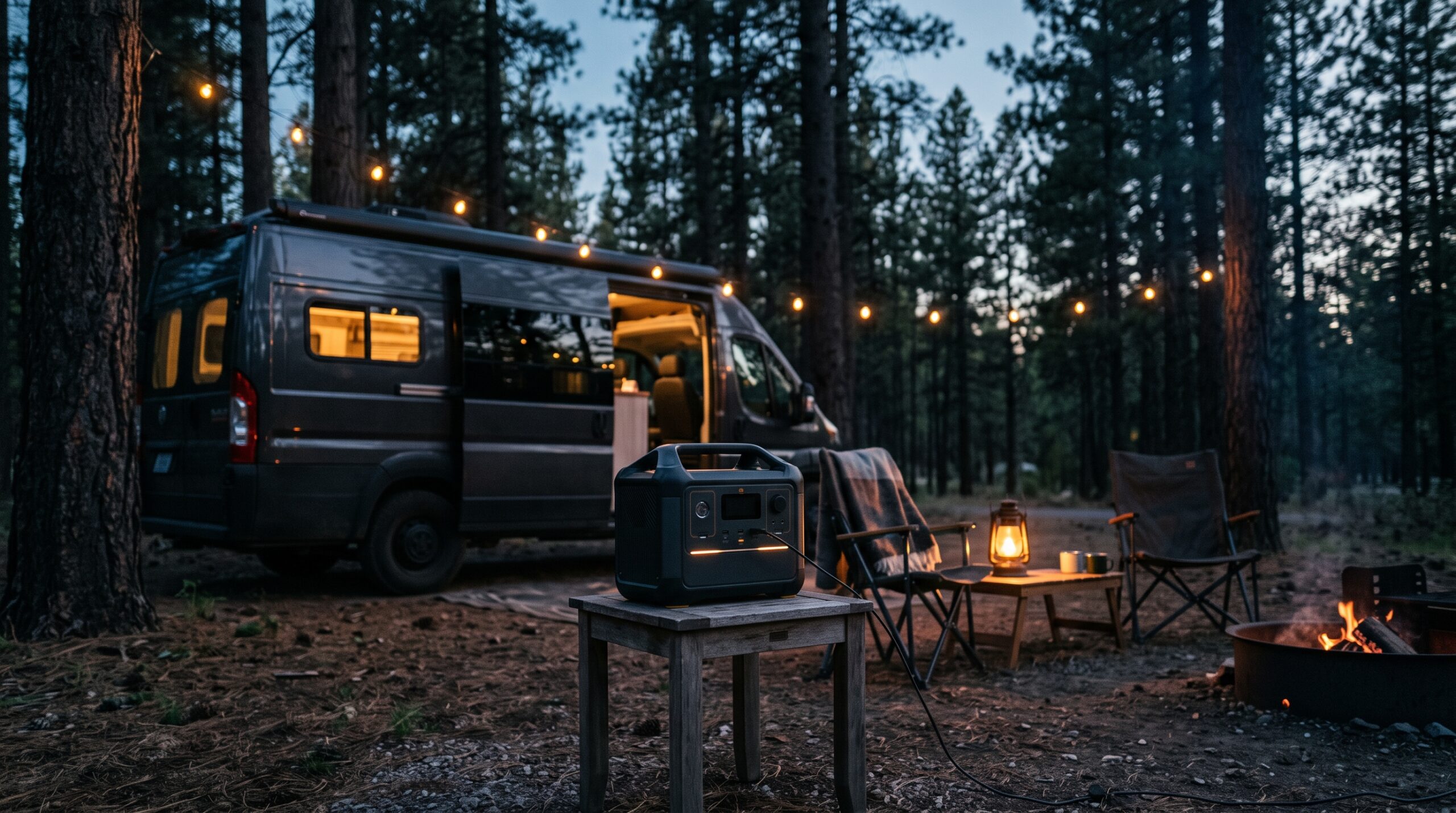
The short answer: most campers are well served by a power station between 500 and 2,000 watt-hours, with 500 to 800Wh covering a phones-lights-and-fan weekend and 1,000 to 2,000Wh covering a 12V cooler, a CPAP, and a few days off the grid. If you only charge phones and run a couple of lights, even a 300Wh unit is enough. The moment you add a fridge or a CPAP, the weekend total climbs fast, which is why the range is so wide.
Two numbers decide the size. Watt-hours set how long you last; the continuous-watt rating sets what you can plug in at once. Camping leans almost entirely on the first, and only the occasional kettle or coffee maker leans on the second.
What you’ll actually run
Most camping loads are small. Phones and tablets take roughly 10 to 20 watt-hours per full charge, an LED lantern or string lights pull 5 to 30 watts, and a portable fan runs anywhere from a few watts for a USB clip-on to about 100 watts for a box fan. A laptop draws 30 to 100 watts depending on the machine and what it is doing. Run only this group and a small battery lasts the whole weekend with room to spare.
The energy budget changes when you add a 12V fridge or cooler. A portable unit like a Dometic CFX3 draws around 60 watts only while its compressor is running, and because it cycles on and off it averages closer to 280 to 350 watt-hours over a full day under mild conditions, more in heat. That is the single biggest draw most campers carry, so if cold food is part of the plan, size for it. We cover the details separately in running a fridge or cooler. A CPAP is the other quiet heavyweight: without a heated humidifier it pulls about 20 to 40 watts, or 160 to 320 watt-hours a night, and a heated humidifier can double or triple that.
Then there are the high-watt items that strain the inverter rather than the battery. An electric kettle, a coffee maker, or a microwave can demand 600 to 1,500 watts for a few minutes. A 300-watt unit will not start them at all, so if camp coffee from a wall outlet matters, you need a station rated for at least 800 to 1,000 continuous watts, not just plenty of watt-hours. Sensitive electronics and a CPAP both want pure sine wave output, which nearly all lithium power stations provide, but it is worth confirming.
Watt-hours for a weekend
Add up what you run each day and multiply by the nights you are out. A power station’s rated capacity is not all usable, though: the inverter loses roughly 10 to 15 percent turning the battery’s DC into AC, and most units hold back the bottom of the pack to protect the cells, so a 1,000Wh station delivers closer to 850 to 900Wh of real, usable energy. Build that cushion into your estimate rather than planning to the last watt-hour.
The table below sketches what a typical two-night weekend draws for a few common camping setups. Treat the figures as ranges, not promises. Real numbers move with how warm it is, how full and how often you open the cooler, and how much you charge.
| Use case | Typical weekend Wh | Example devices |
|---|---|---|
| Phones and lights only | ~100–300 Wh | Phone/tablet charging, LED lantern, string lights |
| Phones, lights, and a fan | ~300–700 Wh | Add a USB or box fan overnight, a little laptop time |
| Add a 12V cooler or fridge | ~700–1,500 Wh | Portable fridge cycling ~280–350 Wh/day, plus charging |
| CPAP camper (no humidifier) | ~600–1,200 Wh | CPAP ~160–320 Wh/night, phones, a light |
| Cabin-style comfort | ~1,500–3,000 Wh | Fridge, laptop, projector, coffee maker in short bursts |
To pin the numbers to your own gear, run them through the Power-Station Sizing calculator, which adds up your devices plus startup surge and tells you the capacity and output you need. If you plan to top up from the sun, the Solar Recharge calculator estimates how long a given panel takes to put that energy back. If you are torn between two capacities, our 1000Wh vs 2000Wh breakdown shows where each size starts to feel tight.
Solar recharge for off-grid
For a one- or two-night trip, most people just arrive with a full battery and never recharge. Solar earns its keep when you stay out longer or boondock without hookups, because it turns a fixed battery into a slow but renewable supply. The catch is that solar is slower and less predictable than the rated numbers suggest. A panel rated 100 watts rarely delivers a steady 100 watts in the field once you account for sun angle, heat, haze, and clouds; planning around 60 to 80 percent of the rating is more realistic.
Match the panel to the station’s solar input. A small unit like the Jackery Explorer 300 Plus accepts up to 100 watts and recharges from a 100-watt panel in roughly 9.5 hours of good sun. A mid-size EcoFlow RIVER 2 Pro takes up to 220 watts and fills from solar in about 4.5 to 9 hours. A 1,000Wh-class Jackery Explorer 1000 v2 accepts up to 400 watts, so two 100-watt panels recharge it in around 7.5 to 8 hours, while a single 100-watt panel stretches that toward 17 hours. The pattern is simple: more panel watts mean faster recharge, up to whatever ceiling the station allows. For a deeper look at matching panels to capacity, see solar recharge.
One practical rule for off-grid stays: if your daily use is close to what a day of sun can replace, you stay even; if it is much higher, you are slowly draining a battery that solar only slows down. A cooler running through hot afternoons is the usual reason the math does not balance, so for long dry-camping trips, either bring more panel than you think you need or a bigger battery to ride out cloudy stretches.
Weight and portability
Capacity costs weight, and where you camp decides how much you can carry. A 288Wh Jackery Explorer 300 Plus weighs about 8 pounds and slips into a pack or a kayak; a 768Wh EcoFlow RIVER 2 Pro is around 18 pounds, an easy one-hand carry from the car to the site. Step up to the 1,000Wh class and a Jackery Explorer 1000 v2 is roughly 24 pounds, while a 2,000Wh Explorer 2000 v2 is close to 40 pounds, a two-hand, set-it-down-and-leave-it weight.
Let the trip pick the size. For backpacking or any pack-it-in site, the smallest battery that covers your phones and lights wins, and you accept that a cooler is off the table. For car camping or van life, a 500 to 800Wh unit hits the sweet spot, light enough to move around but big enough for a fridge and a CPAP. For an RV or a base camp you drive to and stay at, the 1,000 to 2,000Wh class makes sense because the weight never leaves the vehicle and you get real headroom. One honest limit for RVers: a power station can run your fridge, lights, fans, and devices for days, but it will not run a rooftop air conditioner for long, if at all, because the surge and the appetite are simply too large for a portable battery.
It doubles as home backup
The same battery you take camping is one of the better outage tools you can own, which makes it easy to justify. A 1,000Wh station that runs your campsite fridge will also keep a home refrigerator cold for roughly 12 to 17 hours during a blackout, run a CPAP through the night, and keep phones, a router, and a light or two alive alongside it. A 2,000Wh unit roughly doubles that and can carry a fridge close to a full day. Nothing about the device changes; only the job does.
That dual purpose is worth weighing when you choose a size. If a unit only ever went camping, you might buy the lightest one that covers a weekend. Because it also stands in for a backup during storms, leaning one size larger often pays off, since the extra capacity that feels optional on a calm trip is exactly what you want when the grid is down for a day. If home backup is the bigger motivation, our 1000Wh vs 2000Wh comparison maps capacity to outage length. For any life-critical medical device, confirm the station against the equipment’s own power requirements and keep a tested backup plan rather than cutting it close.
Camping and RV sizes, live prices


As an Amazon Associate we earn from qualifying purchases. Prices are pulled automatically from Amazon and may have changed.
Frequently asked questions
What size power station do I need for camping?
For a typical weekend, somewhere between 500 and 2,000 watt-hours covers most setups. If you only charge phones and run lights and a fan, 300 to 500Wh is plenty. Add a 12V cooler or a CPAP and you want 1,000Wh or more, and for several days off-grid or RV-style comfort, lean toward 1,500 to 2,000Wh. Size to the device that draws the most, usually the fridge.
How many watt-hours do I need for a weekend of camping?
Add up each day’s use and multiply by your nights, then leave a cushion because only about 85 to 90 percent of a station’s rated capacity is usable. A minimalist phones-and-lights weekend lands near 100 to 300Wh, adding a fan and some laptop time pushes it to 300 to 700Wh, and a cooler or CPAP can carry the total past 1,000 to 1,500Wh. A 1,000Wh station suits most two-night trips.
Can a power station run a 12V fridge or cooler while camping?
Yes, and it is one of the most common uses. A portable fridge such as a Dometic CFX3 draws around 60 watts only while its compressor cycles, averaging roughly 280 to 350 watt-hours per day in mild conditions and more in heat. A 500 to 1,000Wh station runs one comfortably for a weekend, especially if you can recharge from solar during the day.
Will a power station run a CPAP overnight when camping?
Usually for several nights. A CPAP without a heated humidifier draws about 20 to 40 watts, or 160 to 320 watt-hours a night, so even a 300 to 500Wh unit covers a night or two. Turning on a heated humidifier can double or triple the draw, so if you use one, size up and run a pure sine wave station. For any device you depend on, keep a backup plan.
Can I recharge a power station with solar while off-grid?
Yes, within limits. Each station has a maximum solar input, and a panel rarely hits its rated wattage in the field, so plan on 60 to 80 percent of the number on the label. A 100-watt panel refills a small 300Wh unit in roughly a day of sun, while a 1,000Wh station with 400 watts of panel can recharge in about 7.5 to 8 hours. If your daily use is close to what a day of sun replaces, solar keeps you even; if it is much higher, it only slows the drain.
Sources
- Jackery Explorer 300 Plus product page (288Wh, 300W output / 600W peak, ~8.3 lb, 100W solar input, ~9.5 hr solar recharge)
- EcoFlow RIVER 2 Pro product page (768Wh, 800W output / 1,600W X-Boost, ~18 lb, 220W solar input, 0–100% in 4.5–9 hr from solar)
- Jackery Explorer 1000 v2 product page (1,070Wh, 1,500W output / 3,000W surge, ~24 lb, 400W solar input)
- EcoFlow DELTA 2 product page (1,024Wh, 1,800W output, ~27 lb, expandable)
- Dometic CFX3 35 portable fridge/freezer (12V energy consumption ~0.98 Ah/h, roughly 280 Wh per 24 hr)
- U.S. Department of Energy, Estimating Appliance and Home Electronic Energy Use