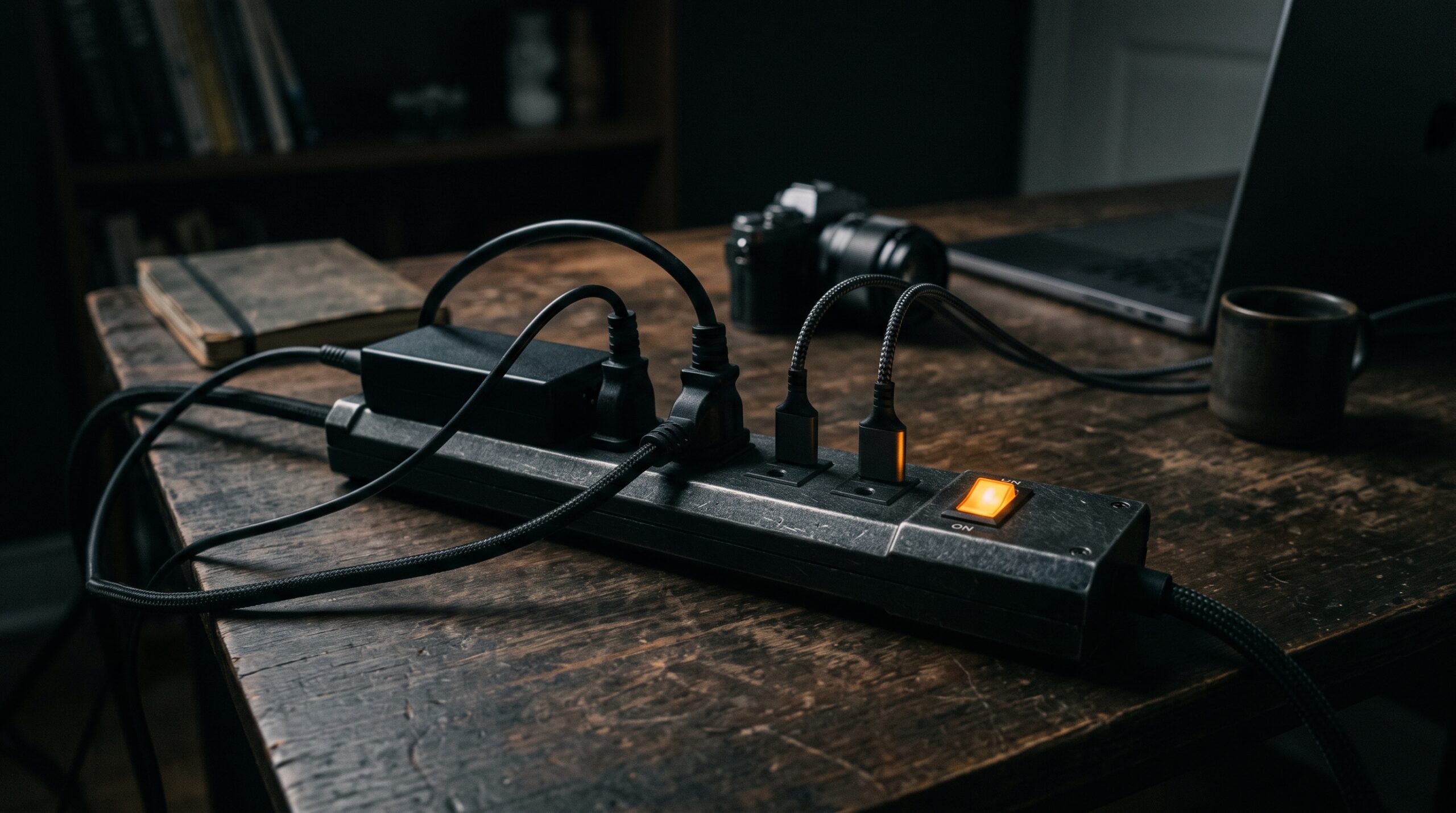
The real danger from an outage isn’t the dark hours, it’s the jolt of voltage that can hit when power comes back, and a true surge protector helps guard against that spike while a plain power strip does not. Power can also surge from a nearby lightning strike or a fault on the grid, and any of those spikes can damage or destroy sensitive electronics in an instant. The Electrical Safety Foundation International (ESFI) is blunt about it: power strips and surge protectors are not the same thing, and a basic power strip offers no surge protection at all.
Here is why the surge when power returns is the part to worry about, how a surge protector differs from a power strip, what joule ratings really mean, when whole-home protection makes sense, and why unplugging is still the surest fix.
⚠️ No surge protector stops a direct lightning strike
Even a high-rated surge protector cannot absorb a direct lightning strike. ESFI’s advice is to disconnect sensitive electronics if you think a surge is coming. A point-of-use protector or a whole-home unit is a layer of defense, not a guarantee, so treat unplugging as the real safeguard when a storm is overhead.
The real risk is the restoration surge
An outage on its own does not harm your electronics. The damage comes when the power returns. As the utility re-energizes the line, voltage can come back with a momentary surge or spike, and that brief overshoot is what reaches the delicate circuits inside a TV, a computer, or a game console. Ready.gov tells people to disconnect appliances and electronics during an outage for exactly this reason: power may come back with surges or spikes that can ruin equipment.
The grid is not the only source. The National Electrical Manufacturers Association estimates that 60 to 80 percent of surges actually start inside the home, when large appliances like air conditioners and well pumps switch on and off. When the power comes back after an outage, many of those motors and compressors can kick on at once, which is its own little surge event on your wiring. Add a nearby lightning strike or a fault on the utility’s equipment, and there are several ways a spike can find your gear. Knowing the risk is part of knowing what to do during an outage.
Surge protector vs power strip
This is the distinction that trips most people up. A plain power strip is just an extension cord with several outlets. It lets you plug in more devices, but it does nothing to stop a voltage spike from passing straight through to whatever is plugged in. A surge protector looks almost identical, but inside it has protective parts, usually metal oxide varistors (MOVs), that intercept excess voltage and divert it away from your devices.
The easiest way to tell them apart is to look for a joule rating and a UL 1449 listing on the box or the underside of the unit. UL 1449 is the safety standard for surge protective devices, once called transient voltage surge suppressors. If there is no joule rating printed anywhere, you are holding a power strip, no matter what the marketing says. That matters for anything you want to keep alive through an outage, including the modem and router that keep your wifi running.
| Feature | Plain power strip | Surge protector |
|---|---|---|
| Adds extra outlets | Yes | Yes |
| Diverts voltage spikes | No | Yes, through MOVs |
| Joule rating on the label | None | Listed, often 1,000 to 3,000+ J |
| Typical UL standard | UL 1363 (power tap) | UL 1449 (surge device) |
| Guards against the restoration surge | No | Yes, up to its rating |
Joule ratings explained
A joule rating tells you how much total energy the protector can absorb over its lifetime before its MOVs wear out. Think of it as a fuel tank for surges. Every spike it soaks up, large or small, draws the tank down a little. Once it is empty, the device quietly becomes a plain power strip: it still passes electricity, but it no longer protects anything, and usually nothing on the outside tells you. Many units have a small protection or grounded light that goes out when the surge components are spent, so check it now and then.
Higher is better for valuable or sensitive electronics. As a rough guide:
- 200 to 600 joules: fine for low-value loads like lamps, fans, and phone chargers.
- 1,000 to 2,000 joules: a sensible floor for computers, monitors, routers, and home-office gear.
- 2,000 joules and up: for home theaters, smart TVs, game consoles, and clusters of pricey electronics.
The number is not the whole story. A genuine UL 1449 listing matters as much as the joules, and ESFI notes that point-of-use protectors must be replaced over time or after a major surge event. A protector that took a big hit during the last storm may already be used up, so plan to swap them every few years.
Whole-home surge protection
A plug-in protector only guards what is plugged into it. A whole-home, or service-entrance, surge protective device is mounted at or in your main electrical panel and protects the entire electrical system, including the large appliances, outlets, and light switches you can never connect to a power strip. It has to be installed by a qualified electrician, and like any surge device it must be replaced over time or after a major event.
The best setup is layered. A panel-mounted unit knocks down the big surges arriving from the grid before they spread through the house, and point-of-use protectors handle the smaller spikes that start inside your own walls, right at your most sensitive devices. Whole-home protection often runs a few hundred dollars installed depending on the unit and your panel, and it is the only practical way to cover hard-wired equipment like a furnace, a well pump, or a refrigerator.
Unplugging is the surest fix
There is one method that can never wear out, run out of joules, or be overwhelmed, and it costs nothing: pull the plug. Ready.gov’s guidance is to disconnect appliances and electronics during an outage so the surge that can arrive with restored power has nothing to reach. It is also the only thing that reliably protects against a direct lightning strike, which no surge protector can absorb.
When the lights go out, unplug the TV, computer, game console, and microwave, and leave a single lamp switched on so you know the moment power is back. Then plug everything in again once the voltage has settled. Add a line about unplugging electronics to your power outage checklist so it becomes routine. For the things you cannot easily unplug, such as a hard-wired furnace or a fridge you want to keep cold, that is exactly where surge protectors and a whole-home unit earn their keep.
Backup power is the other half of outage prep. If you are sizing a battery to ride through the dark hours, use the Power-Station Sizing calculator to match capacity to your loads, and the Appliance Runtime calculator to see how long a station would keep the fridge, router, or medical gear running.
Frequently asked questions
Does a surge protector work during a power outage?
It does nothing while the power is off, because there is no voltage to manage. Its job is the moment power returns, when a surge or spike can come back on the line. A plain power strip never protects, whether the power is on or off.
Will a power strip protect my electronics during an outage?
No. A plain power strip only adds outlets. Without a joule rating and a UL 1449 listing on the label, it offers zero surge protection, so the spike when power returns passes straight through to your devices.
How many joules do I need in a surge protector?
For computers, TVs, and other sensitive electronics, look for at least 1,000 to 2,000 joules, and 2,000 or more for a home theater or clustered gear. Higher is better, and replace the protector after any major surge.
Is whole-home surge protection worth it?
It is the best defense for hard-wired and large appliances you can never plug into a strip, installed at your panel by a qualified electrician. Pair it with point-of-use protectors at your devices for layered coverage.
Should I unplug things during a power outage?
Yes. Ready.gov recommends disconnecting appliances and electronics so the surge that can arrive with restored power cannot reach them. It is the only protection that never wears out and the only one that handles a direct lightning strike.
Sources
- Electrical Safety Foundation International — Surge Protection: Keeping Your Electronics and Home Safe
- Electrical Safety Foundation International — Understanding Power Surges and Surge Protective Devices
- U.S. Consumer Product Safety Commission — Transient Voltage Surge Suppressors, UL 1449
- NEMA Surge Protection Institute — UL 1449: Surge Protective Devices
- Ready.gov (FEMA) — Power Outages