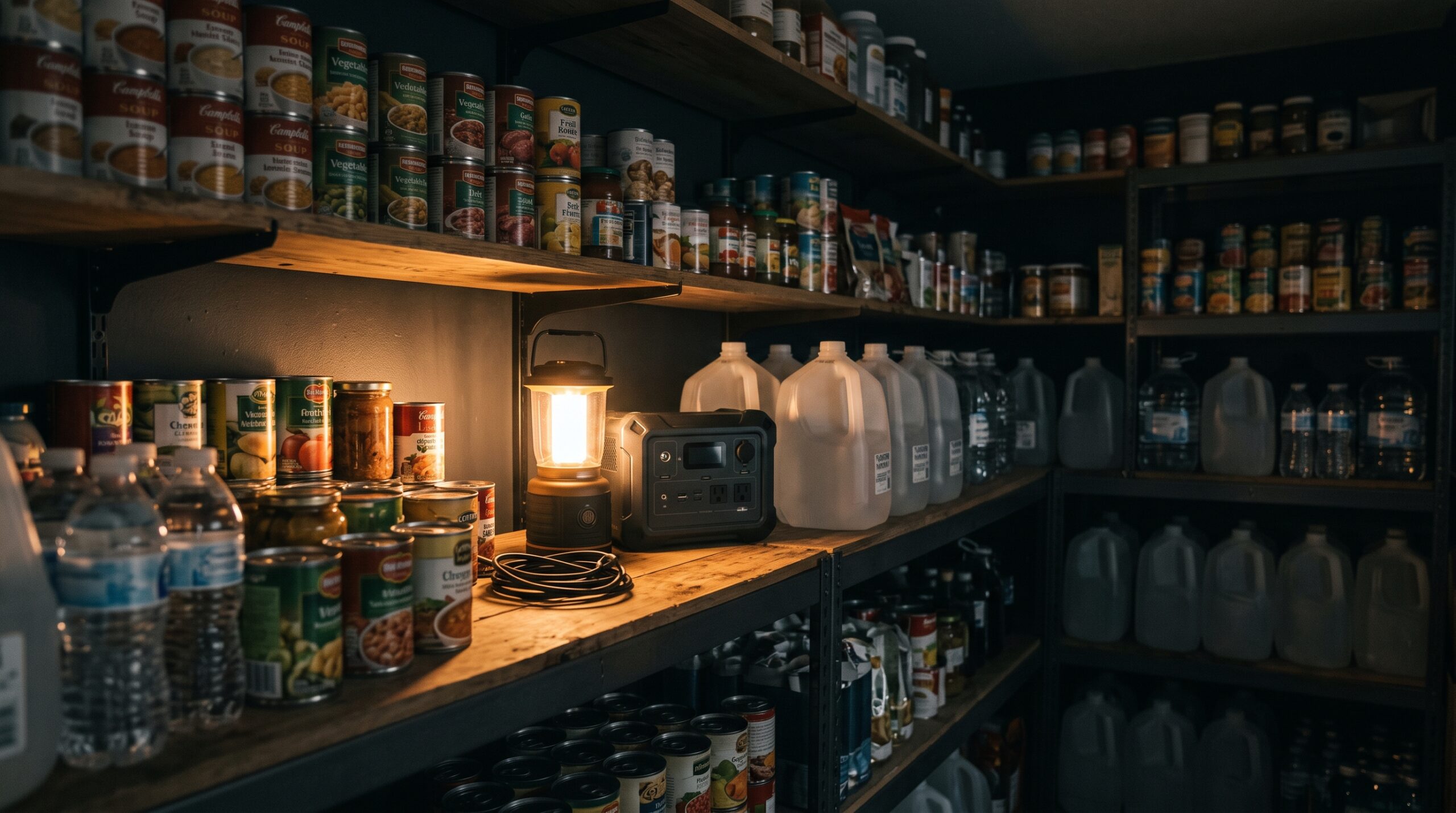
Most outages are over in a few hours, but ice storms, hurricanes, wildfires, and grid failures can leave the power off for days or a week or more. Surviving a long outage comes down to five things: store water and shelf-stable food for the long haul, run any generator safely outdoors, protect medications and medical devices, manage heat and cold over many days, and leave for a shelter before your home becomes dangerous. Ready.gov and the American Red Cross recommend keeping at least a two-week supply of water when you can, roughly one gallon per person per day, and keeping the refrigerator and freezer closed so food stays cold as long as possible.
⚠️ Over days, generator safety still comes first
Run generators outdoors only, at least 20 feet from the house with the exhaust pointed away from windows, doors, and vents, and use a battery-powered carbon monoxide alarm indoors. Never run a generator in a garage or basement, and never burn charcoal, a camp stove, or a gas range indoors to cook or heat. Over a long outage, also watch for heat and cold illness, especially in older adults, young children, and anyone with a health condition.
Water and food for the long haul
For a short outage you can lean on whatever is already in the kitchen. For a multi-day outage you need a real supply. Ready.gov advises storing one gallon of water per person per day for drinking and sanitation, and building toward a two-week supply when space allows. Do not forget water for pets, and store extra for washing hands and cleaning. Our guide on how much water to store walks through the math for your household.
Plan your food the same way. Lean on shelf-stable items that need no cooking or refrigeration, and keep a manual can opener and basic supplies in your emergency kit. Our list of non-perishable foods covers options that hold up for days. As power stays off, work through your refrigerated and frozen food first using federal food-safety timelines, then move to your shelf-stable stock.
| Where the food is | How long it stays safe | What to do |
|---|---|---|
| Refrigerator (door kept closed) | About 4 hours | After 4 hours above 40°F, throw out perishable food such as meat, fish, eggs, milk, and leftovers. |
| Full freezer (door kept closed) | About 48 hours | Keep the door shut. Food is safe to refreeze or cook if it still has ice crystals or is at 40°F or below. |
| Half-full freezer (door kept closed) | About 24 hours | Same rule. Group items together and add ice or frozen gel packs to extend cold time. |
Keep an appliance thermometer in the refrigerator and freezer so you can check the actual temperature. Never taste food to decide whether it is safe. When in doubt, throw it out.
Sustained backup power: fuel and solar
Backup power over days is about both safety and rationing. The most common cause of death after storms is carbon monoxide poisoning from generators, so the placement rules in the warning above are not negotiable. Beyond that, the question is making your fuel or charge last.
- Gas or propane generators: Store fuel safely and ration it. You rarely need to run a generator around the clock. Many people run it a few hours at a time to keep the refrigerator and freezer cold and to recharge phones and medical devices, then shut it off. Let it cool before refueling, and keep it dry and outdoors.
- Portable power stations and solar: A battery station with a solar panel can recharge in daylight, which makes it well suited to multi-day outages. Prioritize the essentials: phones, a weather radio, medical devices such as a CPAP, and small medical refrigeration if a clinician recommends it.
- Stretch every watt: Charge devices during the day, run high-draw appliances only when needed, and turn things off the moment they are done.
Not sure what size battery or generator your household needs, or how long it will run your gear? Size it before the next storm with the Power-Station Sizing calculator, then check how many hours of runtime you will get with the Appliance Runtime calculator.
Sanitation and hygiene
Over a long outage, staying clean is part of staying healthy. Set aside water for handwashing and cleaning on top of your drinking supply, and keep simple backups on hand so you are not caught short.
- Moist towelettes and hand sanitizer for when running water is limited.
- Soap, paper towels, and heavy-duty garbage bags with ties for personal sanitation and waste.
- If your water service or well pump is affected, plan a toilet backup, such as bucket liners, and keep waste sealed and away from living and food areas.
- Wash hands before handling food and after using the toilet to prevent illness while help may be slow to arrive.
Medication and medical needs
This is the area where a long outage turns serious fastest, so plan it before you need it. Talk with your doctor or pharmacist about a power-outage plan for any medicine that needs refrigeration and for any device that runs on electricity.
- If the power is out for more than a day, discard medication that should be refrigerated unless the label says otherwise, and contact your doctor or pharmacist right away for a new supply.
- Never ration or stop a life-critical medication on your own. Ask your provider how long it can be stored warm and what to do if you run low.
- For power-dependent devices such as oxygen concentrators or a CPAP, arrange a backup power source and a fallback plan in advance.
- Ask your electric utility whether it keeps a medical priority or medical baseline list, and keep a written list of your medications and doses.
Heating and cooling over days
A house without power slowly drifts toward the outdoor temperature, and over several days that can become a health risk. Handle heat and cold deliberately, and check often on older adults, young children, and anyone with a medical condition.
Staying warm: Layer clothing, close off one room to hold heat, and use blankets and sleeping bags. Never use a gas range, oven, charcoal grill, or camp stove to heat your home. If you use a space heater, wood stove, or fireplace, follow the manufacturer’s instructions and keep anything that can burn well clear. Hypothermia is a danger in the cold. If someone’s body temperature drops below 95°F, seek medical attention immediately.
Staying cool: In extreme heat, an electric fan alone will not prevent heat illness once temperatures climb. Drink water, dampen skin, stay on the lowest floor out of the sun, and move to a cooling center if your home gets too hot. Learn the signs of heat exhaustion, such as heavy sweating, weakness, and nausea, and of heat stroke, such as hot or red skin, confusion, and a body temperature of 106°F or higher, which is a medical emergency.
Communication and information
When the grid is down for days, staying informed and reachable takes planning. Keep a battery-powered or hand-crank radio, ideally a NOAA weather radio, so you can follow alerts and restoration updates even if cell networks are strained.
- Conserve phone battery: lower screen brightness, switch on low-power mode, and send short texts instead of calls, which often go through when networks are busy.
- Keep charged power banks and a car charger as backups, and recharge devices whenever you run a generator or have daylight for solar.
- Keep a written list of emergency contacts and your utility’s outage line in case your phone dies.
- Know how to receive local emergency alerts and where your community posts updates.
When to relocate
Staying home is not always the safe choice. Plan to leave for somewhere with power before conditions become dangerous rather than after. Consider relocating if any of these are true:
- Your home is becoming too hot or too cold to stay safe.
- You rely on electricity for a medical device or refrigerated medicine and your backup power is running low.
- Your water, food, or other essential supplies are running out.
Communities often open warming or cooling centers and charging stations during long outages. Staying with friends or family who have power is also a good option. To find local help, dial 2-1-1. To find a shelter, call 1-800-RED-CROSS (1-800-733-2767), visit redcross.org, or use the free Red Cross Emergency app, and bring your emergency kit, medications, and supplies with you.
Frequently asked questions
How long should I prepare a power outage to last?
Most outages are short, but major storms can keep power off for several days to more than a week. A practical target is to prepare to be self-sufficient for at least two weeks, focusing on water, food, medication, and a way to handle heat or cold.
How much water do I need for a week-long outage?
Ready.gov recommends one gallon of water per person per day for drinking and sanitation, and storing a two-week supply when you can. For a household of four over a week, that is about 28 gallons at a minimum, plus extra for pets and cleaning.
Is my refrigerated and frozen food still safe after a long outage?
A closed refrigerator keeps food safe for about 4 hours, and a full freezer for about 48 hours (24 hours if half full). Throw out perishable refrigerated food held above 40°F for more than 4 hours. Frozen food can be refrozen or cooked if it still has ice crystals or is at 40°F or below. When in doubt, throw it out.
Can I run a generator overnight while I sleep?
Only if it is outdoors, at least 20 feet from the house with exhaust pointed away from windows, doors, and vents, and you have a working carbon monoxide alarm inside. Never run a generator in a garage, basement, or any enclosed space. Many households run a generator in cycles rather than continuously to conserve fuel.
When should I leave home during a long outage?
Leave before conditions get dangerous if your home is becoming too hot or too cold, if you depend on power for a medical device or refrigerated medicine and your backup is running low, or if you are running out of water or food. Go to a community warming or cooling center, a shelter, or stay with friends or family who have power.
Sources
- Ready.gov, Power Outages
- Ready.gov, Water
- FoodSafety.gov, Food Safety During a Power Outage
- CDC, Keep Food Safe After a Disaster or Emergency
- CDC, What to Do to Protect Yourself During a Power Outage
- American Red Cross, Power Outage Safety