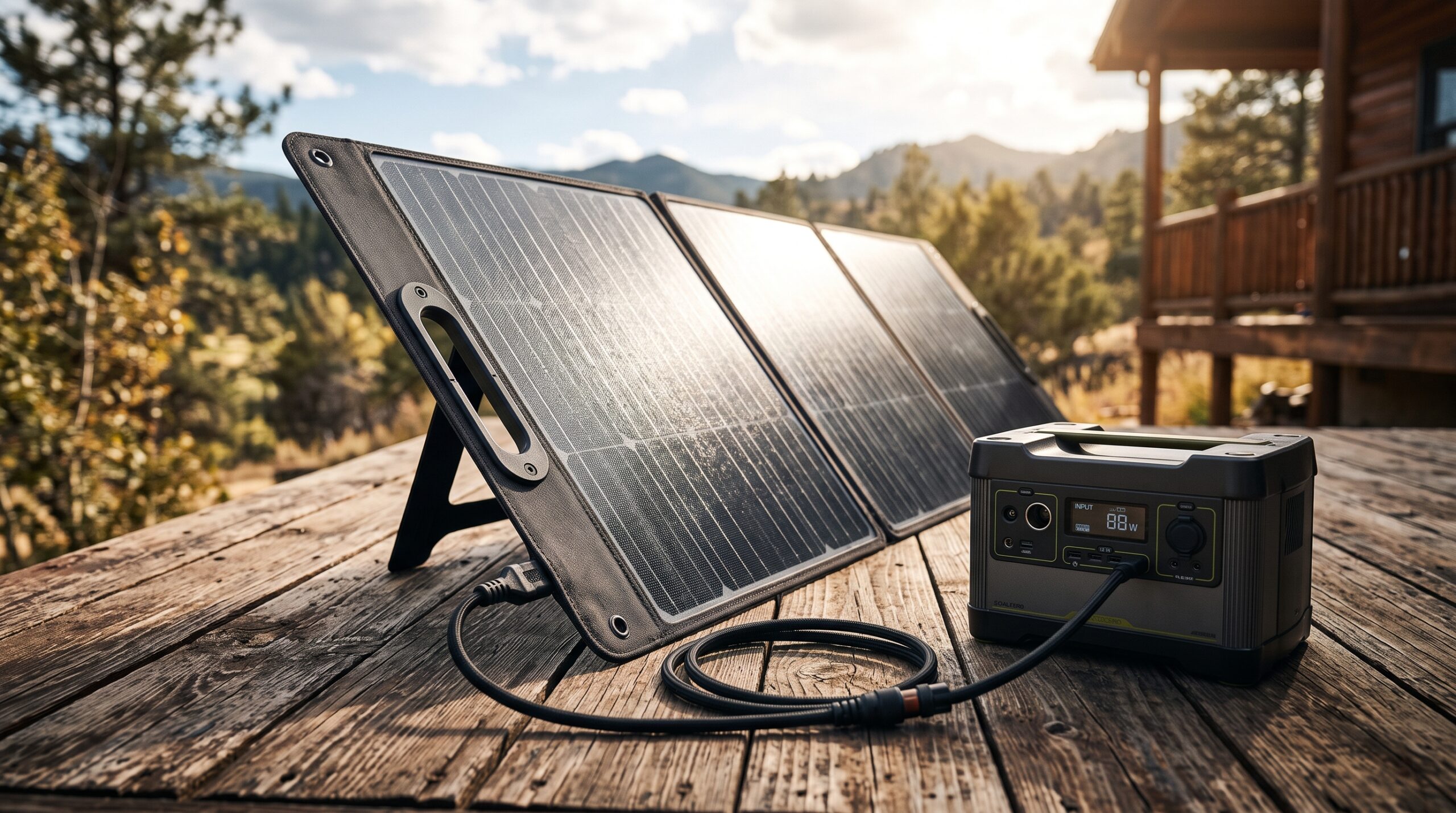
The best portable solar panel for a power station is the one whose wattage fits both your station’s maximum solar input and the hours of strong sun you actually get: roughly 100W for phones and a small station, 200W to refill a 1,000Wh unit in a sunny day, and 400W or more for fast charging and bigger batteries. Bigger is not automatically better, because every station caps how much solar it will accept.
Spec sheets make this harder than it needs to be, throwing around lab wattages and conversion-efficiency numbers that rarely survive a real afternoon outdoors. The shortcut is to start from your station, not the panel, and then match the panel class to the job. Here is how the tiers line up.
Match the panel to your station first
Before you compare panels, pull up your power station’s spec sheet and find three numbers. They are hard ceilings, and the right panel lives inside all three.
- Maximum solar input (watts). Every station limits how much solar it will take. A compact unit like the Jackery Explorer 1000 v2 accepts up to about 400W, the EcoFlow Delta 2 (1,024Wh) up to 500W, and a large station such as the Delta 2 Max (2,048Wh) up to 1,000W. Hanging an oversized array on a small station does not charge it faster than its cap.
- Input voltage window. Stations charge only within a voltage range, often something like 11 to 60V. A panel below the minimum will not start charging; one above the maximum can shut the input down. Wiring panels in series adds voltage, so a long string can overshoot a small station.
- Connector and adapter. Many stations use an XT60 or XT60i input, while most third-party panels terminate in MC4. That usually means a cheap adapter cable, not a dealbreaker, but worth confirming before a trip.
Once those three line up, panel choice comes down to how much energy you need per day. If you want the underlying arithmetic, the solar recharge math breaks down exactly how panel watts, sun hours, and real-world losses combine into a daily harvest figure.
100W class: phones, small devices, and compact stations
A panel in the 60W to 110W range is the entry tier. In a sunny day it gathers somewhere around 300 to 450 watt-hours after real-world losses, enough to top off a 300Wh to 500Wh station, keep phones and lights going, or trickle a mid-size station along when you cannot give it a full array. These panels are the lightest and most packable, which is why backpackers reach for them.
Current examples show the spread. The EcoFlow 110W folds to a slim package, rates 25 percent conversion efficiency, uses an XT60i connector, and carries an IP68 dust and water rating at roughly 7 pounds. Jackery’s SolarSaga 100 pairs natively with its Explorer stations, and ultralight options like FlexSolar’s sub-2-pound panels exist for hikers who count grams. Expect entry-tier pricing here; the trade is lower daily yield, so this class suits small loads rather than refilling a big battery.
200W class: a one-day refill for a 1,000Wh station
The 200W to 220W class is the volume sweet spot for power-station owners. In strong sun it harvests roughly 700 to 900 watt-hours a day, which is most or all of a 1,000Wh station in a single good day and a comfortable match for weekend camping, a small DC fridge, or a multi-day outage buffer. It is still foldable and one-person portable, just heavier and bulkier than the 100W tier.
Two mainstream panels frame the class. Jackery’s SolarSaga 200W uses a bifacial design that adds yield from reflected light, rates up to 24.3 percent efficiency, carries an IP68 build, and connects via a DC8020 plug with a DC7909 adapter for its stations. EcoFlow’s NextGen 220W is rated 220W (plus or minus 5W) on N-type TOPCon monocrystalline cells at 25 percent efficiency, weighs about 15.9 pounds, ships with an XT60i cable, and is IP68 rated. Third-party 200W panels from makers like Renogy bring an MC4 termination that fits most open-input stations with an adapter. This is the mid tier on price and the default recommendation for most buyers.
400W and up: faster charging and bigger stations
Once your station holds 2,000Wh or more, or you simply want a faster top-up, step up to 400W and beyond. A 400W panel gathers roughly 1,400 to 1,700 watt-hours in a sunny day, enough to carry a 2,000Wh station over a strong day or refill a 1,000Wh unit in a few hours of good light. These panels are large foldables or rigid arrays, heavier to carry and slower to set up, and they assume a station with a high solar-input cap.
The Anker SOLIX PS400 is a representative 400W foldable: up to 23 percent efficiency on monocrystalline cells, an IP67 weather rating, a built-in kickstand with four set angles (30, 40, 50, and 80 degrees) plus a sunlight-alignment guide, and MC4 cables with an MC4-to-XT60 adapter in the box. Its optimum operating point sits near 48V and 8.33A, which is exactly why the station-side voltage window matters at this size. Premium-tier pricing applies, and only a large-input station can actually use all of it; on a small station the extra watts are wasted.
| Panel wattage | Recharges in a sunny day | Best for |
|---|---|---|
| 100W class (60–110W) | ~300–450Wh harvested; tops off a 300–500Wh station | Phones, lights, small or compact stations, backpacking |
| 200W class (200–220W) | ~700–900Wh harvested; most of a 1,000Wh station | Weekend camping, mid-size stations, outage buffer |
| 400W+ class | ~1,400–1,700Wh harvested; a 2,000Wh station over a strong day | Large stations, faster charging, off-grid base |
Foldable vs rigid
Nearly every panel marketed as “portable” is a foldable: monocrystalline cells laminated into a fabric case that folds into a briefcase shape with a built-in kickstand. Foldables win on packability and quick setup, and the better ones add adjustable legs, a zippered cord pouch, and clasps that hold the panel shut in transit. The trade is durability over years of flexing and a slightly higher price per watt than a bare rigid panel.
Rigid panels, usually aluminum-framed glass units, cost less per watt and tend to last longer, but they do not fold, are awkward to carry, and are really meant for a semi-permanent spot on an RV roof or a fixed ground mount. For a power station you move around, a foldable is almost always the right call; choose rigid only if the panel will live in one place. This is also part of the wider solar generator vs battery decision, where the panel and the station are sold as one kit.
Connectors and compatibility
A panel only helps if its plug and voltage suit your station. The common terminations you will meet are MC4 (the universal standard on third-party and rigid panels), XT60 and XT60i (EcoFlow and many newer stations), DC8020 and DC7909 (Jackery and various barrel-plug stations), and Anderson-style connectors on some brands. Matching them is usually a matter of the right adapter cable.
- Same brand, easiest. A panel and station from one maker plug together and stay inside the rated voltage window by design.
- Mixed brands, check two things. Confirm the connector (or buy a known adapter such as MC4-to-XT60) and confirm the panel’s open-circuit voltage falls inside the station’s input range. A panel that reads, say, 23.5V open-circuit suits an 11 to 60V window with room to spare.
- Series wiring adds voltage. Linking panels in series multiplies voltage and can overshoot a small station’s ceiling, so stick to the manufacturer’s recommended configuration.
The built-in MPPT charge controller in modern stations optimizes within those limits but cannot exceed the input cap or the voltage window. If you are weighing solar against the wall, our guide to charging a power station covers how the inputs compare.
What to look for
Beyond wattage, a handful of specs separate a panel that performs from one that disappoints in real conditions.
- Rated wattage versus real output. Plan on 60 to 75 percent of the label in good sun once you account for heat, haze, dust, cable losses, and imperfect tilt. A 200W panel delivering 130 to 160W in bright light is normal, not defective.
- Cell type and efficiency. Quality 2026 panels use monocrystalline cells, increasingly N-type TOPCon, rated around 21 to 25 percent efficiency. Higher efficiency mostly buys you the same watts in a smaller, lighter package.
- Foldability and weight. Check both the folded size and the carry weight, not just wattage. The jump from the 100W to the 200W class roughly doubles both.
- Durability and weather rating. Look for an IP rating in the IP65 to IP68 range so a passing shower will not end the day, and sturdy stitching, grommets, and a stand that holds an angle in wind.
- Angle and alignment. Adjustable kickstand angles and a sun-alignment guide meaningfully raise daily yield, because a panel facing the sun squarely collects far more than one lying flat.
Want the numbers for your own gear and location instead of a rule of thumb? Run them through our Solar Recharge calculator, which takes your station capacity, panel wattage, and local sun hours and returns a realistic recharge estimate. If you are still deciding how big a station you need before sizing the solar, start with the Power-Station Sizing calculator and come back to match the panel.
Panels by class, live prices

EcoFlow 110W Portable Solar Panel
Foldable with carry case, IP68 — the 100W class
$259.00Check price on Amazon →

Jackery SolarSaga 100 Prime
100W bifacial, IP68 — pairs natively with Explorer stations
$199.00Check price on Amazon →

EcoFlow 220W NextGen
Bifacial N-type, adjustable kickstand — a day refill for 1,000Wh

Jackery SolarSaga 200W
Bifacial, IP68 — the 200W class for faster refills
$379.00Check price on Amazon →

Anker SOLIX PS400
400W foldable, IP67, MC4 — for large and expandable stations
As an Amazon Associate we earn from qualifying purchases. Prices are pulled automatically from Amazon and may have changed.
Frequently asked questions
What size solar panel do I need for my power station?
Match it to the station’s capacity and your sun. As a rough guide, a 100W panel suits a small 300Wh to 500Wh station, a 200W panel refills most of a 1,000Wh station in a sunny day, and 400W or more is for 2,000Wh-plus stations or faster charging. Never exceed the station’s maximum solar input, which you will find on its spec sheet.
Can I use any brand of solar panel with my power station?
Usually yes, with two checks. The connector must match or convert with an adapter, most often MC4-to-XT60, and the panel’s open-circuit voltage must fall inside the station’s input voltage window. Same-brand kits skip both worries, but most open-input stations accept third-party panels fine.
Are foldable solar panels as good as rigid ones?
For a portable power station, yes. Foldables use the same monocrystalline cells and pack down for travel with a built-in stand. Rigid panels cost a little less per watt and may last longer, but they do not fold and are better suited to a fixed RV roof or ground mount than to gear you carry and reposition.
Will a bigger panel charge my station faster?
Only up to the station’s maximum solar input. If your station caps at 200W, a 400W panel will not charge it any faster than a 200W one, because the station throttles the input. A bigger panel helps only when the station can actually accept the extra watts, or in weak light where the surplus rating offsets losses.
How much power will a portable panel really make?
Plan on about 60 to 75 percent of the rated wattage in good sun. Lab ratings assume full standardized sunlight, a cool panel, and perfect alignment; real conditions add heat, haze, dust, and an imperfect angle. Seeing 130 to 160W from a 200W panel on a clear day is a normal, healthy result.
Sources
- Anker SOLIX PS400 portable solar panel (400W, up to 23% efficiency, IP67, four kickstand angles, MC4-to-XT60 adapter)
- EcoFlow NextGen 220W solar panel (N-type TOPCon, 25% efficiency, 15.9 lb, XT60i, IP68)
- Jackery SolarSaga 200W solar panel (bifacial, up to 24.3% efficiency, IP68, DC8020 connector)
- EcoFlow 110W solar panel (25% efficiency, XT60i, IP68, ~7 lb)
- EcoFlow Delta 2 (1,024Wh, up to 500W solar input, 11–60V window)
- Jackery Explorer 1000 portable power station (maximum solar input reference)
- Outdoor Life: best portable solar panels of 2026, tested (real-world output, cell types)
- NREL PVWatts calculator (location-specific peak sun hours)