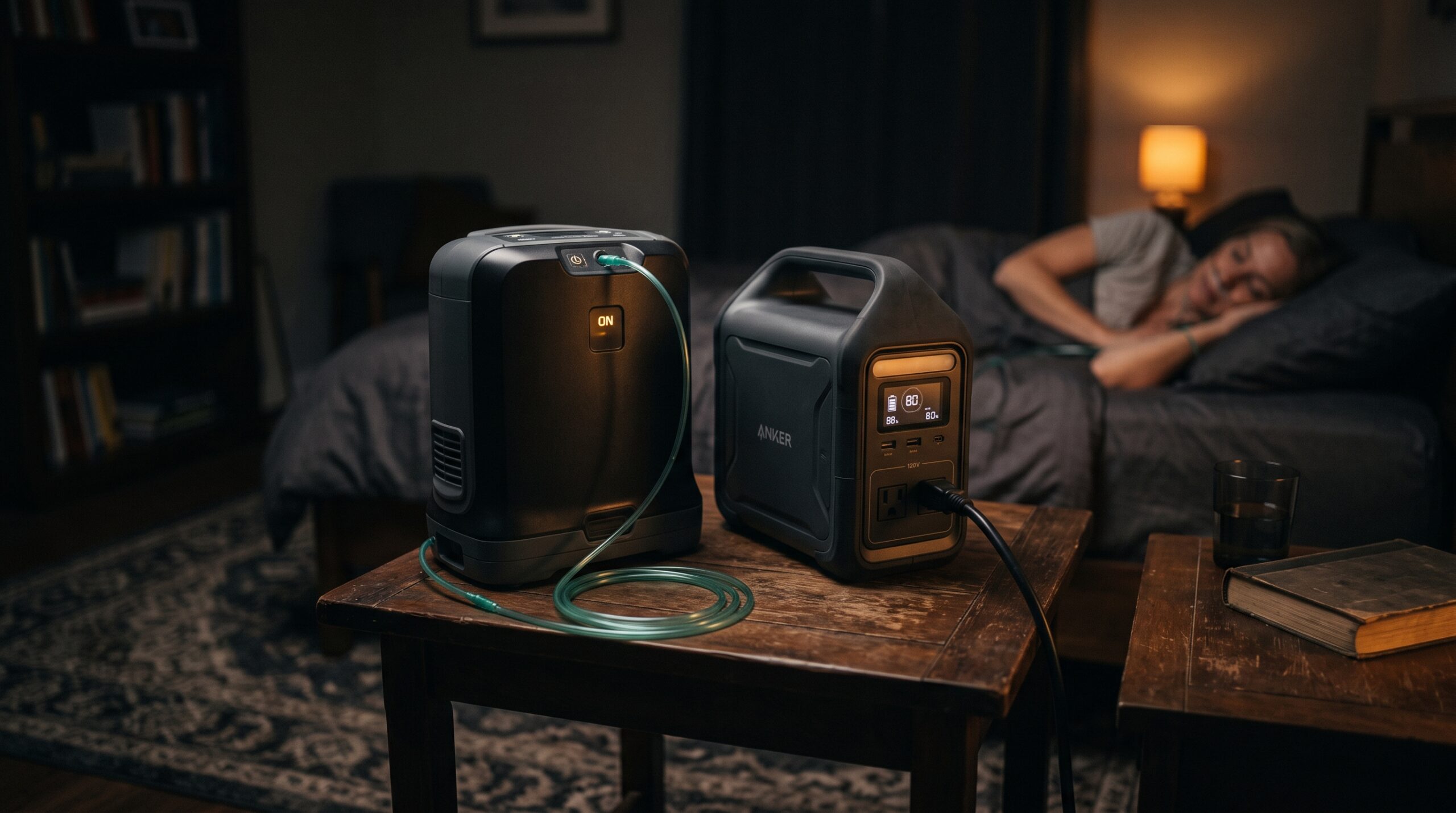
If you or someone in your home uses an oxygen concentrator, a power outage is not just an inconvenience – it interrupts a life-critical device. A home concentrator typically draws around 300 to 600 watts continuously, so it drains a battery far faster than a phone or a lamp, and no single gadget covers a long outage on its own. The dependable answer is a layered plan: a non-electric oxygen tank you can fall back on, a portable concentrator that runs on its own batteries, an optional power station to bridge a home unit for a few hours, and registration with your utility’s medical-priority program. Build that plan with your equipment supplier and clinician before you ever need it.
⚠️ Oxygen is life-critical – plan with your provider, not just a battery
Confirm your backup-oxygen plan with your equipment supplier (DME) and physician, keep a non-electric compressed-oxygen tank as a fallback, register with your utility’s medical-priority program, and follow your device manual. This is planning guidance, not medical advice.
How much power an oxygen concentrator uses
A stationary home concentrator runs an air compressor more or less continuously, which is why it pulls real power. Most home units sit in the 300 to 600 watt range, and larger 10-liter machines can climb toward 500 to 700 watts. As concrete examples, the Philips Respironics EverFlo averages about 350 watts, and the Inogen At Home uses roughly 275 watts at its 5 LPM setting and about 100 watts at 2 LPM continuous flow. Your exact number is printed on the device label and in the manual – check it, because the wattage drives every battery and power-station decision below.
Portable oxygen concentrators (POCs) draw much less because many deliver oxygen in pulse doses rather than a constant stream, but they trade runtime for that efficiency and are sized for mobility, not 24/7 home use. If you also run other devices, see our broader guide to backup power for medical equipment so you size for the whole load, not just one machine.
Why batteries drain fast
Three things make a concentrator hard on batteries. First, it is a continuous load: if continuous-flow oxygen is prescribed, the machine runs around the clock, not just at night like a CPAP that you can scale back. Second, the compressor surges when it cycles on, so a power station or inverter has to handle a momentary spike well above the running wattage. Third, running on battery means an inverter is converting DC to AC, and that conversion loses roughly 10 to 15 percent along the way.
Put together, a 300 to 600 watt continuous draw means even a large portable power station is measured in hours, not days. That is the core reason oxygen needs a layered plan instead of one big battery.
The layered plan: tank, portable concentrator battery, power station
No single device should be your whole answer. The American Lung Association advises that oxygen suppliers provide stand-alone oxygen tanks that do not rely on electricity, and that portable concentrators carry extra batteries and a car charger. Stack the layers so a failure in one is covered by the next:
- A non-electric compressed-oxygen tank. This is the one option that needs zero electricity, so it is your true fallback. Ask your DME how many tanks to keep on hand and how long each lasts at your prescribed flow.
- A portable concentrator with charged spare batteries. It runs on its own battery packs and recharges from a car’s 12-volt outlet, so it keeps you mobile during an evacuation. Keep every battery topped up before storm season.
- A power station to bridge a home unit. A battery power station can keep a stationary concentrator running for a few hours – useful for a short outage – but plan it as a bridge, not an indefinite supply.
- A registered medical-priority status with your utility. Not power itself, but it buys you advance warning and faster restoration, which buys time for the layers above.
| Option | Role | Notes |
|---|---|---|
| Non-electric compressed-oxygen tank (from your DME) | Primary fallback – works with no electricity | The only option that needs no power at all. Ask your supplier how many tanks and hours to keep. |
| Portable oxygen concentrator + spare batteries | Mobile bridge – runs on its own battery and car charger | Pulse-dose batteries can last several hours per pack on low settings; charge spares ahead of time. |
| Portable power station (battery) | Short bridge for a home concentrator | Needs a pure sine wave output and enough continuous plus surge watts; runtime is hours, not days. |
| Portable generator (outdoors only) | Longer bridge for a home concentrator | Run outdoors, 20+ feet from doors, windows and vents to avoid carbon monoxide; confirm clean power with your DME. |
| Utility medical-priority registration | Advance notice and faster restoration | Not power – it gives priority and outage notifications. Sign up well before an outage. |
Sizing a power station for a limited bridge
If you want a power station to bridge a home concentrator, three things matter. The inverter’s continuous wattage must clear your concentrator’s running draw with margin, and its surge rating must absorb the compressor’s startup spike. The output should be pure sine wave, because the motor in a concentrator dislikes the choppy output of cheaper inverters. And the usable capacity, measured in watt-hours (Wh), sets how long you get.
The rough math: divide usable watt-hours by the concentrator’s wattage, then trim 10 to 15 percent for inverter losses. A 1,000 Wh station running a 350-watt EverFlo lands near 2.5 to 3 hours; a 2,000 Wh station roughly doubles that. Those are estimates, not promises, and higher flow settings shorten them. Treat any battery bridge as a way to buy time until you switch to a tank or the grid returns.
To turn your own numbers into hours, run them through our Appliance Runtime calculator, then size the unit with the Power-Station Sizing calculator. Bring the wattage from your device label, and check the result against what your DME recommends.
Register with your utility’s medical-priority program
Most utilities run a medical-baseline or medical-needs program for customers who depend on electricity for equipment like supplemental oxygen. Registering does not guarantee the lights stay on, but it flags your account so you get advance notice of a planned shutoff and, often, priority during restoration. In California, for example, PG&E’s Medical Baseline Program sends extra notifications before a Public Safety Power Shutoff, and a medical professional completes part of the application.
Call your electric company and ask how to enroll, since applications can take a few weeks to process – do it before storm season, not during an outage. The American Lung Association also recommends telling your local fire and police departments that you rely on powered medical equipment at home.
Plan ahead and practice
Write down an inventory of every device that needs power, your concentrator’s wattage, and the order of your layers – tank first, then portable, then station. Share the plan with a neighbor or family member who can check on you, and store backup batteries charged. If anyone in the home also depends on cooled medication, fold in our guidance on refrigerated medicine during an outage so nothing gets missed.
Then test it. Practice switching to your tank, time how long a fully charged battery actually lasts, and confirm your power station starts the concentrator cleanly. The middle of an outage is the wrong moment to learn that a battery is flat or an inverter trips on startup.
Frequently asked questions
How many watts does an oxygen concentrator use?
Most home (stationary) concentrators draw roughly 300 to 600 watts continuously, and large 10-liter units can reach 500 to 700 watts. For reference, the Respironics EverFlo averages about 350 watts and the Inogen At Home uses about 275 watts at 5 LPM. The compressor also surges higher when it cycles on. Your exact figure is on the device label and in the manual – use that number for any battery or power-station math.
Can a power station run my oxygen concentrator?
Often yes, as a limited bridge. The power station needs a pure sine wave output, enough continuous wattage to cover the running draw, and enough surge headroom for the compressor’s startup spike. Runtime is measured in hours, not days. Confirm compatibility with your DME before relying on it, and keep a non-electric tank ready in case it falls short.
How long will a battery or power station last?
Divide the power station’s usable watt-hours by your concentrator’s wattage, then subtract 10 to 15 percent for inverter losses. A 1,000 Wh station running a 350-watt concentrator gives roughly 2.5 to 3 hours; higher flow settings cut that down. Use our runtime and sizing calculators to model your own numbers, and verify the result against your supplier’s advice.
Do I still need an oxygen tank if I have a battery?
Yes. The American Lung Association advises that suppliers provide stand-alone oxygen tanks that do not rely on electricity. A non-electric compressed-oxygen tank is your true fallback because batteries discharge and generators can fail. Keep the tanks your DME recommends, and know how to switch to them.
How do I register with my utility for medical priority?
Ask your electric company for its medical-baseline or medical-needs program. You complete an application, your clinician verifies the medical need, and once approved you receive advance notifications of planned shutoffs and, often, priority during restoration. Processing can take a few weeks, so enroll before an outage rather than during one.
Sources
- American Lung Association, Preparing for a Power Outage as a Medical Device User: https://www.lung.org/blog/power-outage-preparation
- American Lung Association, Power Outages and Lung Health: https://www.lung.org/clean-air/emergencies-and-natural-disasters/power-outages
- American Lung Association, Using Oxygen Safely: https://www.lung.org/lung-health-diseases/lung-procedures-and-tests/oxygen-therapy/using-oxygen-safely
- PG&E, Medical Baseline Program: https://www.pge.com/en/account/billing-and-assistance/financial-assistance/medical-baseline-program.html
- California Public Utilities Commission, Medical Baseline: https://www.cpuc.ca.gov/consumer-support/financial-assistance-savings-and-discounts/medical-baseline
- Inogen, Inogen At Home Oxygen Concentrator specifications: https://www.inogen.com/product/inogen-at-home-oxygen-concentrator/
- Inogen, How many hours do portable oxygen concentrators last: https://www.inogen.com/resources/traveling-oxygen/how-many-hours-do-portable-oxygen-concentrators-last/