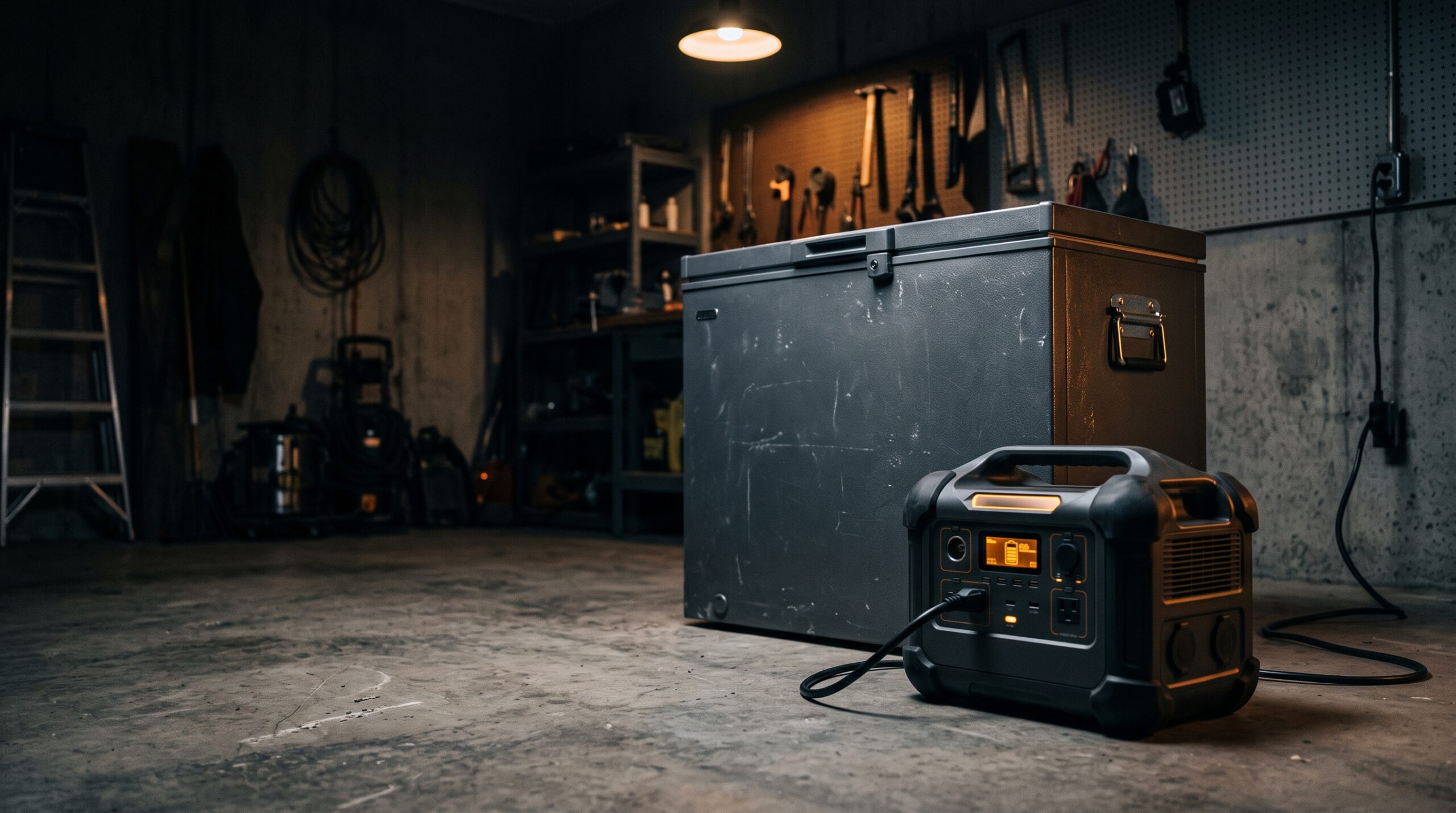
For most home freezers, a power station with at least 1,000 starting watts and 1,000–1,500 watt-hours of capacity will keep things frozen for about 24 hours. The running draw is small (a chest freezer pulls roughly 40–100 watts, an upright closer to 100–150), but two numbers actually decide your size: the startup surge when the compressor kicks on, and the total watt-hours you’ll burn over a day. This guide shows the math and gives you a table to size from.
The two numbers that matter: surge watts and watt-hours
Sizing a power station for a freezer comes down to two separate requirements, and a unit can pass one while failing the other.
- Watts (surge and continuous): The inverter has to survive the moment the compressor starts. That startup surge runs about 2–3 times the running watts, so a freezer that hums along at 100 watts can spike to 600–1,200 watts for a fraction of a second. If the inverter can’t supply that, it trips and the freezer never starts.
- Watt-hours (capacity): This is the fuel tank. It decides how many hours the freezer keeps running. A freezer doesn’t draw power the whole time, which is the part most people get wrong.
The watt rating is the easy hurdle. Almost any power station with a 1,000-watt or larger inverter clears the surge of a typical residential freezer. If you want the full explanation of why those two figures differ, see running watts vs. starting watts.
Why the compressor only runs part of the time
A freezer’s compressor cycles. It runs until the interior hits the set temperature, shuts off, and waits until the box warms slightly before kicking on again. Over a full day it’s actually running somewhere around 30–50% of the time. That fraction is the duty cycle, and it’s the single biggest reason a freezer needs far fewer watt-hours than its nameplate suggests.
Duty cycle isn’t fixed. A well-sealed chest freezer in a cool basement might cycle only 30–35% of the time. The same freezer in a hot garage in August, or one you open often, can run 60–70% of the time. Ambient heat, how full it is, and how often the lid opens all push that number up. For sizing, plan around a realistic value for your conditions rather than a best case. More on the underlying draw is in how many watts a freezer uses.
The daily watt-hour math
Here’s the formula that turns a nameplate wattage into a real daily energy figure:
Running watts × 24 hours × duty cycle = watt-hours per day
Take a chest freezer that draws 80 watts while running, at a 40% duty cycle:
- 80 W × 24 h × 0.40 = 768 watt-hours per day
That’s why a freezer with a tiny running wattage still wants a four-figure battery for a full day. Now do an upright that runs at 130 watts on the same 40% duty cycle:
- 130 W × 24 h × 0.40 = 1,248 watt-hours per day
One more reality check. Power stations lose roughly 10–15% to inverter inefficiency, so add a margin on top of the raw figure. A 768 Wh need is really closer to 880 Wh of usable battery. The runtime tables in the next section already build that cushion in. You can run your own appliance numbers with the runtime calculator or work backward from a target with the sizing calculator.
Freezer sizing table
Estimates below assume a 40% duty cycle and include an efficiency margin. Heavy lid use, a hot room, or a fuller-than-usual box will push the daily figure higher, so size up if your conditions are rough.
| Freezer type | Running watts | Est. surge watts | Est. daily Wh (40% duty) | ~12-hour station | ~24-hour station |
|---|---|---|---|---|---|
| Compact chest (5–7 cu ft) | 40–60 W | 300–600 W | ~400–550 Wh | 500–600 Wh | 768 Wh–1,000 Wh |
| Mid chest (10–15 cu ft) | 70–100 W | 500–900 W | ~700–950 Wh | 500–800 Wh | 1,000–1,500 Wh |
| Upright (14–18 cu ft) | 100–150 W | 600–1,200 W | ~1,150–1,400 Wh | 700–1,000 Wh | 1,500–2,000 Wh |
| Large/garage upright (20+ cu ft) | 140–200 W | 800–1,500 W | ~1,350–1,900 Wh | 1,000 Wh | 2,000 Wh+ |
Two takeaways. First, almost every row clears the surge with a 1,000-watt inverter, except the largest garage uprights, which want 1,500 watts or more of surge headroom. Second, the gap between the 12-hour and 24-hour columns is just battery size, so if you expect outages longer than a day, buy a station you can recharge from solar or a wall outlet rather than chasing a giant battery alone. A fridge runs on similar logic if you’re sizing both; see what size power station to run a refrigerator.
Keep the lid closed and you’ll need far less
The cheapest watt-hour is the one you never spend. Every time the lid opens, warm air rushes in and the compressor runs longer to recover, which drives the duty cycle up. A freezer that’s kept shut and stays packed full holds cold far better than a half-empty one, because the frozen mass acts like a thermal battery.
This matters for outage planning beyond just battery sizing. According to USDA FSIS, a full freezer holds a safe temperature for about 48 hours if you keep the door closed, or about 24 hours if it’s half full. That buys you a lot of room. In many short outages you don’t need to power the freezer at all for the first day or two, as long as you resist opening it. We cover the timing in detail in how long a freezer lasts without power.
A practical approach: keep an appliance thermometer in the freezer, leave it shut, and only connect the power station once the inside temperature starts climbing toward 0°F. That stretches a modest battery across a much longer outage.
Food safety still sets the real deadline
Battery runtime and food safety are different clocks, and the food clock wins. USDA FSIS guidance is that frozen food can be safely refrozen if it still contains ice crystals or is at 40°F (4°C) or below. If items have thawed and sat above 40°F for more than two hours, throw them out, even if they look fine.
So the goal of the power station isn’t just to keep the freezer humming. It’s to keep contents at or below that safe threshold until power returns. Pair the battery math here with the food-safety timeline, and when in doubt, follow the FSIS rule rather than guessing.
Battery chemistry matters for repeated use
If you’ll lean on the station during multi-day outages or seasonal blackouts year after year, the battery chemistry matters. LiFePO4 (lithium iron phosphate) cells are rated for roughly 3,000–4,000+ charge cycles before dropping to 80% capacity, compared with about 500–1,000 for older NMC lithium-ion. Cycled daily, that’s the difference between a station that lasts a couple of years and one that lasts a decade. LiFePO4 also tolerates heat better, which is relevant if the unit sits in a garage next to the freezer.
For a freezer that you may need to power repeatedly, LiFePO4 is the better long-run value despite the higher sticker price. The trade-offs are laid out in LiFePO4 vs. lithium-ion power stations.
The 1,000Wh and 2,000Wh classes, live prices



As an Amazon Associate we earn from qualifying purchases. Prices are pulled automatically from Amazon and may have changed.
Frequently asked questions
Will a 1,000Wh power station run a freezer for 24 hours?
For a compact or mid-size chest freezer, usually yes. At a 40% duty cycle those draw roughly 550–950 Wh per day, which fits inside 1,000 Wh with a little margin. A large upright running closer to 1,200–1,400 Wh per day would need a bigger battery or a recharge partway through.
Can a small power station handle the startup surge?
Most freezers surge to 600–1,200 watts for a split second when the compressor starts, so a power station with a 1,000-watt or larger inverter handles a typical chest or upright freezer. Very large garage uprights can spike higher and want 1,500 watts of surge headroom or more.
Do I need a pure sine wave inverter for a freezer?
A pure sine wave output is the safe choice for any appliance with a compressor motor. Modified sine wave can make motors run hot or buzz, and most modern power stations are pure sine wave anyway. See pure sine wave vs. modified sine wave if you’re unsure what yours puts out.
Is it cheaper to just leave the freezer off and keep it closed?
For short outages, often yes. A full, unopened freezer holds a safe temperature for about 48 hours per USDA FSIS, so you may not need to power it at all on day one. Save the battery for when the internal temperature actually starts to climb.
How do I size a station if I also want to run other things?
Add up the daily watt-hours of each device and check that the inverter can supply their combined surge if they might start at once. The sizing calculator handles the addition for you across a freezer, fridge, lights, and phone charging.