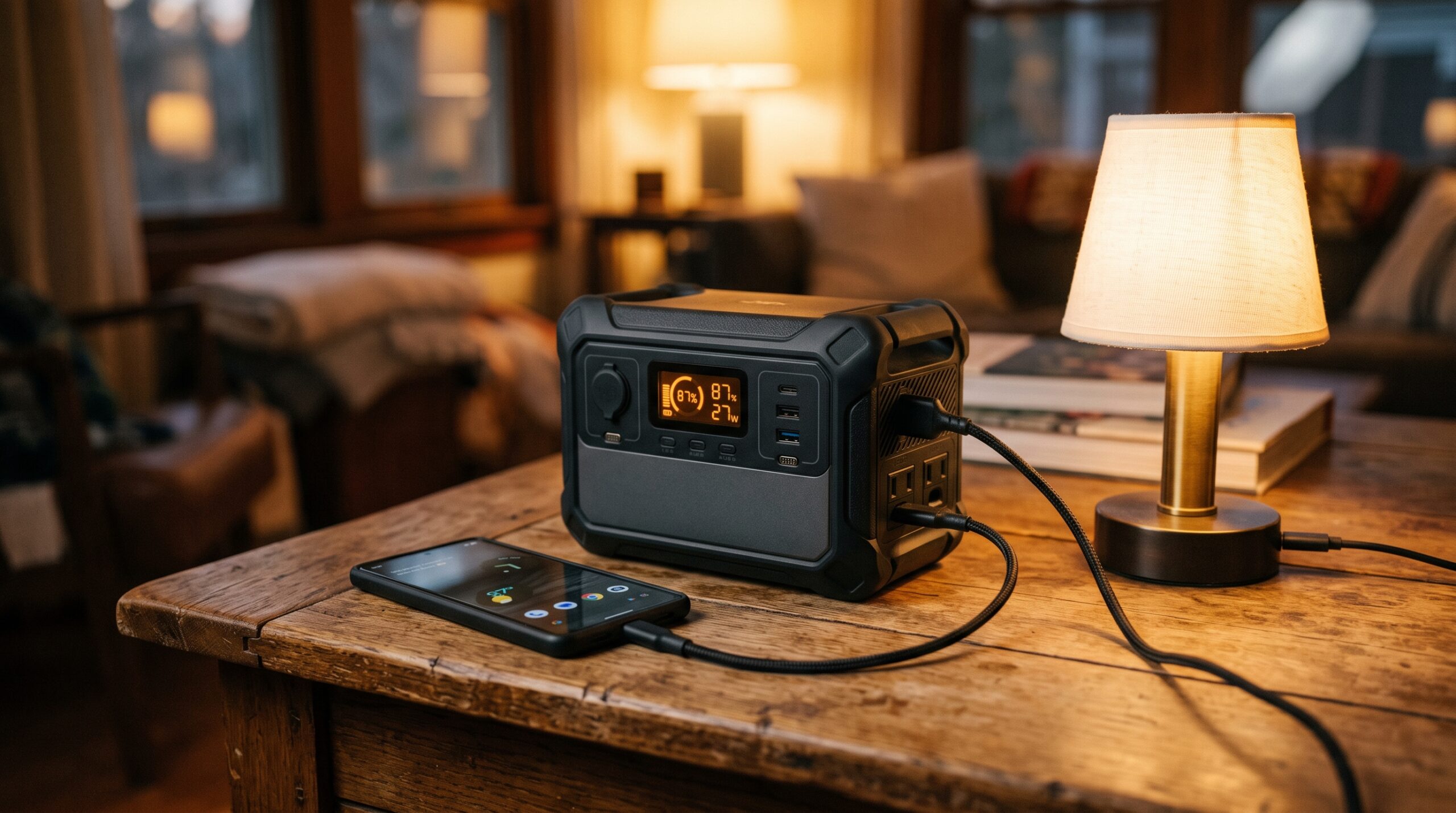
For under $500 you can realistically buy a power station with roughly 250 to 800 watt-hours of storage and about 300 to 1,000 watts of continuous output. That is enough to keep phones, laptops, a router, a CPAP, lights, and short fridge cycles running through an outage, but not enough to run a furnace, a well pump, a space heater, or central AC. This guide covers what that budget actually buys, what to prioritize, and a few popular current models worth a look.
What under $500 actually buys you
Price tracks capacity and output closely, so a budget tells you roughly what size you are shopping for. In the under-$500 range you are usually choosing between two tiers.
- Compact units (about 250 to 300Wh, 300W output): light, easy to carry, and often $180 to $300. Good for charging small electronics and running low-draw gear for a long time.
- Mid-size units (about 500 to 1,000Wh, 600 to 1,500W output): heavier and usually $300 to $500, sometimes a little more outside of sales. These can briefly run a coffee maker, a microwave, or a small fridge, and they hold more reserve overnight.
Capacity (watt-hours) tells you how long it runs something. Output (watts) tells you whether it can run that thing at all. A budget unit can have plenty of one and not enough of the other, so check both before you buy. If you are unsure how big you need, the runtime calculator lets you enter a device and a battery size and see the rough hours.
What to prioritize on a tight budget
You cannot have everything at this price, so spend on the things that matter for an outage and skip the extras.
- LiFePO4 battery if you can get it. Lithium iron phosphate cells are rated for several thousand charge cycles and hold up better over years than the older NMC lithium-ion used in some cheaper units. Most current sub-$500 models from EcoFlow, Anker, and Bluetti use LiFePO4, and several Jackery “Plus” models do too. The trade-offs are explained in our LiFePO4 vs lithium-ion guide.
- Enough surge for your devices. Motors and heating elements draw a spike when they start. A fridge compressor or a coffee maker can pull two to three times its running watts for a moment. Look at the surge or peak rating, not just continuous output. Some units add a feature (EcoFlow calls it X-Boost) that lets a smaller inverter start higher-watt resistive loads.
- USB-C Power Delivery. A 100W or higher USB-C PD port charges most laptops directly without the AC inverter running, which wastes less energy and is quieter.
- A real pure sine wave AC outlet. Pure sine wave output is safer for sensitive electronics and medical devices like a CPAP. Most name-brand units now ship pure sine wave; confirm it before buying an off-brand bargain.
Things you can usually skip to save money: very fast charging, app control, and high solar input. They are nice, but they are not what keeps your phone alive during an outage. If you only need to top up phones and a tablet, a large power bank may be all you need; see power bank vs power station.
Strong sub-$500 options right now
These are popular, widely available models with published specs, listed as solid choices rather than a ranked or tested winner. Street prices move a lot with sales, so treat the prices below as approximate ranges, not quotes. Always confirm current capacity, output, and price on the manufacturer’s page before you buy.
| Model (class) | Capacity | Continuous / surge output | Battery type | Approx. price |
|---|---|---|---|---|
| EcoFlow River 3 (compact) | ~245Wh | ~300W / 600W X-Boost | LiFePO4 | ~$180–230 |
| Anker Solix C300 (compact) | ~288Wh | ~300W | LiFePO4 | ~$200–250 |
| Jackery Explorer 300 Plus (compact) | ~288Wh | ~300W | LiFePO4 | ~$250–300 |
| EcoFlow River 3 Plus (compact+) | ~286Wh | ~600W / 1,200W X-Boost | LiFePO4 | ~$250–300 |
| Jackery Explorer 600 V2 (mid) | ~640Wh | ~800W / ~1,600W | LiFePO4 | ~$300–400 |
| Bluetti Elite 100 V2 (mid) | ~1,024Wh | ~1,800W | LiFePO4 | ~$500, often discounted lower |
The pattern is consistent across brands: the small 300Wh units are cheapest and most portable, while spending toward the top of the budget gets you closer to 1,000Wh and a 1,500W-plus inverter that can briefly handle kitchen appliances. If your main goal is keeping a fridge and a few essentials going at home, read our home backup picks for the larger end of this range.
What budget power stations can and can’t run
This is where most disappointment comes from. A sub-$500 unit is genuinely useful, but only for the right loads.
- Handles well: phones and tablets (dozens of recharges), a laptop, a Wi-Fi router and modem, LED lights, a CPAP for one or more nights, a fan, and short bursts on a small fridge or a microwave on the bigger units.
- Marginal: a full-size refrigerator overnight (possible on a 1,000Wh unit for several hours, but it eats the battery fast), a coffee maker or kettle (brief use only), and power tools (depends on surge).
- Won’t do: a gas or electric furnace, central air conditioning, a well pump, a sump pump under heavy load, a space heater, an electric water heater, or any all-night high-draw appliance. These either exceed the output or drain the battery in well under an hour.
The simple rule: budget units are for low and medium-draw electronics and short bursts, not for whole-home heating, cooling, or pumping. For a sense of what the larger inverters can manage, see what a 1,000W power station can run. If your priority is medical equipment, plan the size around real runtime rather than the headline output.
How to buy a budget power station without regret
A short, honest checklist before you spend:
- List your real loads first. Write down the few devices you actually need during an outage and their watts. Size the unit to those, not to a “just in case” list.
- Check output and surge against your biggest device. If your fridge needs 1,200W to start, a 600W unit will not run it, no matter how big the battery is.
- Buy on a sale. These models go on real discounts often. Patience can move you up a size for the same money.
- Prefer a name brand with a warranty. A multi-year warranty and a real support channel matter more than a slightly bigger number from an unknown seller.
- Confirm the spec sheet. Capacity and output get rounded up in marketing. Read the manufacturer’s own page before checkout.
We don’t run affiliate links or post live prices here, because both go stale fast and can mislead. Use the model names above as a starting point and verify everything on the seller’s current listing.
Under-$500 picks, live prices

Jackery Explorer 300
292Wh, 300W — the cheapest way into a real power station
$259.00Check price on Amazon →


As an Amazon Associate we earn from qualifying purchases. Prices are pulled automatically from Amazon and may have changed.
Frequently asked questions
What is the best budget power station under $500?
There isn’t one universal winner, because it depends on your loads. For light electronics, a compact 300Wh LiFePO4 unit like the EcoFlow River 3 or Anker Solix C300 is plenty. If you want enough output for a small fridge or a microwave in short bursts, stretch toward a 600 to 1,000Wh unit such as the Jackery Explorer 600 V2 or a discounted Bluetti Elite 100 V2.
Can a power station under $500 run a refrigerator?
A larger budget unit (around 1,000Wh and 1,500W or more) can run a typical fridge for a few hours, as long as its surge rating covers the compressor startup. The small 300Wh units cannot sustain a full-size fridge. Check the fridge’s running and starting watts against the unit’s continuous and surge output.
Is LiFePO4 worth it on a budget unit?
Yes, when you can get it without paying a big premium, and at this point most current name-brand sub-$500 models already use it. LiFePO4 cells last far more charge cycles and tolerate age better than older lithium-ion, so the unit stays useful for years of occasional outages instead of degrading quickly.
Can a budget power station run a CPAP all night?
Usually yes. Most CPAPs draw a modest amount when the humidifier and heated hose are off, so a 300Wh unit can often cover a night and a 500 to 640Wh unit gives comfortable margin. Run it on DC or USB-C if your machine supports it to save energy, and confirm pure sine wave AC output for safety.
How long will a sub-$500 power station last during an outage?
It depends entirely on the load. A 300Wh unit might recharge a phone 15 to 25 times, run a 10W router for a day, or power a CPAP overnight, but it would drain a 60W fridge in around four to five hours. Estimate your own numbers with the runtime calculator before relying on it.