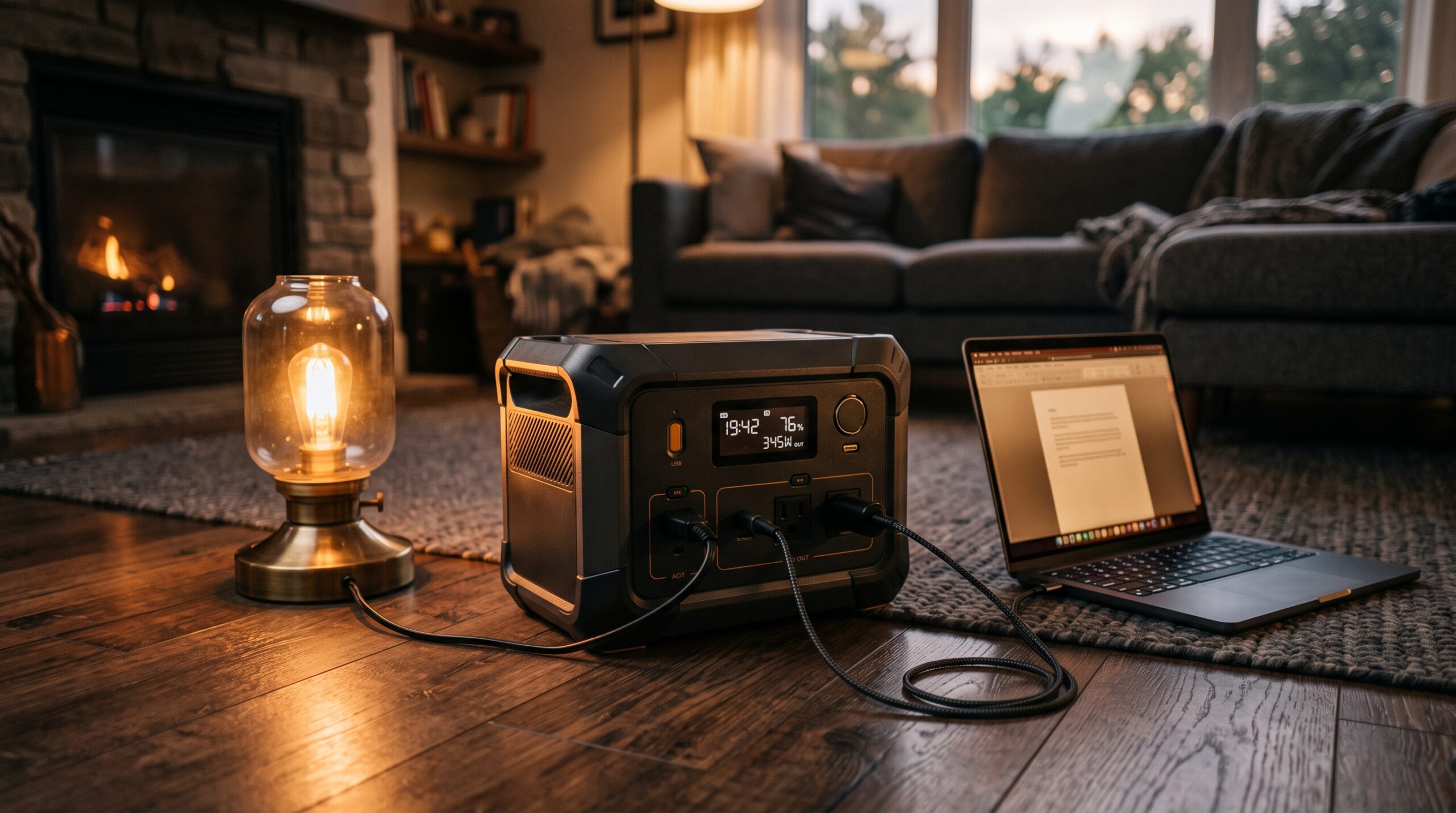
Spend up to $1,000 on a portable power station and you land in a genuinely useful tier: roughly 1,000 to 1,500 watt-hours of capacity, around 1,500 to 2,000 watts of continuous output, and almost always a LiFePO4 battery rated for thousands of charge cycles. That’s enough to keep a refrigerator cold for the better part of a day, run a CPAP through several nights, and keep phones, laptops, lights, and a router going for a long stretch. What it won’t reliably do is run a furnace all night or start a well pump without checking the surge numbers first. This guide covers what the bracket realistically powers and how to pick a model that fits your outage.
What the under-$1,000 bracket actually gets you
At this price, you’re buying the “comfortable weekend outage” class of battery. Most units cluster around 1,000 to 1,500Wh of usable energy and 1,500 to 1,800W of steady AC output, with short surge bursts above that. Nearly all current models use LiFePO4 (lithium iron phosphate) cells, which last far longer than the older lithium-ion packs and tolerate heat better. You also get meaningful solar input, fast wall charging, and a useful spread of ports.
The practical takeaway: this tier handles essentials, not your whole house. It’s the sweet spot for people who want to ride out a multi-hour or overnight outage with their fridge, medical devices, and electronics intact. If you need to run central heating, a well pump, or a window AC for hours, you’re usually looking at a bigger battery or a generator instead of a power station.
What it realistically runs
Two numbers decide what you can power. Watts (the output rating) sets what you can turn on at once. Watt-hours (the capacity) sets how long it stays on. A 1,500Wh battery has enough stored energy to run a 150W refrigerator for roughly 8 to 10 hours of real-world cycling, but only a few minutes of a 1,500W space heater. Here’s what a sub-$1,000 station handles comfortably versus where it struggles.
- Refrigerator or freezer: Yes, for many hours. A typical fridge draws 100 to 200W while running and cycles on and off, so a 1,000 to 1,500Wh unit can keep one cold most of a day. See what size power station you need for a fridge.
- CPAP overnight: Yes, usually several nights. A CPAP without the heated humidifier often draws 30 to 60W, so a 1,000Wh-plus battery can cover multiple nights. Check the details in our CPAP power station guide.
- Phones, laptops, lights, router: Yes, for a long time. These low-draw loads barely dent the battery.
- Coffee maker, microwave, toaster: Short bursts only. These pull 1,000 to 1,500W, which most units handle, but they drain capacity fast.
- Power tools and high-wattage gear: Brief use, and watch the surge. A circular saw or shop vac can spike well past its running watts at startup.
- Furnace, well pump, window AC, space heater: This is where the bracket hits its limits. A furnace blower or well pump has a large startup surge, and a space heater runs flat-out near the inverter’s ceiling. Confirm both the running and starting watts before counting on it.
Rather than guess, plug your specific devices and a target capacity into our runtime calculator to see how many hours a given size actually delivers for your loads.
How to choose in this bracket
Once you’re shopping around $1,000, the spec sheet matters more than the brand name. Weigh these six things:
- Capacity vs. output: These are different jobs. Capacity (Wh) decides runtime; output (W) decides what can run at all. A big battery with a weak inverter still won’t start a high-wattage appliance, and a strong inverter with a small battery dies quickly. Match both to your real loads. Our breakdown of 1000Wh vs 2000Wh shows how that trade-off plays out.
- LiFePO4 battery: Strongly prefer it. LiFePO4 typically lasts 3,000 to 4,000-plus cycles versus a few hundred for older lithium-ion, and it’s more stable. Nearly every good model in this tier already uses it. Here’s why LiFePO4 beats lithium-ion.
- Surge headroom: Look for a peak (surge) rating well above the continuous rating. Motors and compressors in fridges, pumps, and tools draw a big spike at startup. A 1,800W unit with a 3,600W surge handles those jumps far better than one with little overhead.
- Solar input: If outages in your area run long, solar matters. Most of this tier accepts 400 to 500W of solar, enough to add real capacity back during a sunny day. Pair it with portable solar panels sized to the input.
- Ports: Count the AC outlets, USB-C (ideally 100W), USB-A, and a 12V car port. More relevant: does it have the outlet types your gear actually needs.
- Expandability: Some models accept add-on battery packs later. If you think your needs will grow, an expandable unit saves you from rebuying the whole system.
If you want the full framework, our how to choose a power station guide walks through every spec line by line.
Strong options under $1,000 right now
These are genuinely popular, widely reviewed models that currently sit at or under $1,000 (often well under, when discounted). This isn’t a tested ranking, just a survey of solid choices and their published specs so you can compare. Prices move constantly, so treat the figures below as ballpark.
| Model | Capacity | Output / surge | Battery | Solar input | Approx. price |
|---|---|---|---|---|---|
| Anker SOLIX C1000 | 1,056Wh | 1,800W / 2,400W | LiFePO4 | Up to 600W | ~$700–$999 |
| EcoFlow Delta 2 | 1,024Wh (expandable) | 1,800W / 2,700W | LiFePO4 | Up to 500W | ~$600–$899 |
| Jackery Explorer 1000 v2 | 1,070Wh | 1,500W / 3,000W | LiFePO4 | Up to ~400W | ~$550–$799 |
| Bluetti AC180 | 1,152Wh | 1,800W / 2,700W | LiFePO4 | Up to 500W | ~$500–$699 |
| EcoFlow Delta 2 Max | 2,048Wh (expandable) | 2,400W / 4,800W | LiFePO4 | Up to 1,000W | ~$849–$999 (on sale) |
A few notes. The Anker SOLIX C1000 and EcoFlow Delta 2 are the most common “first power station” picks here, with strong output, fast wall charging, and expansion options. The Jackery Explorer 1000 v2 is lighter and leans toward camping and RV use, with a high surge rating relative to its 1,500W continuous output. The Bluetti AC180 is often the cheapest of the group while still delivering 1,800W. The EcoFlow Delta 2 Max is the outlier: it normally lists higher but regularly discounts under $1,000, and it brings roughly double the capacity if you can catch the sale. If you want a head-to-head on the big three brands, see our Jackery vs EcoFlow vs Bluetti comparison.
Setting honest expectations
A sub-$1,000 station is backup for essentials, not a whole-home generator. It will keep your fridge, medical gear, and electronics running through a typical outage, and with solar it can stretch over multiple days. It will not run central HVAC, a well pump, or an electric range for hours, and it can’t be hardwired into your home’s circuits the way a standby generator can. If your goal is true whole-house coverage during long outages, weigh a power station against a home battery backup or a generator instead.
Spending less? Our best budget power station under $500 guide covers the smaller tier, which still covers phones, lights, and a CPAP, just with less runtime to spare. And before you buy at any price, run your real device list through the runtime calculator so you size up, not down.
How to buy
The smart move is to size first, then shop. Total up the running watts of everything you need on at the same time, add surge headroom for anything with a motor or compressor, and pick a capacity that covers your expected outage length with margin. Then watch for sales: power stations from major brands discount heavily and often, so a model that lists at $999 may sell for $700 during a holiday event. Buy from the manufacturer or a reputable retailer with a clear warranty (most are three to five years), and confirm the battery is LiFePO4. We don’t link to stores or post live prices here, because both change too fast to trust. Decide on the specs you need first, and the right deal becomes obvious when it appears.
Under-$1,000 picks, live prices


Jackery Explorer 1000 v2
1,070Wh, 1,500W — light and simple for outages
$499.00Check price on Amazon →

Jackery Explorer 2000 v2
2,042Wh, 2,200W — big capacity, not expandable
$899.00Check price on Amazon →
As an Amazon Associate we earn from qualifying purchases. Prices are pulled automatically from Amazon and may have changed.
Frequently asked questions
Can a power station under $1,000 run a refrigerator?
Yes. A typical home refrigerator draws 100 to 200W while the compressor runs and cycles on and off, so a 1,000 to 1,500Wh unit in this tier can usually keep one cold for most of a day, sometimes longer. The startup surge is brief, and these units have enough headroom to absorb it. Use the runtime calculator with your fridge’s wattage for a closer estimate.
Will it power a furnace or well pump?
Maybe, but check the surge first. A gas furnace’s blower motor and a well pump both spike well above their running watts at startup, and that spike can exceed a 1,500 to 1,800W inverter’s limit. Some larger units in this bracket can start a small furnace blower, but running either for hours will drain the battery quickly. Confirm both the running and starting watts of your specific equipment before relying on it.
Is LiFePO4 worth it in this price range?
Yes, and you barely have to look for it. Almost every good model under $1,000 already uses LiFePO4, which lasts roughly 3,000 to 4,000-plus charge cycles versus a few hundred for older lithium-ion, and handles heat more safely. If you find a cheap unit that still uses standard lithium-ion, that’s a reason to keep looking, not a bargain.
How long will it run my devices?
It depends on the load. Divide the battery’s watt-hours by your device’s watts for a rough hours figure, then knock off 10 to 15 percent for inverter losses. A 1,500Wh unit runs a 50W CPAP for many hours but a 1,200W microwave for only about an hour of continuous use. The runtime calculator does this math for your exact gear.
Should I spend more than $1,000?
Only if your loads demand it. The under-$1,000 tier covers essentials well. If you need to run a whole house, central AC, or high-draw appliances for long stretches, a larger battery, an expandable system, or a generator is the better fit. Match the purchase to what you actually need to keep on, not to the biggest number you can afford.