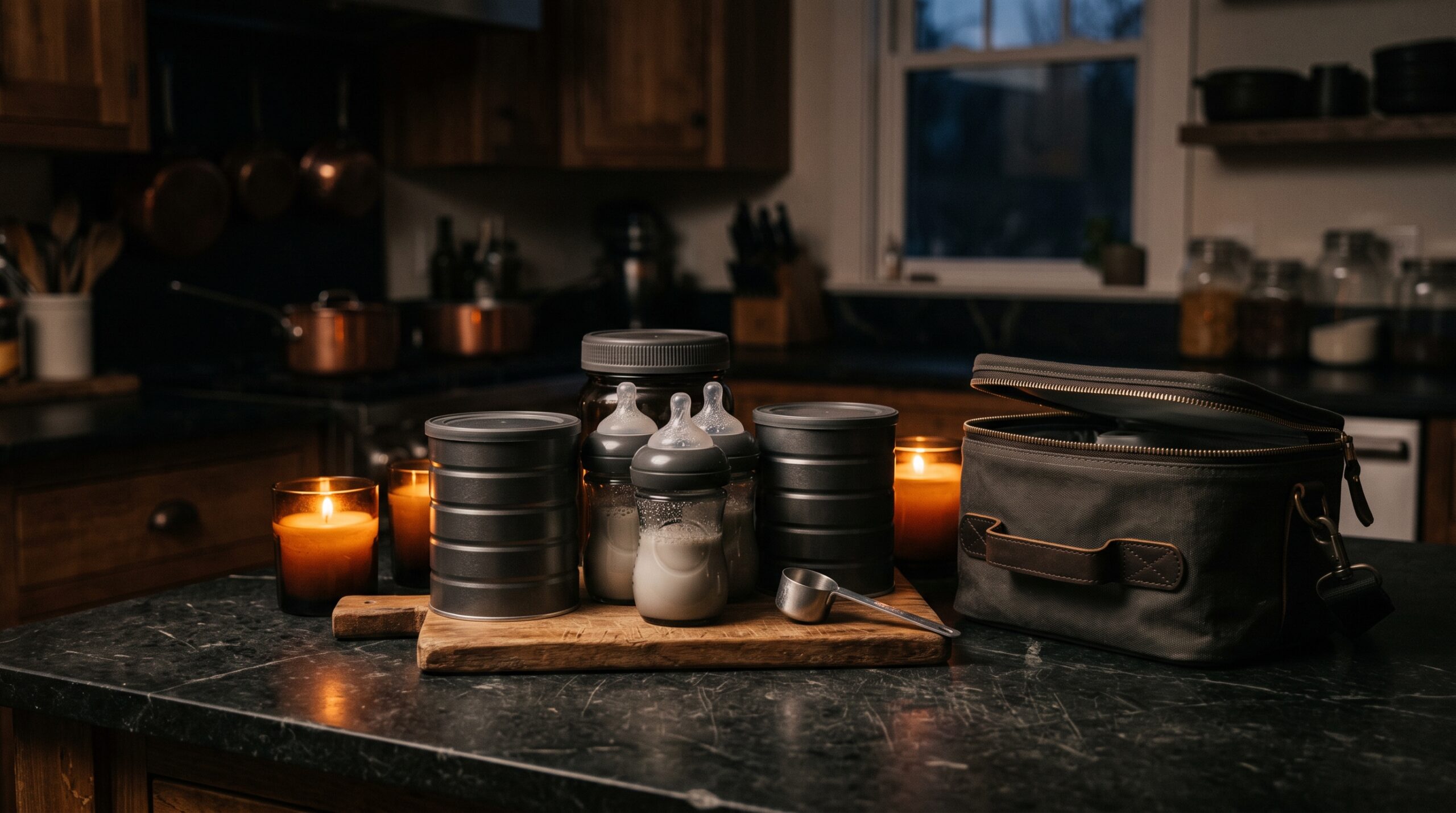
If the power goes out while you have a formula-fed baby, the safest choice is ready-to-feed formula, because it is sterile and needs no mixing with water. If you only have powdered formula, you need safe water (bottled or properly treated) to prepare it. And keep the clock in mind: the CDC says prepared formula left at room temperature should be used within 2 hours, and within 1 hour once your baby starts feeding. This article is general information, not medical advice. Always follow your pediatrician and the CDC.
Reach for ready-to-feed formula first
During an outage, ready-to-feed (RTF) formula is the safest option the CDC recommends. It comes sterile in single-serving cans or bottles, so you do not have to mix it with water that may no longer be safe. Unopened RTF formula is shelf-stable and does not need refrigeration until you open it, which matters when the fridge is off.
The CDC notes this is especially important if your baby is younger than 2 months, was born prematurely, or has a weakened immune system. For those babies, RTF formula is the preferred choice in any emergency. Do not add water to ready-to-feed formula; it is already at the correct strength, and diluting it can be harmful. For more on caring for an infant when the lights are out, see our guide on a power outage with a baby.
If you must mix powdered formula, use safe water
An outage can come with a boil-water advisory or other water problems, so tap water may not be safe for mixing. The CDC’s guidance is to use bottled water to prepare powdered or concentrated formula until local authorities confirm the tap water is safe again.
If bottled water is not available, the CDC and AAP say to boil water to make it safe: bring it to a rolling boil for 1 minute, then let it cool before mixing. For young, premature, or immune-compromised infants, pediatric guidance is to use boiled water and let it cool before preparing the bottle. If you are unsure whether your water is safe, follow CDC guidance and your pediatrician rather than guessing. Our walkthrough on how to purify water during an emergency covers boiling and other approved methods in more detail.
Formula time and temperature limits (per CDC)
These limits do not change during an outage. They are the same numbers the CDC publishes for everyday formula feeding, and they exist because formula plus your baby’s saliva lets bacteria grow. When in doubt, throw it out.
| Formula state | Safe time / temperature limit |
|---|---|
| Unopened ready-to-feed (sealed) | Shelf-stable until the date on the label; no fridge needed until opened |
| Freshly prepared formula, sitting at room temperature | Use within 2 hours of preparation |
| Prepared formula, once feeding begins | Use within 1 hour from the start of feeding; discard what is left in the bottle |
| Prepared formula, refrigerated at 40°F (4°C) or below | Use within 24 hours |
| Opened container of ready-to-feed, covered and refrigerated | Discard after 48 hours if not used (AAP) |
| A bottle you have warmed | Use promptly (about 1 hour); do not put it back in the fridge to reheat later |
A few rules that are easy to forget under stress: throw out any formula left in the bottle after a feeding rather than saving it, and never refreeze or re-refrigerate formula your baby has already started. If you are not going to use freshly prepared formula within 2 hours and the fridge is still cold, store it right away and use it within 24 hours.
Keeping prepared formula and open containers cold
An unopened fridge keeps food cold for about 4 hours after the power goes out, according to FoodSafety.gov, so keep the door shut as much as you can. If the outage looks like it will run longer, move refrigerated formula and any opened container into a cooler with ice or frozen gel packs and aim to hold it at 40°F (4°C) or below. A simple appliance thermometer in the cooler takes the guesswork out.
- Keep the fridge and freezer doors closed to stretch the cold as long as possible.
- Have a cooler, ice, and frozen gel packs ready before storm season, not during the outage.
- Check the temperature with a thermometer; formula stored above 40°F for the limits above should be discarded.
- If you cannot keep prepared formula cold, switch to unopened ready-to-feed for the duration.
The same cooler strategy applies to the rest of your fridge. Our guides on how to keep food cold without power and whether food is safe after a power outage go deeper on the 4-hour rule and the 40°F line.
Warming a bottle without electricity
Babies do not need warm formula; room-temperature or cool formula is fine. If you do warm a bottle, the CDC says never use a microwave, because microwaves create hot spots that can burn your baby’s mouth. That warning applies whether or not the power is on.
To warm a bottle without a microwave, place the closed bottle in a bowl of warm (not boiling) water for a few minutes, or hold it under warm running water if you have it. Before feeding, shake the bottle and test a few drops on the inside of your wrist; it should feel warm, not hot. Use a warmed bottle promptly and do not return it to the fridge to reheat later.
Build a small formula emergency kit
The simplest way to feed safely through an outage is to plan before one happens. Ready.gov recommends keeping a supply of food and water for emergencies, and for formula-fed babies that means a small, dedicated kit.
- Single-serving ready-to-feed formula in cans or bottles (enough for several days).
- Sealed bottled water for mixing powdered formula if needed.
- Clean bottles and nipples, plus a way to clean and sanitize them.
- A cooler with ice or frozen gel packs and an appliance thermometer.
- A manual can or bottle opener and any feeding supplies your baby uses.
Fold these items into your broader power outage emergency kit checklist so they are ready before the next storm. Rotate the formula and bottled water so nothing passes its date.
Frequently asked questions
How long can prepared formula sit out during an outage?
The CDC says to use prepared formula within 2 hours of preparation if it sits at room temperature, and within 1 hour once your baby starts feeding. After that, throw it out. These limits are the same with or without power.
Can I use tap water to mix formula if the power is out?
Only if your local authorities have not flagged the water as unsafe. The CDC advises using bottled water during an emergency, or boiling water for 1 minute and letting it cool if bottled water is not available. If you are unsure, follow CDC guidance and your pediatrician.
Is refrigerated formula still safe after the power comes back?
Prepared formula is good for up to 24 hours if it stayed at 40°F (4°C) or below. A closed fridge holds that temperature for about 4 hours, per FoodSafety.gov. If the outage ran longer and you did not keep the formula cold in a cooler, discard it. When in doubt, throw it out.
Can I warm a bottle on a gas stove or grill instead of a microwave?
You do not need to heat formula at all. If you want to take the chill off, the CDC’s method is to set the closed bottle in a bowl of warm water for a few minutes, which you can prepare on a stove. Never warm formula in a microwave, and always test the temperature on your wrist before feeding.
Should I stock powdered or ready-to-feed formula for emergencies?
Ready-to-feed is the safest for an outage because it is sterile and needs no water. Powdered formula is fine to keep too, but it depends on safe water for mixing. The CDC suggests keeping ready-to-feed on hand in case the water is unsafe, especially for babies under 2 months, premature, or immune-compromised. Talk to your pediatrician about what fits your baby.
Sources
- CDC — Infant Formula Preparation and Storage
- CDC — Prepare and Store Powdered Infant Formula in an Emergency
- American Academy of Pediatrics (HealthyChildren.org) — How to Safely Prepare Formula With Water
- FoodSafety.gov — Food Safety During a Power Outage
- Ready.gov — Food
This article is general information, not medical advice. Time and temperature limits follow CDC, AAP, and FoodSafety.gov guidance, but your situation may differ. For decisions about feeding your baby, follow your pediatrician and the CDC.