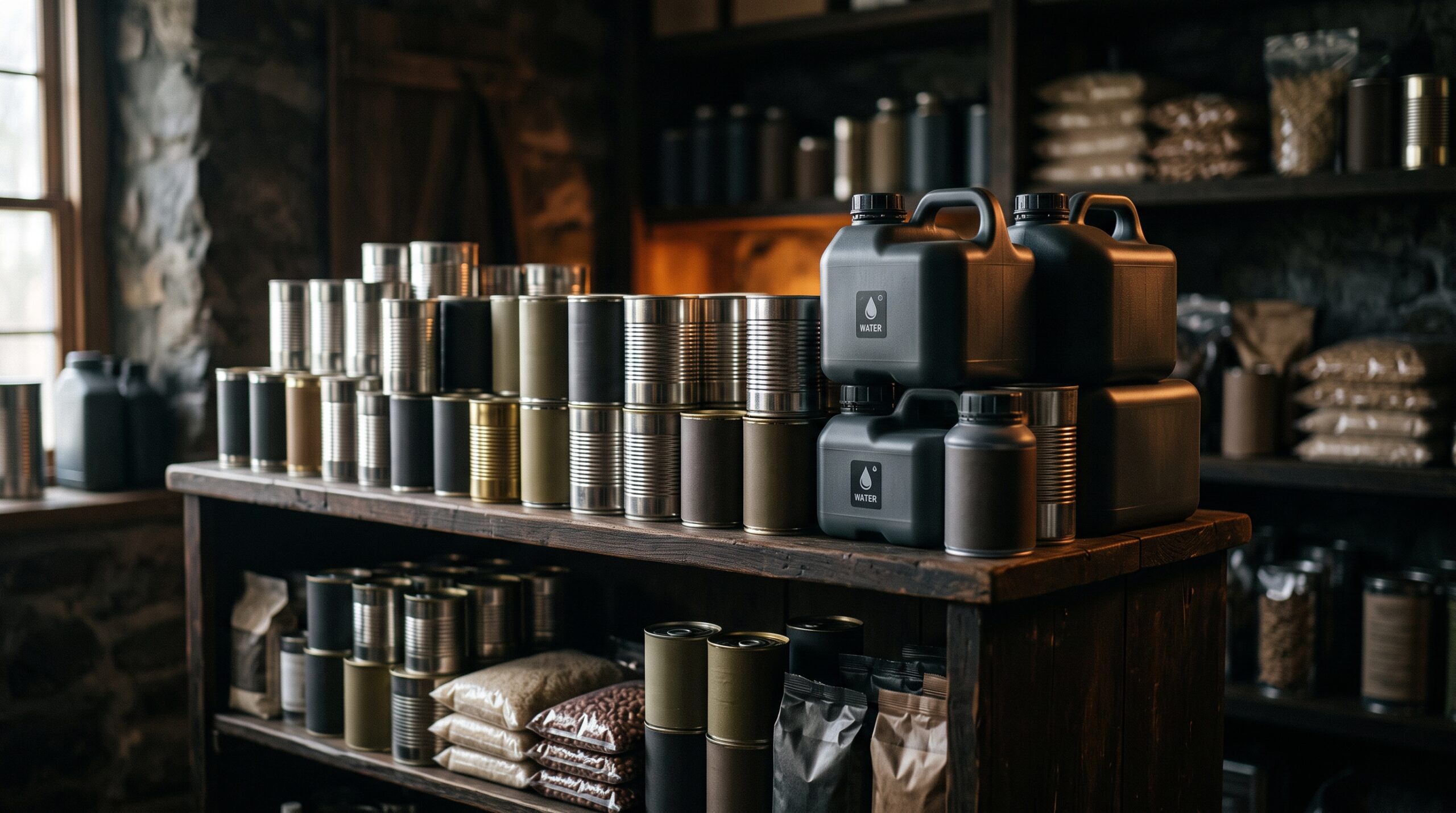
The official starting point is simple: keep at least a three-day supply of non-perishable food for an evacuation, and aim for a two-week supply at home if you can. Plan on roughly 2,000 calories per person per day for food, and store one gallon of water per person per day for drinking and sanitation. Once you fix those three numbers, the rest is just multiplication, and this guide turns it into a concrete shopping list for a one-, two-, or four-person household.
The official baselines: three days minimum, two weeks ideal
Federal and Red Cross guidance gives you two targets, not one. The minimum is a three-day (72-hour) supply of food and water per person, sized so you can grab it and go during an evacuation. The better goal for sheltering in place is a two-week supply, since real outages from hurricanes, ice storms, and grid failures can keep stores closed and roads impassable for days at a time.
- Food: Ready.gov says to store “at least a several-day supply of non-perishable food,” and most agencies treat three days as the floor and two weeks as the practical goal.
- Calories: A common preparedness planning figure is about 2,000 calories per person per day. Children, older adults, and less active people often need less; active adults and nursing parents need more.
- Water: One gallon per person per day covers drinking plus basic sanitation. Hot weather, illness, pregnancy, and young children push that number up.
If you only do one thing this week, build the three-day kit first. It is cheap, it fits in a tote, and it doubles as your grab-and-go bag. You can find the full kit list in our power outage emergency kit checklist, and the water side is covered in depth in how much water to store for a power outage.
The simple math: people times days times 2,000 calories
You do not need a spreadsheet. Multiply the number of people by the number of days, then multiply by 2,000 calories. That gives you a total calorie target, which is a more honest measure than “number of cans,” because a can of green beans (about 120 calories) and a jar of peanut butter (about 3,000 calories) are not interchangeable.
- One person, three days: 1 × 3 × 2,000 = 6,000 calories
- One person, two weeks: 1 × 14 × 2,000 = 28,000 calories
- Four people, two weeks: 4 × 14 × 2,000 = 112,000 calories
To translate calories into items, a useful rule of thumb is that an average shelf-stable item delivers roughly 250 calories, so you need about eight items per person per day. That is only an estimate. Calorie-dense staples like peanut butter, canned meat, nuts, and oats let you hit the target with far fewer items, while low-calorie canned vegetables take many more.
How much food and water by household size
The table below applies the 2,000-calorie and one-gallon baselines to common household sizes at both the three-day and two-week targets. Item counts are approximate and assume a mixed pantry averaging about 250 calories per item; adjust down if you lean on calorie-dense foods.
| Household | Duration | Total calories | Approx. food items | Water (gallons) |
|---|---|---|---|---|
| 1 person | 3 days | 6,000 | ~24 | 3 |
| 1 person | 2 weeks | 28,000 | ~110 | 14 |
| 2 people | 3 days | 12,000 | ~48 | 6 |
| 2 people | 2 weeks | 56,000 | ~225 | 28 |
| 4 people | 3 days | 24,000 | ~96 | 12 |
| 4 people | 2 weeks | 112,000 | ~450 | 56 |
A four-person, two-week supply is a real grocery haul, so do not expect to buy it in one trip. The point of the table is to set a clear finish line, not to spend it all at once. For ideas on what actually goes in the cart, see our list of the best non-perishable foods for a power outage and these no-cook meals for a power outage that need no stove or fridge.
Build your stockpile affordably over time
The cheapest way to a two-week supply is to buy a little extra each grocery trip rather than one large order. This spreads the cost, lets you buy on sale, and keeps everything within normal expiration windows because you are eating and replacing as you go.
- Buy two, store one. Each time you buy a staple you already use, grab a second and set it aside. Your stockpile grows from foods you know your family eats.
- Anchor on calorie-dense, low-cost items. Peanut butter, canned beans, rice, oats, pasta, canned tuna and chicken, shelf-stable milk, and trail mix give you the most calories per dollar and per inch of shelf.
- Add variety and morale food. Crackers, dried fruit, instant coffee, and a few comfort snacks make a stressful week more bearable, especially for kids.
- Do not forget a manual can opener. A pantry of cans is useless without one. Keep a spare in the kit.
If a power outage is your main concern, lean toward foods that need no cooking at all, then keep a camp stove or grill (used outdoors only) as a backup for hot meals.
Rotation, expiration dates, and storage conditions
A stockpile is only as good as its freshness. Use the first-in, first-out method: place new purchases behind older ones so you always reach for the oldest item first. Mark the purchase or use-by date on each item with a marker so you are not squinting at fine print during an emergency.
- Rotate once or twice a year. Ready.gov recommends rotating non-perishable staples on a regular schedule. A spring and fall check works well.
- Store cool, dry, and dark. Keep canned food in a cool, dry place. Heat and light shorten shelf life. Aim for a spot well below 70 degrees if you can, such as an interior closet or basement shelf.
- Protect boxed and bagged food. Move opened or paper-packaged foods into tightly closed plastic or metal containers to keep out pests and moisture.
- Know that “best by” is about quality, not safety. Most canned and dry goods are fine well past the printed date if the package is intact, but rotating keeps quality high and avoids guesswork.
Special needs: infants, medical diets, and pets
The 2,000-calorie baseline is a starting average, not a one-size-fits-all rule. Build your plan around the actual people and animals in your home.
- Infants: Store enough formula, bottles, and clean water to mix it for at least three days, ideally two weeks. If you breastfeed, you still want a backup supply. See our guide to a power outage with a baby for the full list.
- Medical and special diets: Stock food that fits diabetic, low-sodium, gluten-free, allergy, or other restrictions. An emergency is the wrong time to break a diet your health depends on. Keep any refrigerated medicines and a plan to keep them cold.
- Older adults: Choose easy-to-open packaging and softer foods, and account for smaller appetites and any prescribed diets.
- Pets: Add at least three days, ideally two weeks, of pet food and water, plus a manual can opener for canned pet food. Our power outage prep for pets guide has the details.
Frequently asked questions
How many days of food should I actually store?
Start with a three-day (72-hour) supply per person, which is the standard minimum for an evacuation kit. Then work toward a two-week supply at home, which federal and Red Cross guidance treat as the better target for sheltering in place during a long outage.
How many calories per person per day should I plan for?
About 2,000 calories per person per day is the common planning figure. Use it to set your total target, then adjust: active adults and nursing parents need more, while young children and less active people typically need less.
How much water goes with the food?
Store one gallon of water per person per day for drinking and sanitation. That is three gallons per person for the three-day kit and 14 gallons per person for a two-week supply. Increase it for hot climates, illness, pregnancy, and young children.
What food lasts longest without refrigeration?
Canned goods, peanut butter, white rice, dried beans, pasta, oats, honey, and commercially sealed dried fruit and jerky all keep for a year or more in cool, dry storage. Choose foods your family already eats so nothing goes to waste during rotation.
Do I need expensive freeze-dried emergency buckets?
No. They are convenient and store for decades, but a two-week supply of normal grocery staples is far cheaper and works just as well for short outages. Buy buckets only as a top-up once your everyday stockpile is in place.