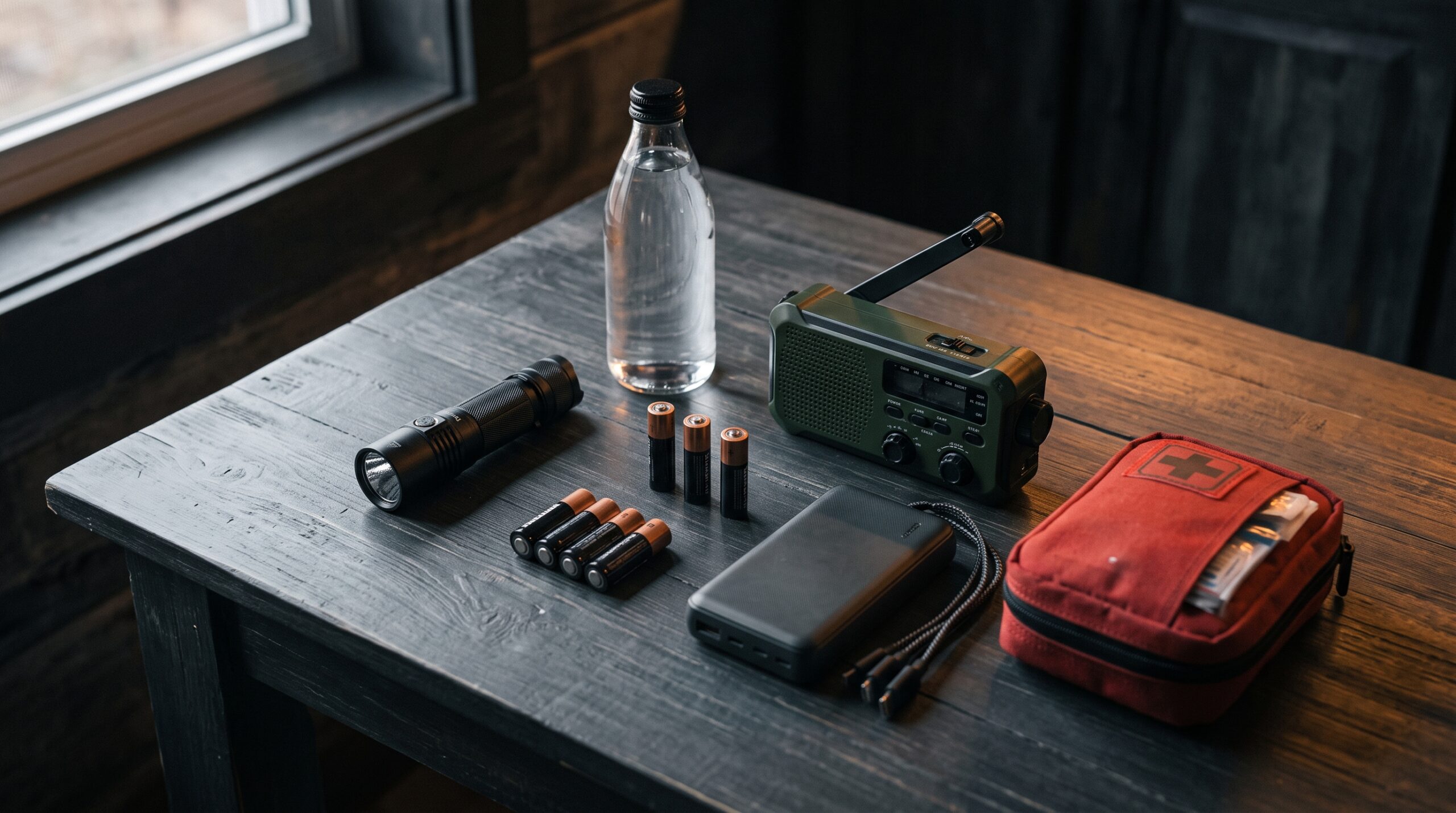
A power outage kit should cover at least three days of water, light, power, food, and information, per Ready.gov.
Three days is the floor, not the goal. If you live where storms or wildfire shutoffs can knock the grid out for a week, build past it. The Red Cross suggests working toward a two-week home supply once the basics are in place.
Water
Store one gallon of water per person per day, with at least a three-day supply for drinking and basic sanitation, per Ready.gov. A household of four needs twelve gallons to clear the three-day bar, and more if anyone is pregnant, sick, or living somewhere hot. Don’t forget pets.
Commercial bottled water is the simplest option, so buy it and rotate by the date on the label. If you fill your own containers, use food-grade ones and replace the water every six months.
Light
Plan for light you can carry and light that frees your hands. A headlamp lets you cook or check the breaker panel without juggling a flashlight, and a couple of LED flashlights plus a battery lantern cover the rest of the house. Keep the matching batteries stored with each light, not scattered in a junk drawer.
Skip the candles. Both Ready.gov and the Red Cross point to flashlights instead, because an open flame in a dark, crowded house is a fire risk you do not need during an outage.
Backup power
This is the part most kits skimp on. A few charged power banks keep phones alive for a day or two, but they will not run a CPAP machine, a sump pump, or a refrigerator. For that you need either a portable power station, which is a large battery in a box that is safe to run indoors, or a fuel generator, which puts out far more power but has to stay outside.
Generators kill people every year through carbon monoxide. The CDC is blunt about it: run a generator outside only, more than 20 feet from the house and away from doors, windows, and vents, and never in a garage even with the door open. Back it up with a battery-powered CO alarm inside the house.
Not sure how big a battery or generator you actually need? Use the Power-Station Sizing calculator to match capacity to the things you want to keep running, and the Appliance Runtime calculator to see how many hours a given battery buys you. They size the backup-power part of your kit so you are not guessing at the store.
Food
Keep at least a three-day supply of non-perishable food that needs no cooking and little or no water: canned goods, peanut butter, dried fruit, energy bars, shelf-stable meals. Add a manual can opener, since an electric one is useless when the power is out.
The bigger food question is what is already in your fridge. FoodSafety.gov says a closed refrigerator holds a safe temperature for about four hours, and a full freezer for about 48 hours, or 24 if it is half full. Keep the doors shut. Throw out any perishable food that has been above 40°F for two hours or more, and when you are not sure, throw it out. Never taste food to decide if it is safe. An appliance thermometer and a cooler packed with ice stretch the safe window.
Warmth and cooling
An outage in January and an outage in July are different emergencies. For cold weather, pack warm blankets or sleeping bags, extra layers, hats, and gloves, and plan to close off and heat one room. For heat, line up shade, battery or hand-powered fans, and extra water, and know where the nearest air-conditioned public building is in case the outage runs long.
Communication and information
When the power is out you still need to know what is happening. A battery-powered or hand-crank radio, ideally a NOAA Weather Radio with a tone alert, delivers official updates with no internet, per Ready.gov. Keep your phone charged, save a backup battery, and write a few key phone numbers on paper in case the phone dies. A whistle lets you signal for help without wearing out your voice.
Health and medications
Pack a first aid kit and a seven-day supply of any prescription medications, and ask your pharmacist what you can keep on hand. If anyone in the house depends on power, such as refrigerated insulin, an oxygen concentrator, or a CPAP, that is a medical priority rather than a convenience: plan backup power for it specifically and ask your utility about a medical-needs registry. Add glasses, hearing-aid batteries, and supplies for infants or pets.
Documents and cash
Keep copies of the records you would hate to lose, including IDs, insurance policies, medical and prescription lists, and bank and contact details, in a waterproof, portable container, plus a digital copy you can reach from your phone. Add some cash in small bills, because card readers and ATMs go down with the grid.
The full checklist
| Item | Why it is in the kit | Notes |
|---|---|---|
| Water, 1 gallon per person per day | Drinking and sanitation | 3-day minimum; build toward 2 weeks at home |
| Non-perishable food, 3-day supply | Eat with no power or cooking | Canned, dried, and shelf-stable items |
| Manual can opener | Open canned food | Electric openers are dead weight in an outage |
| Headlamp and LED flashlights | Hands-free and portable light | Use instead of candles |
| Battery lantern | Light a whole room | Store spare batteries with it |
| Extra batteries | Power radios, lights, and alarms | Match sizes to your devices |
| Portable power station or generator | Run phones, medical gear, or the fridge | Generator outside only, 20+ ft from the house |
| Power banks | Top up phones and small devices | Charge them before storm season |
| Battery-powered CO alarm | Catch carbon monoxide from a generator | Essential if you run any fuel device |
| NOAA weather radio (battery or hand-crank) | Official alerts with no internet | Tone-alert models wake you for warnings |
| Phone, chargers, and backup battery | Stay reachable and informed | Keep a written list of key numbers |
| Whistle | Signal for help | Louder and less tiring than shouting |
| First aid kit | Treat minor injuries | Check and restock once a year |
| 7-day medication supply | Bridge a prolonged outage | Note anything that needs refrigeration |
| Appliance thermometer and cooler with ice | Judge fridge and freezer safety | Above 40°F for 2+ hours means toss it |
| Warm blankets or sleeping bags | Stay warm in a winter outage | Or fans and extra water for summer |
| Hygiene and sanitation supplies | Stay clean without running water | Moist towelettes, garbage bags, plastic ties |
| Important documents, waterproof | Insurance, ID, medical, contacts | Keep a digital backup too |
| Cash in small bills | Buy supplies when cards fail | ATMs and readers need power |
Frequently asked questions
How many days of supplies should a power outage kit cover?
At least three days, which is the minimum Ready.gov recommends for a basic kit. If outages in your area tend to run longer, build toward a two-week home supply as the Red Cross suggests.
How much water do I need for a power outage?
Plan on one gallon per person per day for drinking and sanitation. A household of four needs about twelve gallons to cover three days, and more in hot weather or for anyone who is pregnant or ill.
How long will food last in the fridge and freezer without power?
FoodSafety.gov says a closed refrigerator stays safe for about four hours and a full freezer for about 48 hours, or 24 hours if it is half full. Discard perishable food that has been above 40°F for two hours or more, and when in doubt, throw it out.
Is a generator or a portable power station better for a kit?
It depends on what you need to run. A portable power station is quiet and safe to use indoors but puts out less power; a generator produces much more but must run outside, at least 20 feet from the house, because of carbon monoxide. Use the sizing calculator above to match either one to your appliances.
Can I use candles during a power outage?
No. Ready.gov and the Red Cross both advise using flashlights instead of candles, because an open flame in a dark house is a serious fire risk during an outage.