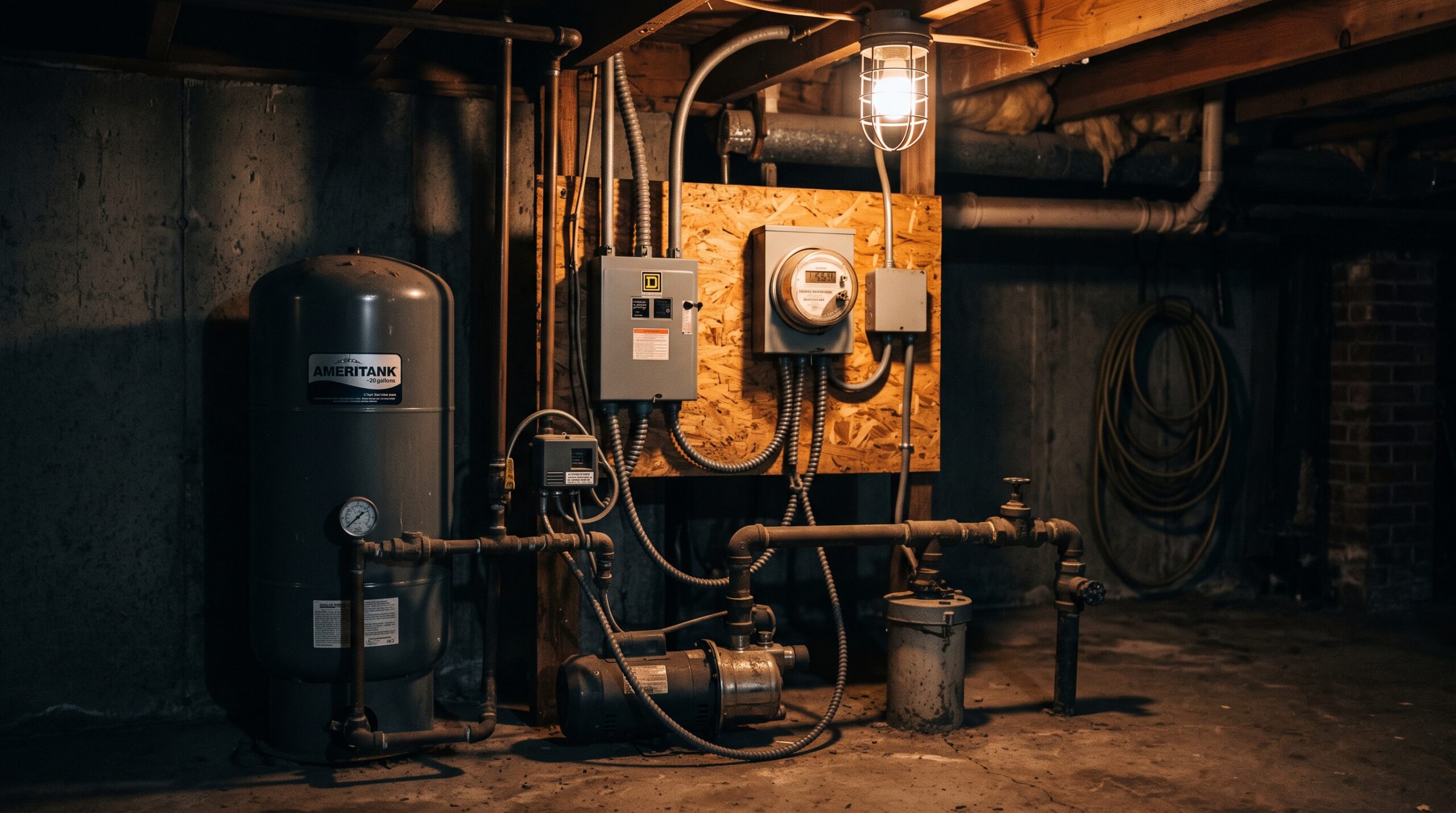
How many watts a well pump uses depends on its horsepower and on whether you mean the steady running draw or the brief jolt the motor pulls at startup. A 1/2 HP well pump runs on roughly 750 to 1,000 watts but can spike to 2,000 to 3,000 watts the instant it kicks on; a 3/4 HP pump runs near 1,000 to 1,500 watts and surges to 3,000 to 4,000 watts; a 1 HP pump runs around 1,500 to 2,000 watts and can jump past 4,000 to 6,000 watts. That starting surge, not the running number, is what usually decides whether a generator or power station can handle your pump.
Running watts and starting surge by horsepower
A well pump has two power numbers that matter. Running watts is the continuous draw once the motor is spinning. Starting watts (also called surge or locked-rotor draw) is the spike that lasts a fraction of a second as the motor overcomes inertia and gets up to speed. A rough rule is about 746 watts of running power per horsepower, with a startup spike two to three times higher than that.
The table below shows typical figures for common single-phase residential pumps. Treat them as a starting point, not a spec sheet. Your actual numbers come off the motor data plate and vary with well depth, voltage, and pump type.
| Pump size | Running watts (approx.) | Starting surge (approx.) |
|---|---|---|
| 1/2 HP | 750 – 1,000 W | 2,000 – 3,000 W |
| 3/4 HP | 1,000 – 1,500 W | 3,000 – 4,000 W |
| 1 HP | 1,500 – 2,000 W | 4,000 – 6,000 W |
| 1.5 HP | 2,000 – 2,500 W | 6,000 – 8,000 W+ |
Why the starting surge decides backup feasibility
Well pumps use induction motors, and an induction motor draws several times its running current the moment it starts. Manufacturers and electricians generally put that inrush at three to seven times the running amps before it settles down. So a 1 HP pump that hums along at 1,500 watts can demand 4,000 watts or more for a split second every time the pressure switch calls for water.
This is why a generator or power station sized only to the running number will fail. If the unit cannot deliver the surge, the motor either refuses to start or trips the inverter. When you compare backup options, match the device’s surge rating to the pump’s surge, not its continuous rating to the pump’s running watts. Our guide to running watts vs starting watts breaks down how those two ratings work on the equipment side.
Most well pumps run on 240 volts
Deep-well submersible pumps and most pumps of 1 HP and up are wired for 240 volts. Many 1/2 HP jet and shallow-well pumps ship set for 120 volts but can be reconnected to 240 volts in the field. This matters for backup power because a lot of portable power stations only put out 120 volts from their standard outlets. Running a 240-volt pump usually means a generator with a 240-volt outlet, a power station that offers a 240-volt option, or a transfer switch wired by an electrician.
To get your pump’s real draw, read the data plate on the motor or the pressure switch panel. It lists voltage and full-load amps. Multiply amps by volts for a running-watts estimate (for example, 8 amps at 240 volts is about 1,920 watts). The plate may also list locked-rotor amps or a service-factor amp rating, which point to how big the startup spike runs.
Why watt-hours usually aren’t the limiter
A well pump does not run constantly. It fills a pressure tank, shuts off, and stays off until you draw enough water to drop the pressure and trip the switch again. A healthy system cycles a handful of times per hour and runs about a minute or more each time. Over a day of normal household use, the pump might run well under an hour total.
Because of that duty cycle, energy use (watt-hours) is rarely what limits a battery power station. The pump sips a modest amount of stored energy across the day. The hard part is delivering the surge each time it starts. So when you size backup power for a pump, lead with the surge rating and the voltage, then check that the battery has enough capacity for a day or two of intermittent cycling.
- Surge rating must clear the pump’s starting watts.
- Continuous rating must clear the running watts.
- Voltage must match (often 240 V).
- Battery capacity needs to cover a day of short, repeated runs.
How well pump watts compare to other pumps
Well pumps draw more than the sump pumps many people picture. A typical 1/3 to 1/2 HP sump pump runs on a few hundred watts and surges to around 1,300 to 2,200 watts, while a 1/2 HP well pump runs higher and surges harder. If you are budgeting backup power for both, size to the well pump first since it sets the harder requirement. For the smaller end, see how many watts a sump pump uses. Keeping the well system itself running during an outage is covered in power outages and well water.
Sizing backup power for your pump
Once you have the running watts, surge watts, and voltage off the data plate, you can match equipment. A 1/2 HP 240-volt pump often needs a generator in the 3,000 to 4,000-watt range; a 1 HP pump commonly calls for 5,000 watts or more unless it has a soft starter, which cuts the inrush roughly in half. Run your numbers through the sizing calculator to see what fits, and read whether a power station can run a well pump before assuming a battery unit will start it.
One caution: many well pumps are hard-wired through a pressure switch and a dedicated circuit, not a plug. There is no outlet to plug a portable unit into. Connecting backup power to a hard-wired pump safely means a transfer switch or interlock installed by a licensed electrician. Do not attempt to back-feed the circuit.
Frequently asked questions
How many watts does a 1/2 HP well pump use?
A 1/2 HP well pump runs on roughly 750 to 1,000 watts. The startup surge is the bigger number, usually 2,000 to 3,000 watts for a fraction of a second each time the motor starts.
What size generator do I need for a 1 HP well pump?
Plan on a generator that can supply at least the pump’s surge, often 4,000 to 6,000 watts for a 1 HP pump. A model in the 5,000-watt-and-up range gives headroom for the inrush. A soft starter on the pump can lower that requirement.
Can a portable power station run a well pump?
Sometimes, if its surge rating beats the pump’s starting watts and it outputs the right voltage. Many 240-volt pumps need a station with a 240-volt option. See can a power station run a well pump for the details.
Where do I find my pump’s exact wattage?
Read the data plate on the motor or the pressure switch box. It lists voltage and full-load amps. Multiply amps by volts for running watts. Locked-rotor or service-factor amps on the plate indicate the starting draw.
Does a well pump use a lot of electricity over time?
Not really. Because the pump only runs in short bursts to refill the pressure tank, daily energy use is modest. The challenge for backup power is the surge at each start, not total watt-hours.
Sources
- Franklin Electric — AIM Manual, 60 Hz Submersible Systems (motor amp and locked-rotor data)
- Goulds Water Technology (Xylem) — JS+ Series Shallow Well Jet Pumps technical brochure
- Oakville Pump — How Much Power Does My Submersible Well Pump Use?
- Jackery — What Size Generator to Run a Well Pump
- Cycle Stop Valves — Pump Run and Off Times (motor inrush and cycling)