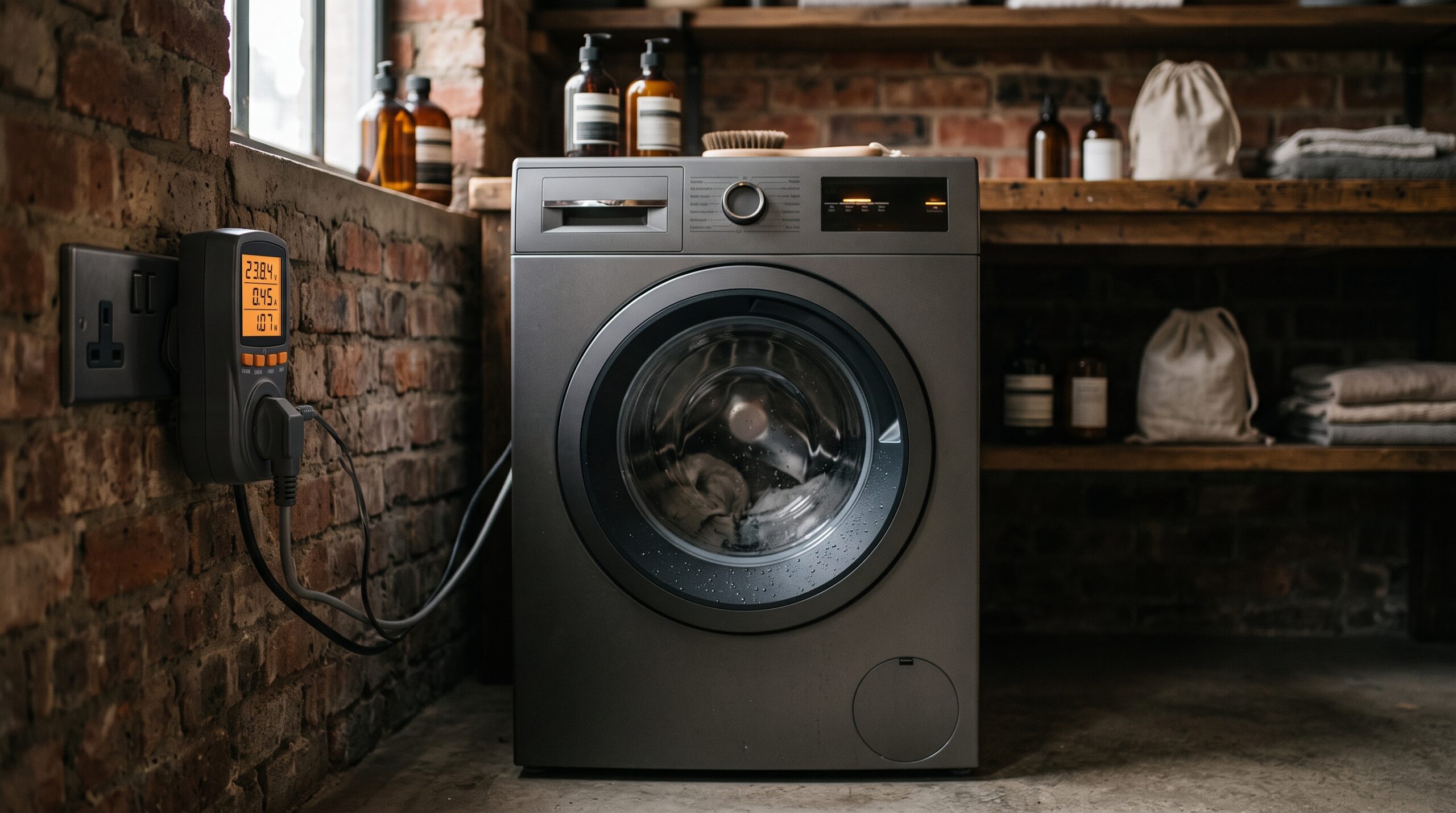
How many watts does a washing machine use? Most washers draw about 300 to 500 watts on a standard top-load cycle, and roughly 500 to 1,200 watts on a front-loader, with the higher numbers showing up only when the machine heats its own water. The motor and pump do most of the work, so a plain cold-water wash is surprisingly light on power, while hot and sanitize cycles cost the most.
Washing machine watts by type and cycle
Wattage depends on the machine style, the cycle you pick, and whether the washer has an internal heater. The numbers below are typical running watts for a 120-volt household washer. Treat them as ballpark figures and check the rating plate or manual on your own unit for an exact draw.
| Washer type or cycle | Typical running watts | What drives the draw |
|---|---|---|
| Compact / high-efficiency, cold wash | 200–400 W | Small motor, low water use |
| Standard top-load with agitator | 300–500 W | Motor and drain pump |
| Front-load, cold or warm (no heater) | 500–800 W | Motor plus high-speed spin |
| Front-load with internal heater (hot / sanitize) | 900–1,200+ W | Internal water heater dominates |
| Startup and spin surge (a few seconds) | up to ~1,000–1,500 W | Motor kicking the drum to speed |
The pattern is steady once you see it: the motor and pump set a baseline of a few hundred watts, and any heating element layered on top is what pushes a washer into four digits.
Running watts vs the startup surge
A washer has two numbers worth knowing. Running watts is the steady draw it sustains through most of the cycle. The startup surge is a brief spike when the motor first spins the drum up to speed, especially at the start of a fast spin. That surge can be noticeably higher than the running figure, but it only lasts a second or two.
This split matters mostly for backup power. A wall outlet on a dedicated circuit shrugs the surge off. A generator or power station, on the other hand, has to handle that peak without tripping. If you are sizing backup, plan around the surge, not the running watts. Our guide to running watts vs starting watts breaks down why the gap exists and how to read it on a spec sheet.
Why heated-water cycles cost the most
The single biggest factor in a washer’s energy use is water temperature. According to the U.S. Department of Energy, about 90 percent of the energy a clothes washer uses goes toward heating water, not turning the drum. Switching a load from hot to warm can cut its energy use roughly in half.
One detail trips people up. Most U.S. washers pull hot water from your home’s water heater through the hot inlet, so that heating energy shows up on the water heater, not on the washer’s own plug. A washer’s measured wattage only jumps when it has a built-in heating element it runs itself, which is common on sanitize and allergen cycles. That is when you see the 900-to-1,200-watt readings in the table above.
Watt-hours per load: the number for backup
Watts tell you the instantaneous draw. Watt-hours tell you how much energy a whole load actually consumes, which is what you care about when running off a battery. A cycle takes time, and the draw rises and falls as the machine fills, agitates, drains, and spins, so energy per load is lower than you might guess from peak watts. If watt-hours are new to you, start with what is a watt-hour.
- Cold or warm wash at the machine: roughly 0.1 to 0.5 kWh (100 to 500 Wh) per load, since only the motor and pump are running.
- Hot cycle with an internal heater: can climb to 1 to 2 kWh or more, because the element runs for a chunk of the cycle.
- Takeaway: a cold-water load is cheap to run and easy on a battery; heated cycles are where the energy and the cost pile up.
A washer is not a dryer
Do not lump the washing machine and the dryer together. A washer is a modest load that mostly spins a motor. An electric dryer is a heating appliance, and it is in a completely different class: it runs on a 240-volt circuit and pulls thousands of watts to make heat, often 3,000 to 5,000 watts or more. That is roughly ten times a typical cold wash.
The practical upshot during an outage is simple. A washer is realistic to back up. An electric dryer usually is not, and most portable power stations cannot run one at all. If that is your question, see whether a power station can run a dryer before you count on it.
Running a washing machine on a power station
A washing machine can run on a power station as long as the inverter handles the startup surge and the cycle stays cold. A unit rated around 1,000 watts of continuous output, with surge headroom above that, covers most top-load and cold front-load washers. Avoid hot and sanitize cycles on battery, because the internal heater can double or triple the draw.
- Check the surge rating, not just the continuous rating, against the washer’s startup spike.
- Stick to cold or warm cycles to keep the draw low and the runtime long.
- Confirm the inverter is up to the motor’s startup load before relying on it in an outage.
To see how a washer stacks up against other appliances on a mid-size battery, look at what a 1000W power station can run. To estimate how long a specific battery would keep a cycle going, plug your numbers into the runtime calculator.
Frequently asked questions
Will a 1000W power station run a washing machine?
Usually yes, for a cold or warm cycle, as long as the unit’s surge rating clears the washer’s brief startup spike. Skip hot and sanitize cycles, since the internal heater can push the draw past what a 1,000-watt inverter can deliver.
How many amps does a washing machine use?
A typical 120-volt washer draws somewhere around 5 to 15 amps depending on the cycle, which is why manufacturers like Whirlpool call for a grounded 120-volt outlet on its own circuit. Machines with internal heaters sit toward the high end during hot cycles.
Does a washing machine use a lot of electricity?
Not really, if you wash cold. The machine itself uses a modest amount of energy per load. Most of the cost in laundry comes from heating water, so the temperature setting matters far more than the brand or the spin speed.
Is washing in cold water actually cheaper?
Yes. Because water heating is the largest piece of a load’s energy use, cold-water washing avoids most of it. The Department of Energy notes that moving from hot to warm alone cuts a load’s energy roughly in half, and cold saves more still.
Can I run my washer and dryer together on backup power?
Almost never on a portable unit. The washer is a light load, but an electric dryer pulls thousands of watts on a 240-volt circuit. Running both at once needs serious capacity, typically a large standby generator rather than a power station.