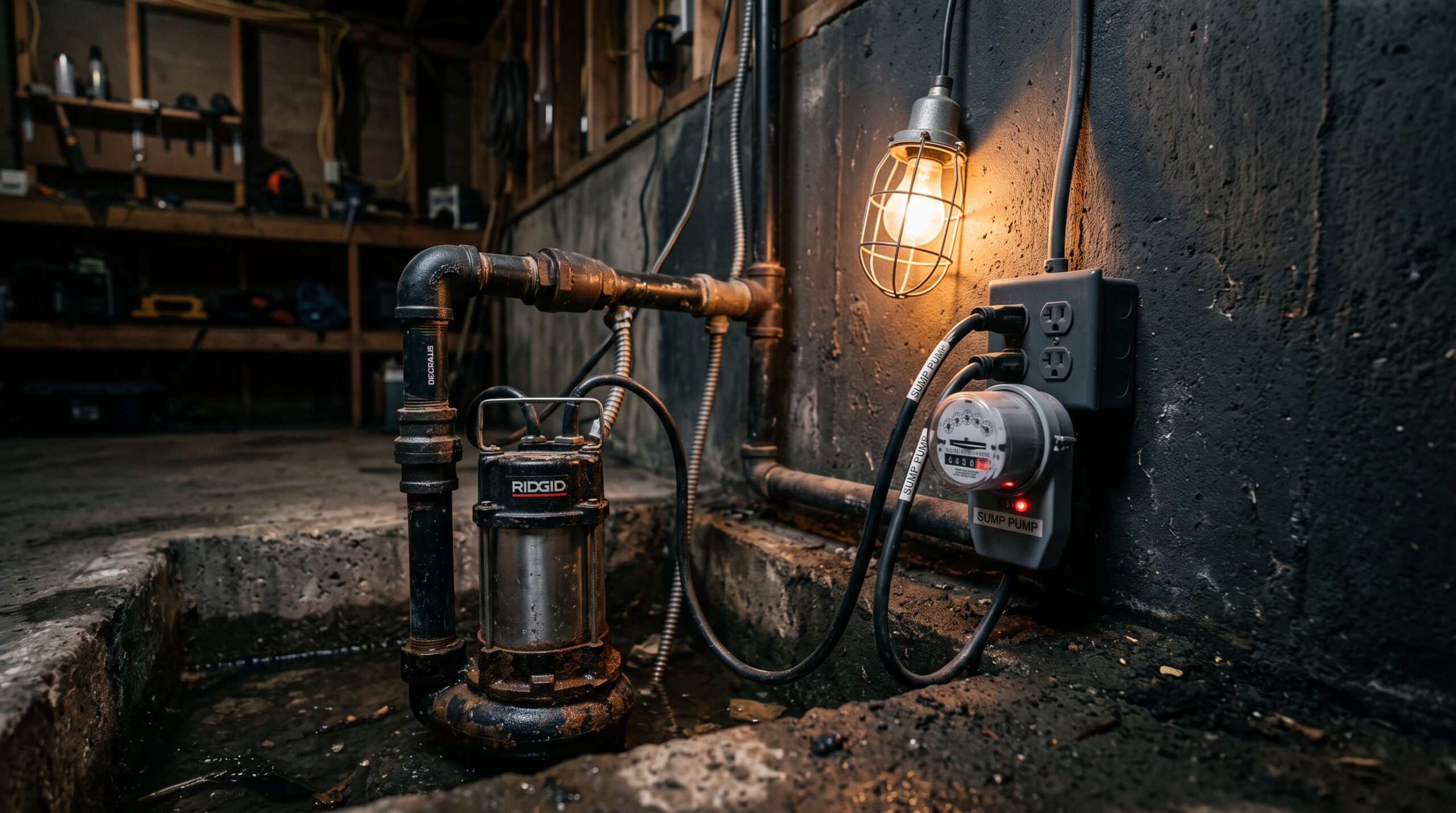
A typical home sump pump draws somewhere between 800 and 1,050 running watts depending on motor size, but the running figure is not the number that decides whether a generator or power station can keep it going. The starting surge, the brief spike when the induction motor kicks on, runs far higher: roughly 1,300–2,900 watts for a 1/3 HP pump and 2,150–4,100 watts for a 1/2 HP pump. Size your backup power around that surge, not the steady running draw.
The short answer: running watts vs starting surge
Every sump pump has two power numbers. The first is running watts, the steady draw once the motor is spinning and moving water. The second is starting watts (also called surge, inrush, or locked-rotor draw), the much larger jolt the motor pulls for a fraction of a second as it overcomes inertia and gets up to speed. For a sump pump, the surge is usually two to four times the running figure, which is why a backup source that looks comfortably oversized on paper can still fail to start the pump. If you want the full mechanics behind these two numbers, see running watts vs starting watts.
Sump pump wattage by motor size
The single biggest factor is the motor’s horsepower rating. Most residential sump pumps fall between 1/4 HP and 3/4 HP, with 1/3 HP and 1/2 HP being the most common. The table below shows representative ranges. Treat them as a starting point and always confirm against your own pump’s label.
| Motor size | Running watts (typical) | Starting surge (typical) |
|---|---|---|
| 1/4 HP | ~500–600 W | ~1,000–1,800 W |
| 1/3 HP | ~700–900 W | ~1,300–2,900 W |
| 1/2 HP | ~1,000–1,050 W | ~2,150–4,100 W |
| 3/4 HP | ~1,200–1,500 W | ~2,300–4,500 W |
The spread inside each row is wide on purpose. A 1/3 HP Zoeller M53, for example, lists about 9.6 amps running but a locked-rotor draw near 25.9 amps, which works out to roughly 3,100 watts of surge at 120 volts. A different 1/3 HP pump from another brand may surge closer to 1,500 watts. Two pumps with the same horsepower badge can demand very different startup power, so the badge alone is not enough to size backup power.
Why the starting surge is the number that matters
Generators and power stations are rated two ways: continuous (running) output and a higher peak (surge) output they can sustain only for a moment. A sump pump motor needs its surge supplied instantly, every single time it cycles on. If your backup source can hold the running watts but cannot deliver the inrush, the pump will stall, trip the unit’s overload protection, or simply refuse to start. That failure mode is most likely to show up at the worst time, during a storm when the pit is filling fast.
Battery power stations have a second wrinkle. A unit might advertise, say, 1,800 watts continuous and 3,600 watts surge, but the surge window is often only a few seconds and the inverter has to handle the inductive load cleanly. Some smaller units list a high surge number but trip on motor startup anyway. This is the core reason a pump that draws barely 1 kW while running can still need a much larger unit. We walk through real unit matches in what size power station for a sump pump.
How to read your pump’s data plate
The most reliable wattage number is the one printed on your own pump, not a generic chart. Find the data plate or label on the motor housing and look for these fields:
- Voltage (V): Almost always 115 V or 120 V for residential pumps.
- Amps (A) or FLA: Full-load amps while running. Multiply amps by volts to estimate running watts. Example: 9.6 A × 120 V ≈ 1,150 W.
- HP: The horsepower rating. Useful for ballpark surge from the table above.
- LRA (locked-rotor amps): If listed, this is the startup draw. Multiply by voltage for surge watts. Many labels omit it, in which case assume the surge can reach roughly 2–4× the running watts.
If the label is faded or missing, check the manufacturer’s spec sheet for your model number. Note that running amps on the plate are a rated maximum, so a clamp-meter reading on your actual pump will often come in lower than amps × volts suggests. If your pump is hard-wired into the electrical panel rather than plugged into an outlet, connecting it to portable backup power is not a simple plug-in job and usually calls for a licensed electrician and possibly a transfer switch.
Watt-hours: a sump pump cycles, it doesn’t run constantly
A sump pump does not run around the clock. It sits idle until the float switch trips, runs in a short burst to empty the pit, then shuts off. How much energy it consumes over an outage depends entirely on how wet the ground is. During a dry spell it might cycle a few times an hour for a few seconds each. During heavy rain or snowmelt it can run nearly continuously.
That makes watt-hours hard to pin down with a single figure. A rough way to estimate: take the running watts, multiply by the fraction of each hour the pump is actually pumping, then multiply by outage hours. A 1/2 HP pump at 1,050 watts running 10 minutes per hour uses about 175 watt-hours per hour, so a 12-hour storm could draw on the order of 2 kWh, plus the energy lost to each restart surge. To model your own scenario against a specific battery capacity, plug your numbers into the runtime calculator.
What it takes to back one up
For a generator, a common rule of thumb is to choose one whose surge rating clears your pump’s startup draw with margin to spare. A 1/3 HP pump generally wants a 3,000-watt-class generator; a 1/2 HP or 3/4 HP pump often needs 3,000 watts or more of surge capacity to start reliably. For a battery power station, look for a continuous rating above the running watts and a surge rating well above the pump’s inrush, and confirm the unit is rated to start inductive motor loads rather than just resistive ones.
To match a specific pump to a specific battery or generator, run your figures through the sizing calculator. If your home also relies on a pressurized water supply, the same surge logic applies, and you may want to read can a power station run a well pump and the broader guide to power outages and well water, since well pumps tend to surge even harder than sump pumps.
Frequently asked questions
How many watts does a 1/3 HP sump pump use?
A 1/3 HP sump pump typically draws about 700–900 watts while running and surges to roughly 1,300–2,900 watts at startup, depending on the specific motor. Some models, like the Zoeller M53, surge close to 3,000 watts, so check your own pump’s label rather than assuming the low end.
How many watts does a 1/2 HP sump pump use?
A 1/2 HP sump pump runs at roughly 1,000–1,050 watts and can spike to anywhere from about 2,150 to 4,100 watts during startup. That wide surge range is exactly why you size backup power to the starting watts, not the running watts.
Will a 2,000-watt power station run a sump pump?
It depends on the surge, not the 2,000-watt continuous rating. Many 1/3 HP and 1/2 HP pumps surge above 2,000 watts, so the power station’s peak rating and its ability to start a motor load are what count. Some 2,000-watt units start small pumps fine; others trip. Verify the pump’s startup draw and the unit’s surge spec before relying on it.
How long can a battery run a sump pump during an outage?
It varies with how often the pump cycles. Because the pump only runs in bursts, a battery’s runtime hinges on how wet conditions are. In light rain a mid-size power station may last many hours; in a heavy storm with near-continuous pumping, runtime drops sharply. Estimate your case with the runtime calculator using your pump’s running watts and an honest guess at duty cycle.
Why does my sump pump need so much more power to start than to run?
Sump pumps use induction motors, which pull a large inrush of current for a split second to break inertia and reach running speed. Once spinning, the draw drops to the steady running figure. This startup surge is a normal motor characteristic, and it is the single most common reason an otherwise adequate generator or power station cannot start the pump.
Sources
- Zoeller — 1/3 HP Cast Iron Submersible Sump Pump (M53) product specs
- Wayne Pumps — sump pump specifications and power supply requirements (PDF)
- EcoFlow — How Many Watts Does a Sump Pump Use?
- Bluetti — How Many Watts Does a Sump Pump Use?
- Home Battery Bank — What Size Generator Do I Need for My Sump Pump?