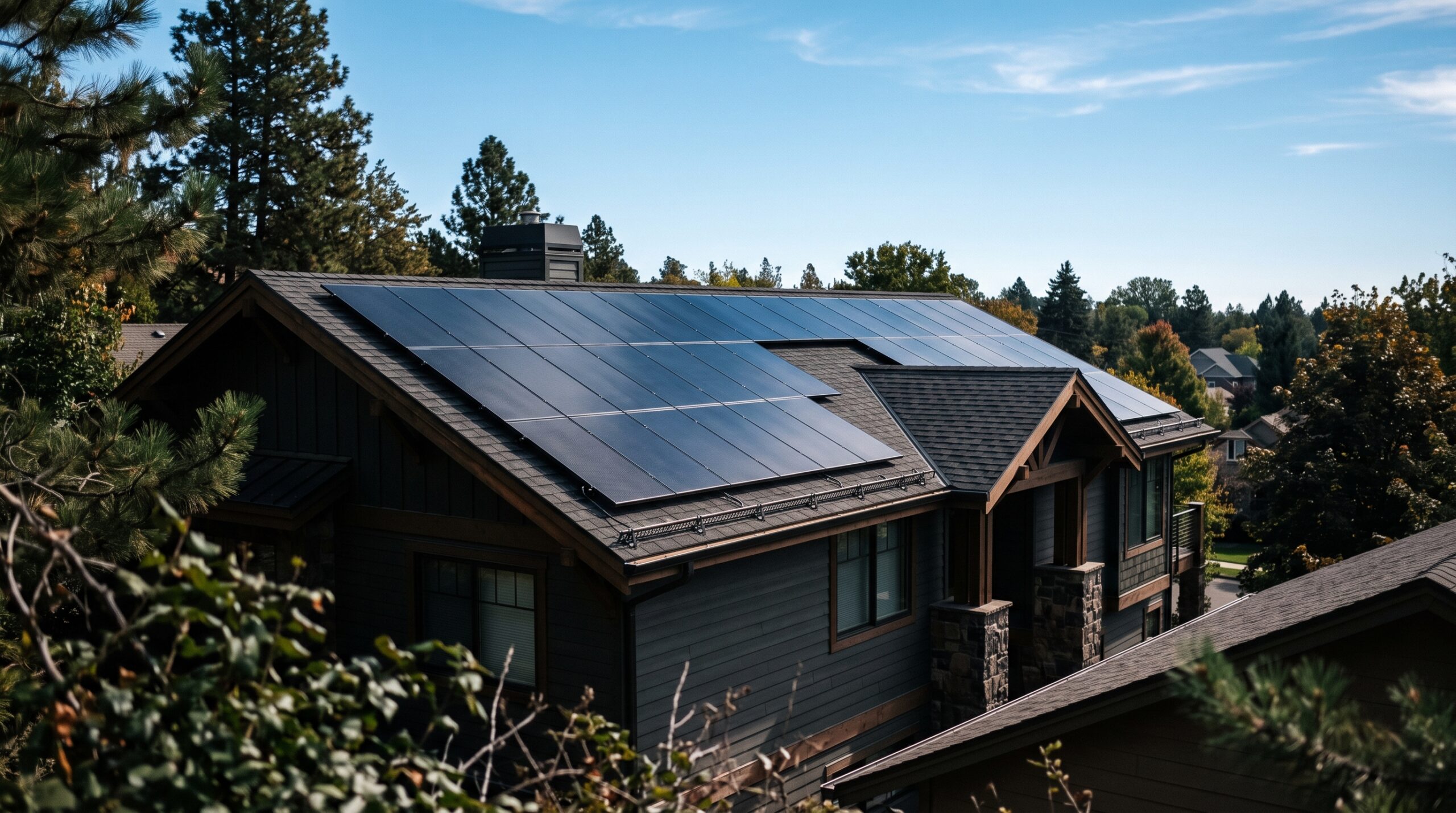
Most US homes need somewhere between 15 and 25 solar panels to cover a full year of electricity, which works out to roughly a 6 to 9 kilowatt (kW) system using today’s 400-watt panels. That is a wide range on purpose: the real answer depends on how much power you use, how much sun your roof gets, and the wattage of the panels you install. Below is the actual math so you can ballpark your own number instead of guessing.
The short answer for a typical home
The average US household buys about 10,791 kWh of electricity per year, or roughly 899 kWh a month, according to the U.S. Energy Information Administration. To offset that with rooftop solar, a home in a moderately sunny location needs about a 7 to 8 kW system, which is roughly 18 to 20 panels rated at 400 watts each.
That lines up with what installers actually quote. EnergySage, which tracks real residential quotes across the country, reports that a typical home needs about 16 to 23 panels and an average system size of roughly 11 to 12 kW for households that want to cover all of their usage with room to spare. If your home is small or efficient, you may need 10 to 12 panels. If you run central air conditioning, electric heat, or an EV charger, you could need 25 to 35.
The formula for how many panels you need
Every honest sizing estimate comes down to one calculation. You take your yearly electricity use and divide it by how much one panel produces in a year:
- Annual production per panel (kWh) = (panel watts ÷ 1,000) × peak sun hours × 365 × derate
- Panels needed = your annual kWh ÷ annual production per panel
- System size (kW) = panels × panel watts ÷ 1,000
Three numbers drive the result:
- Peak sun hours — the number of hours per day your location averages the equivalent of full, direct sun. Most of the US falls between about 3.5 (cloudy Northwest and Northeast) and 6 (desert Southwest).
- Derate factor — a real-world haircut of about 0.83 that accounts for inverter losses, wiring, heat, dust, and shading. NREL’s free PVWatts tool uses a default loss of around 14% plus inverter efficiency, which is where that figure comes from.
- Panel wattage — most panels sold today are 400 to 430 watts. We use 400 W below.
Worked example for the average home at 4.5 peak sun hours: one 400 W panel makes 0.4 × 4.5 × 365 × 0.83 ≈ 545 kWh per year. Divide 10,791 kWh by 545, and you get about 20 panels, or a 7.9 kW system.
How much electricity does your home use?
Usage is the single biggest variable, and it swings hard by region and lifestyle. The EIA found Louisiana homes average 14,774 kWh a year (lots of electric heating and air conditioning), while Hawaii homes average just 6,178 kWh. The fastest way to get your own number is to pull 12 months of utility bills and add up the kWh, since a single month does not capture summer and winter swings.
If you do not have a year of bills handy, multiply your typical monthly kWh by 12. A home that uses 900 kWh in a mild month but 1,800 kWh in peak summer will badly under-size a system if you only plan around the mild month.
Usage, system size, and panel count
This table assumes a moderate 4.5 peak sun hours, 400-watt panels, and a 0.83 derate. Read across from whatever your yearly usage is.
| Annual use (≈ monthly) | System size | 400 W panels |
|---|---|---|
| 6,000 kWh (~500/mo) | ~4.4 kW | ~11 |
| 9,000 kWh (~750/mo) | ~6.6 kW | ~17 |
| 10,800 kWh (~900/mo, US average) | ~7.9 kW | ~20 |
| 12,000 kWh (~1,000/mo) | ~8.8 kW | ~22 |
| 15,000 kWh (~1,250/mo) | ~11 kW | ~28 |
How your location changes the number
Two identical homes with identical bills can need very different systems based on sun alone. A home in Phoenix gets far more usable sunlight than the same home in Seattle, so it needs fewer panels for the same output. The table below holds usage steady at the US average of about 10,800 kWh a year and varies only the peak sun hours.
| Region (example) | Peak sun hours | System size | 400 W panels |
|---|---|---|---|
| Pacific NW, Northeast | ~3.5–4.0 | ~9–10 kW | ~23–26 |
| Midwest, Mid-Atlantic | ~4.5 | ~7.9 kW | ~20 |
| South, Central US | ~5.0 | ~7.1 kW | ~18 |
| Southwest (AZ, NV, NM) | ~5.5–6.0 | ~6.0–6.5 kW | ~15–16 |
For a real, address-specific estimate, NREL’s PVWatts pulls actual solar data for your exact location. Our solar calculator does the same kind of math in a few clicks if you just want a fast ballpark.
Grid-tied solar is not outage backup
This is the part most sizing guides skip. A standard rooftop system is grid-tied, and by law it shuts off the moment the grid goes down. The inverter is built to stop sending power so it cannot electrocute a lineman working on the wires. That means a normal solar array gives you exactly zero electricity during a blackout, even at noon on a sunny day. We cover why in detail in do solar panels work during a power outage.
To actually keep the lights on during an outage you need a home battery and a hybrid or backup-capable inverter, which is a separate purchase from the panels. Batteries also add real cost, so price that out before assuming solar equals backup. See home battery backup cost for current numbers. Sizing for backup is a different exercise than sizing to zero out your bill, since you only need to carry critical loads through the outage, not your entire annual usage.
Rooftop panels vs. portable solar for a power station
Do not confuse whole-home rooftop solar with the small portable panels people use to recharge a power station. Those are 100 to 400 W folding panels meant to top up a battery for camping or emergencies, not to run a house. If that is what you are after, see how many solar panels to recharge a power station and how a solar generator works, which is the panel-plus-battery combo that does keep working in an outage.
In short: rooftop solar is about cutting your monthly bill across the year. Portable solar and a power station, or a home battery, is about having power when the grid fails. Many households end up wanting both for different reasons.
Frequently asked questions
How many solar panels do I need for a 2,000 square foot house?
Square footage is a poor proxy because two same-size homes can use wildly different amounts of power. That said, a 2,000 sq ft home often uses around 9,000 to 12,000 kWh a year, which lands at roughly 17 to 22 panels in a moderate-sun area. Always size from your kWh bills, not your floor area.
How much electricity does one solar panel produce?
A single 400-watt panel produces roughly 500 to 700 kWh per year in most of the US, depending on sun. In a cloudy region it might make under 500 kWh; in the desert Southwest it can top 700 kWh. On a good day that is somewhere around 1.5 to 2.5 kWh from one panel.
Can solar panels fully power a house?
Yes, a correctly sized grid-tied system can offset 100% of your annual usage on paper. But solar makes power during the day and your home uses power around the clock, so you still rely on the grid (or a battery) at night. Offsetting your yearly total is not the same as being independent from the grid.
Why do estimates for the same house vary so much?
Because the inputs vary. Different peak sun hours, panel wattages, roof orientation, shading, and how much of your bill you want to cover all change the count. A south-facing, unshaded roof in Arizona needs far fewer panels than a partly shaded, north-sloped roof in Vermont with the same electric bill.
Will more panels keep my power on during an outage?
No. Panel count has nothing to do with outage backup. A grid-tied array of any size shuts down when the grid fails. Keeping power during an outage requires battery storage and a compatible inverter, regardless of how many panels you have on the roof.
Sources
- U.S. Energy Information Administration — How much electricity does an American home use?
- U.S. Energy Information Administration — Electricity use in homes
- NREL — PVWatts Calculator (solar production estimator)
- U.S. Department of Energy — Solar Rooftop Potential
- EnergySage — How many solar panels do I need for my home?