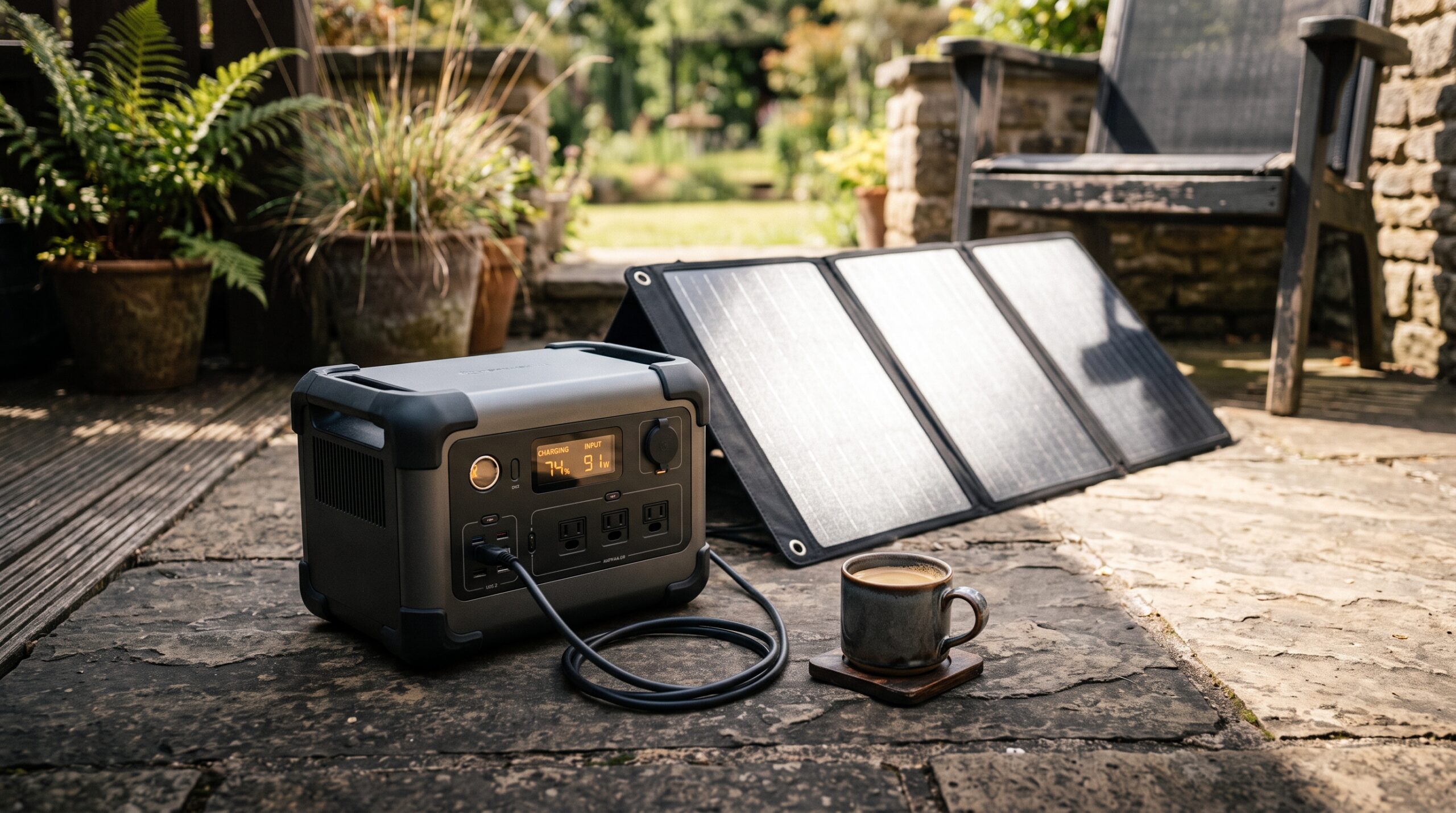
Short answer: it depends on how you’ll use it. A solar generator is genuinely worth it if you want silent, fume-free backup you can recharge from the sun during a multi-day outage or off-grid trip. It’s a weaker buy if your outages are short and rare, you live somewhere cloudy, or you need to run heavy loads for the whole house, where a power station on its own or a fuel generator often makes more sense.
What a solar generator actually is
“Solar generator” is a marketing name. There’s no engine and no combustion. It’s a battery power station paired with one or more portable solar panels. The station stores the energy and turns it into household AC through an inverter; the panels are simply one way to refill the battery. You can usually recharge the same station from a wall outlet or a car port too, so the solar panels are an add-on that buys you fuel-free recharging when the grid is down. If you want the mechanics in plain terms, see how a solar generator works.
That distinction matters for the “worth it” question, because the real decision is whether the solar capability earns the extra cost over a station you charge another way. The panels are what you’re actually paying extra for.
The case for buying one
Solar makes sense when one of its core advantages solves a problem you actually have:
- Multi-day outages with no fuel runs. Once a gas generator runs dry, you’re hunting for fuel. A solar setup tops the battery back up every sunny day, so a long outage doesn’t end the moment your jerry can does.
- You need it to run indoors or quietly. No carbon monoxide, no exhaust, almost no noise. That’s a real safety and livability win in an apartment, a tent, or a bedroom with a CPAP running overnight.
- RV, van, or remote use. If you’re regularly away from outlets, sunlight is often the only “fuel” available, and you don’t have to carry or store gasoline.
- Frequent outages where daytime recharge keeps you going. If your area loses power often, the ability to refill during the day can stretch a modest battery across an event that would otherwise drain it.
Reviewers consistently point to the same trade: power stations are quieter, cleaner, and safer to use around people than gas units, and the optional panels are what turn a few hours of backup into something that can keep going. That convenience is the product you’re paying for.
When it might not be worth the extra cost
Be honest with yourself about these cases before adding panels:
- Rare, short outages. If your power blips out for an hour or two a couple of times a year, a battery station alone (or even a large power bank) may cover you, and you can recharge it from the wall once the grid returns. The panels just sit in a closet. Our take on the station-only question is here: is a portable power station worth it.
- Cloudy regions or winter use. Solar recharge is weather- and season-dependent. Short winter days and overcast skies can slow charging to a crawl, so you can’t count on the sun bailing you out exactly when a storm has knocked out the grid.
- Whole-home or long high-load needs. Running a well pump, central AC, or an electric range for hours pulls more energy than most portable batteries hold. For sustained high loads, a fuel generator is usually cheaper per watt. See gas generator vs. power station to weigh it.
The honest truth about solar recharge speed
This is where a lot of buyers get disappointed, so it’s worth being blunt. A panel rated at 200W almost never delivers a clean 200W. In good conditions you’ll typically see roughly 60-85% of the rating, and on a gray day it can drop to a small fraction of that. On top of that, conversion and heat losses mean you should plan for the battery needing about 20-30% more energy in than its rated capacity.
The other limit is daylight. Panels only produce meaningful power during “peak sun hours,” and most of the U.S. gets only about 4-6 of those per day depending on location and season. A rough planning rule:
Solar watts you need ≈ battery watt-hours ÷ peak sun hours. So refilling a 1,000Wh station in a single 4-hour solar window realistically wants somewhere around 250-400W of panels, not 100W. Plan with 4 peak sun hours as a conservative default if you don’t know your local number.
If solar charging is the whole reason you’re buying, size the panels honestly. We walk through the math in how long it takes to charge a power station with solar and break down panel counts in how many solar panels to recharge a power station.
What the panels add to the price
Prices move constantly and vary by sale, so treat these as ballpark figures rather than quotes. Complete kits (station plus a matching panel) run roughly from around $350 for a small 300Wh setup up to about $2,500-$2,750 for a large multi-day kit with a 600W panel, based on 2025-2026 retail listings from review outlets. A capable 1,000Wh-class station on its own often lands in the few-hundred-dollar range on sale, and the solar panel is frequently a meaningful slice of the total on top of that.
Set that against a gas generator. Fuel units generally cost less per watt up front and can run as long as you keep feeding them, but they add ongoing fuel costs, maintenance, noise, fumes, and storage hassle. Solar flips that equation: a higher entry price (mostly the panels) in exchange for no fuel bills, no emissions, and very little upkeep. Which side wins depends entirely on your load and how long your typical outage lasts.
Quick “worth it?” scenarios
| Your situation | Verdict | Better fit if not |
|---|---|---|
| Multi-day outages, want fuel-free recharge | Worth it — solar shines here | — |
| Need power indoors / no noise / CPAP at night | Worth it — no fumes, near silent | — |
| RV, van, or remote off-grid living | Worth it — sun is your only “fuel” | — |
| Rare, short outages (an hour or two) | Probably overkill | Station alone, or a large power bank |
| Cloudy climate or winter-heavy use | Use caution — slow recharge | Station you charge from the wall; keep gas as backup |
| Whole-home or long high-load (AC, well pump) | Often not the cheapest path | Fuel generator, cheaper per watt |
How to decide, and how to buy
Start from your real need, not the spec sheet. List the devices you must keep running, estimate the watt-hours you’d burn through a typical outage, then ask whether you genuinely need to recharge mid-event. If yes, the panels earn their cost. If you only need a few hours of backup once in a blue moon, buy the station and skip or downsize the solar.
- Run your numbers with the solar calculator to see how much panel you’d actually need for a realistic daytime recharge.
- Size the panel to the battery and your local sun, not to the marketing photo. Under-paneling is the most common regret.
- Buy the station and panels as a matched pair when you can, so the connectors and charge controller are designed to work together. If you’re shopping piecemeal, our picks for the best solar generators can narrow it down.
- Ignore fake “deal” pressure and made-up list prices. Watch the real street price over a week or two; this category goes on sale constantly.
Still torn between a kit with panels and a plain battery? Compare them directly in solar generator vs. battery power station.
Station plus panel — what it really costs


EcoFlow 220W NextGen
Bifacial N-type, adjustable kickstand — a day refill for 1,000Wh

Anker SOLIX PS400
400W foldable, IP67, MC4 — for large and expandable stations
As an Amazon Associate we earn from qualifying purchases. Prices are pulled automatically from Amazon and may have changed.
Frequently asked questions
Is a solar generator worth it for occasional power outages?
If outages are short and infrequent, the battery station does most of the work and you can recharge from the wall afterward. The solar panels mainly pay off when outages last long enough that you’d otherwise run out of stored power. For a few hours once or twice a year, a station alone is usually enough.
Can a solar generator power a whole house?
Most portable units can run essentials like a fridge, lights, phones, and Wi-Fi, not a whole house with central AC and electric heat. Sustained high loads drain a portable battery fast, and at that scale a fuel generator or a home battery system is usually a better and cheaper fit per watt.
How long does it take to recharge from solar?
Longer than the simple math suggests. Panels deliver well under their rated wattage in real conditions, and you only get a handful of peak sun hours a day. As a starting point, divide the battery’s watt-hours by your panel wattage, then add 20-30% for losses. Clouds, heat, dirt, and short winter days all stretch it further.
Is solar cheaper than a gas generator?
Not usually up front, especially once you add panels. Gas units tend to cost less per watt and run as long as you have fuel. Solar wins on running costs over time: no fuel, no fumes, minimal maintenance. Whether that trade favors you depends on how big and how long your power needs are.
Do I have to use solar to charge it?
No. Nearly all of these stations also charge from a wall outlet and most charge from a car. Solar is an option for fuel-free recharging when the grid is down, which is exactly why it’s worth it for some people and unnecessary for others.