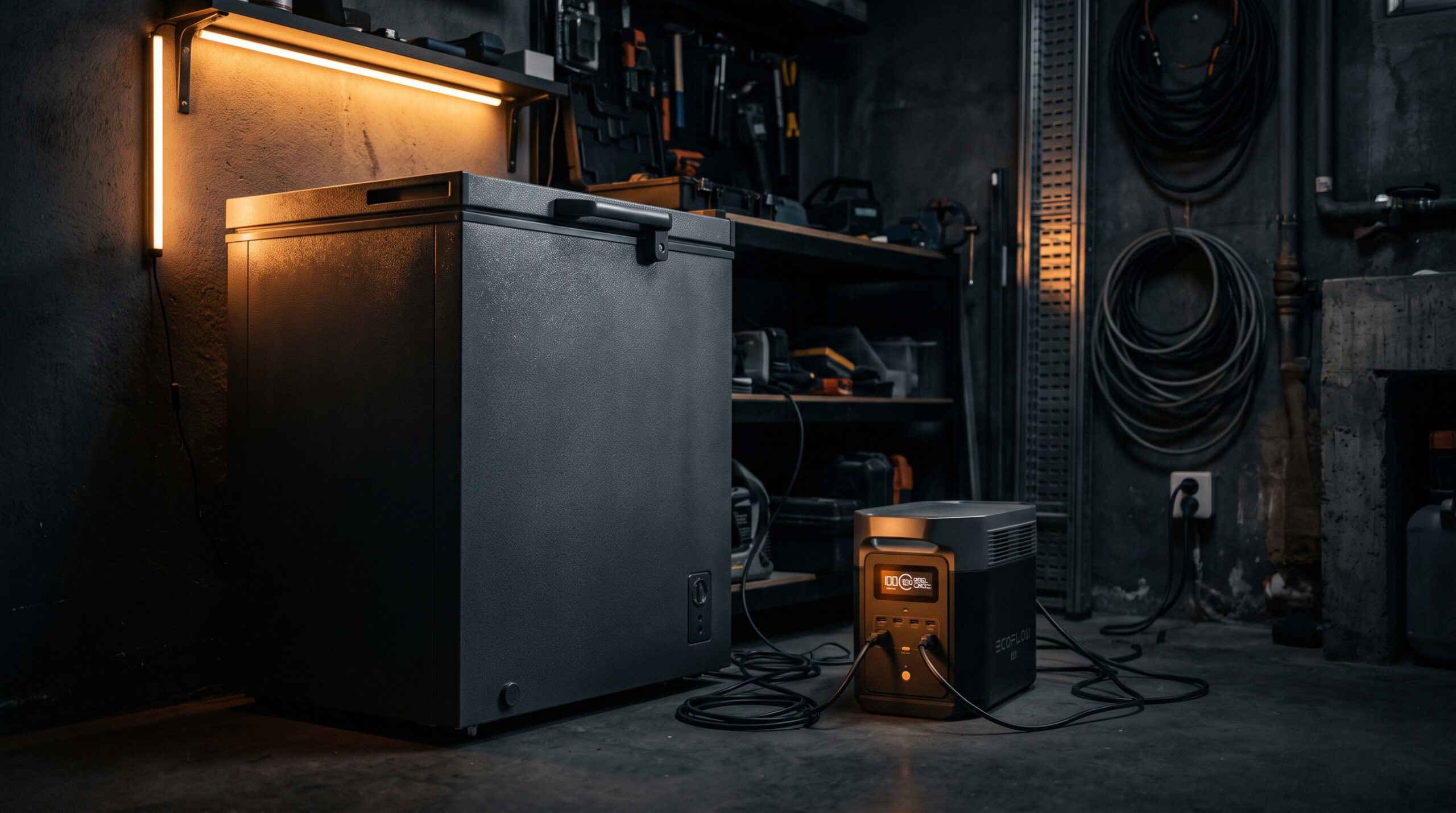
A typical freezer uses 100 to 400 watts while the compressor is running, with a brief startup surge of roughly 800 to 2,200 watts the moment the compressor kicks on. Compact models sit below that range, and large auto-defrost uprights sit near the top.
The running number is what the freezer pulls minute to minute. The surge is a short spike that lasts a second or two but decides whether a generator or power station can actually start the unit. Both numbers matter, and they matter for different reasons.
Running watts vs. starting watts
Running watts (sometimes called rated or continuous watts) is the steady draw while the compressor hums along keeping the box cold. For most household freezers that lands somewhere between 100 and 400 watts, depending on size, age, and how efficient the model is.
Starting watts (also called surge or peak watts) is the much larger spike the motor pulls in the instant it switches on. A freezer compressor is an induction motor, and these draw a heavy inrush current at startup before settling to their running level. The surge is usually about two to three times the running figure and lasts only a fraction of a second, but your backup power source has to supply it cleanly or the compressor will stall and the unit may not start at all.
That gap is the whole reason a 100-watt freezer can need a 1,000-watt or larger power source. You are not sizing for the steady draw. You are sizing for the worst single second.
How many watts each type of freezer uses
Freezer type changes the numbers more than almost anything else. A chest freezer is usually the most efficient of the group because its lid opens from the top, so cold air does not spill out every time you open it, and these models tend to carry more insulation. An upright freezer is more convenient but loses cold air through its front door like a refrigerator, so it generally draws more, especially auto-defrost models. A compact or mini freezer has a small compressor and the lowest draw, though it can still surge well above its running watts.
The ranges below are typical figures, not guarantees. Your specific model can land outside them, and the only number that is exactly right is the one on your own nameplate or EnergyGuide label.
| Freezer type | Running watts | Starting / surge watts | Est. daily energy |
|---|---|---|---|
| Compact / mini freezer (~1–4 cu ft) | 50–100 W | 300–800 W | 150–400 Wh |
| Chest freezer (~5–15 cu ft) | 80–200 W | 600–1,500 W | 400–900 Wh |
| Upright freezer (~10–21 cu ft) | 100–400 W | 800–2,200 W | 900–1,400 Wh |
For context on the daily figures, ENERGY STAR puts a certified chest freezer at about 215 kWh per year and a certified upright at about 395 kWh per year. Divide those by 365 and you get roughly 590 and 1,080 watt-hours per day. A larger or older auto-defrost upright can run higher still; the Department of Energy lists a 16.6-cubic-foot auto-defrost upright at around 438 kWh per year, or about 1,200 watt-hours a day.
Daily watt-hours and why duty cycle lowers the number
A freezer does not run its compressor around the clock. It cycles on to pull the temperature back down, then shuts off and coasts until it warms slightly, then repeats. The share of time the compressor actually runs is the duty cycle, and for a freezer in a comfortable room it is often somewhere around 30 to 50 percent.
That is why the daily energy use is far lower than the running watts might suggest. A unit that draws 150 watts while running but only runs half the time averages about 75 watts across the day, which works out near 1,800 watt-hours over 24 hours. You can estimate any appliance the same way: multiply running watts by the hours it actually runs per day, then divide by 1,000 to get kilowatt-hours.
Duty cycle climbs when the freezer is in a hot garage, when it is packed with newly added warm food, or when the door or lid gets opened often. A full freezer actually holds its cold better between cycles than an empty one, so a stocked freezer in a cool spot is the most efficient setup. Plan your backup numbers for the warm-weather, hard-working case rather than the easy one.
How to read the EnergyGuide label
The fastest way to ground these numbers for your own freezer is the yellow EnergyGuide label, an FTC program that lists the model’s estimated yearly energy use in kilowatt-hours. Take that yearly kWh figure, divide by 365, and multiply by 1,000 to get a realistic daily watt-hour number for backup planning.
If the label is gone, the running wattage is usually stamped on the nameplate at the back or bottom of the unit. When only amps are listed, multiply amps by 120 volts to get watts (a 1.5-amp freezer is roughly 180 running watts). That gives you the running figure; for the surge, assume two to three times that until you can confirm the peak draw with a plug-in watt meter.
How freezer watts translate to backup power sizing
Two questions decide whether a power station or generator will keep your freezer running: can it start the compressor, and can it run long enough to matter.
For starting, match the surge, not the running watts. A chest or mini freezer with a surge under 1,500 watts will start on most 1,000-watt power stations, since many of those briefly peak near 2,000 watts. A large auto-defrost upright that surges toward 2,200 watts needs more headroom, so look at the unit’s stated surge or peak rating, not just its continuous rating, before you trust it.
For runtime, work from daily watt-hours and the station’s usable capacity. Real usable energy is roughly 85 to 90 percent of the rated watt-hours once you account for inverter losses, and it is smart to add about a 15 percent buffer for a hot day. As a rough guide, a 2,000Wh power station can run an efficient chest freezer for about two to three days and a typical upright for roughly 18 to 40 hours, depending on duty cycle, ambient heat, and how often the door is opened. A 2,000-watt inverter generator comfortably starts and runs a single freezer; if you go the gas route, run it outdoors only and well away from windows because of carbon monoxide.
Rather than eyeball it, plug your freezer’s numbers into the Power-Station Sizing calculator to find the surge and capacity you need, then use the Appliance Runtime calculator to see how long a given battery will keep it cold during an outage.
Frequently asked questions
How many watts does a chest freezer use?
A standard chest freezer typically uses about 80 to 200 running watts and surges to roughly 600 to 1,500 watts at startup. Because the lid opens from the top and the cold air stays put, chest models are usually the most efficient type, with an ENERGY STAR certified unit using around 215 kWh a year, or close to 590 watt-hours per day.
How many watts does a freezer use per day?
Most home freezers use somewhere between about 400 and 1,400 watt-hours per day. The figure depends on type, size, and duty cycle: an efficient chest freezer often lands near 500 to 600 watt-hours daily, while a larger auto-defrost upright can run closer to 1,100 to 1,400. The daily number is much lower than the running watts because the compressor only runs part of the time.
What size power station or generator do I need to run a freezer?
Size to the surge first. A power station or generator that can deliver the freezer’s starting watts, commonly 800 to 2,200 for a full-size unit, will start the compressor. A 2,000-watt inverter generator handles a single freezer with room to spare. For battery backup, a 2,000Wh power station typically runs a freezer for one to three days, with chest models lasting longer than uprights.
Will a 1,000-watt power station run a freezer?
Often yes, as long as its surge rating covers the freezer’s startup spike. Many 1,000-watt stations briefly peak near 2,000 watts, which is enough to start most chest, mini, and smaller upright freezers. A large auto-defrost upright with a high surge may need a unit with more peak headroom, so check the station’s surge or peak rating, not just its continuous wattage.
How do I find my freezer’s exact wattage?
Check the nameplate on the back or bottom of the freezer, which usually lists watts or amps. If it shows amps, multiply by 120 volts to get running watts. For yearly energy, read the kWh figure on the yellow EnergyGuide label, or measure the real draw with an inexpensive plug-in watt meter, which also captures the actual startup surge.
Sources
- ENERGY STAR (EPA/DOE), Freezers: energystar.gov/products/freezers
- U.S. Department of Energy, Purchasing Energy-Efficient Residential Freezers: energy.gov/cmei/femp/purchasing-energy-efficient-residential-freezers
- U.S. Department of Energy, Estimating Appliance and Home Electronic Energy Use: energy.gov/energysaver/estimating-appliance-and-home-electronic-energy-use
- U.S. Energy Information Administration, Use of electricity in U.S. homes: eia.gov/energyexplained/use-of-energy/electricity-use-in-homes.php
- Federal Trade Commission, EnergyGuide energy labeling: ftc.gov/news-events/topics/truth-advertising/energyguide-energy-labeling