After a power outage, throw out any perishable food that has been above 40°F for two hours or more, according to the USDA. A closed refrigerator holds safe temperatures for only about four hours, so once the cold runs out, the two-hour clock is what decides whether an item stays or goes.
Below is how the 40°F and two-hour rules work together, how to check your food without guessing, a keep-or-toss list by food type, a quick note on refrigerated medicine, and when thawed food can go back in the freezer.
⚠️ When in doubt, throw it out
Never taste food to judge whether it is safe. You cannot see or smell the bacteria that cause foodborne illness. This is planning help built on USDA and FDA guidance, not a substitute for the official charts linked at the bottom.
The 40°F / 2-hour rule
Two numbers carry almost all of this. The first is 40°F. Below it, perishable food is in the safe zone. At or above it, you are in what the USDA calls the danger zone, where bacteria multiply quickly. The second is two hours. Once food climbs above 40°F, it is safe for only about two hours before it should be thrown out. On a hot day, when the air around the food is above 90°F, that window drops to one hour.
An unopened refrigerator keeps food cold for roughly four hours after the power goes out. So a short outage often ends before anything crosses 40°F. The risk shows up in longer outages, or when the door has been opened, because that is when the temperature creeps up and the two-hour clock starts to matter.
How to check your food
Do not judge by look or smell, and never by taste. The bacteria that make people sick often leave no clue you can detect. Go by temperature and time instead.
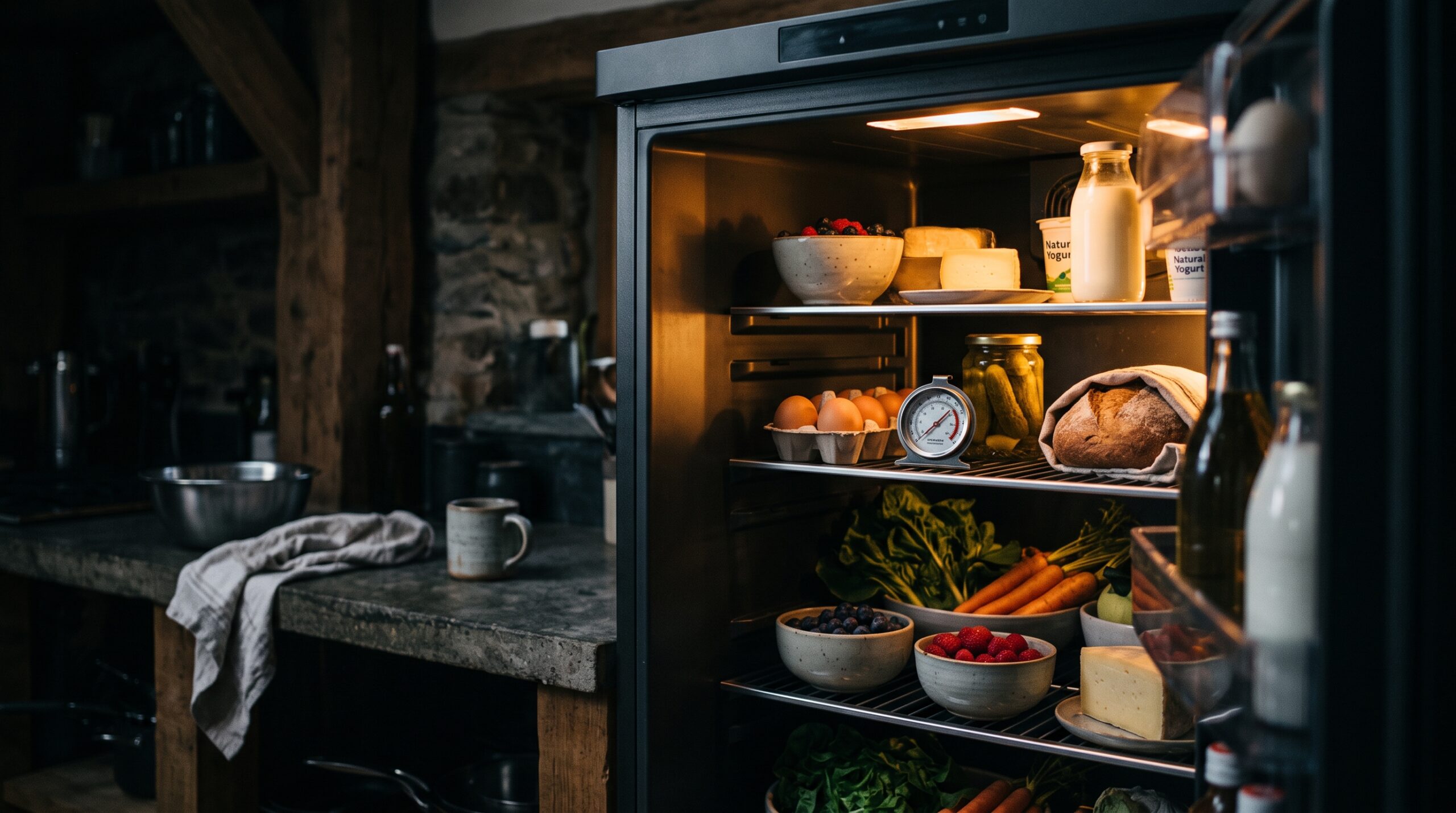
The reliable way to know is an appliance thermometer kept inside the refrigerator, and another in the freezer. When the power returns, read it. If the refrigerator stayed at or below 40°F the whole time, the food inside is safe. If it sat above 40°F for more than two hours, throw out the perishable items. Without a thermometer you are guessing, and with food safety the safe guess is to discard anything you are unsure about.
Keep or toss, by food type
Not everything in the refrigerator spoils at the same rate. Once food has been above 40°F for more than two hours, the USDA and FoodSafety.gov split it roughly as follows. The high-moisture, protein-rich items go; the dry, high-acid, or shelf-stable ones usually stay.
| Food | Keep or toss |
|---|---|
| Meat, poultry, fish, and seafood (raw or cooked) | Toss |
| Lunch meat, hot dogs, bacon, sausage | Toss |
| Milk, cream, yogurt, sour cream, buttermilk | Toss |
| Soft cheeses (brie, cottage, cream cheese, ricotta, shredded) | Toss |
| Eggs and egg dishes | Toss |
| Cooked leftovers, casseroles, soups, stews | Toss |
| Cut fruit, cooked vegetables, opened juices | Toss |
| Cooked pasta, rice, and potatoes | Toss |
| Opened mayonnaise, tartar sauce, horseradish | Toss if above 50°F over 8 hours |
| Hard and processed cheeses (cheddar, Parmesan, Romano) | Keep |
| Butter and margarine | Keep |
| Whole fresh fruits and raw vegetables | Keep |
| Ketchup, mustard, jam, jelly, peanut butter, pickles, olives | Keep |
| Bread, rolls, muffins, cakes (no cream filling) | Keep |
This is a guide, not the full chart. When an item is not listed or you are on the fence, fall back on the rule at the top: when in doubt, throw it out.
A note on refrigerated medicine
Refrigerated medicine is not food, and the call is not yours to make alone. The FDA advises that drugs kept refrigerated should be discarded if the power was out for a long time, because heat can quietly reduce their potency. The exception is a medicine you need to stay alive, such as insulin. The FDA says these may be used until a new supply is available, then replaced as soon as you can. Because the right answer depends on the specific drug and how long it was warm, confirm with your pharmacist or the manufacturer before relying on or discarding anything.
Can you refreeze thawed food?
Often, yes. The USDA says food that still has ice crystals or is at 40°F or below is safe to refreeze, even though the texture and quality may drop afterward. Food that fully thawed and sat above 40°F for more than two hours should be thrown out rather than refrozen. The same 40°F and two-hour logic that decides the refrigerator decides the freezer.
Keep the fridge cold next time
The cleanest way to avoid this decision entirely is to keep the fridge cold next time. A battery power station can run a refrigerator straight through an outage, so the food never crosses 40°F in the first place. A typical fridge draws roughly 100 to 400 watts while the compressor runs and only cycles part of the time, which is why a mid-size power station can hold one cold for a day or more on a charge.
The size you need depends on your fridge, not the battery’s label. Run your own numbers with the Appliance Runtime calculator to see how long a given power station would keep yours cold, or use the Power-Station Sizing calculator to find the capacity that covers a one or two day outage.
Frequently asked questions
How long is food safe in the fridge during a power outage?
About four hours if you keep the door closed. After that, throw out any perishable food that has been above 40°F for two hours or more.
Can I tell if food is unsafe by how it looks or smells?
No, and you should never taste it either. The bacteria that cause foodborne illness usually leave no smell, taste, or appearance you can detect. Go by temperature and time.
The food still seems fine. Is it really unsafe?
It can be. Looking and smelling normal does not mean a perishable item is safe after it has been warm too long. If it was above 40°F for more than two hours, the guidance is to throw it out.
Is my refrigerated medicine still good after an outage?
Ask your pharmacist. The FDA says refrigerated drugs should usually be discarded after a long outage, but a medicine you need to stay alive, such as insulin, may be used until you can get a new supply. Confirm the specifics with your pharmacist or the manufacturer.
What if the fridge stayed at or below 40°F the whole time?
Then the food inside is safe. That is exactly why an appliance thermometer is worth keeping in the refrigerator, so you can read the real temperature instead of guessing.