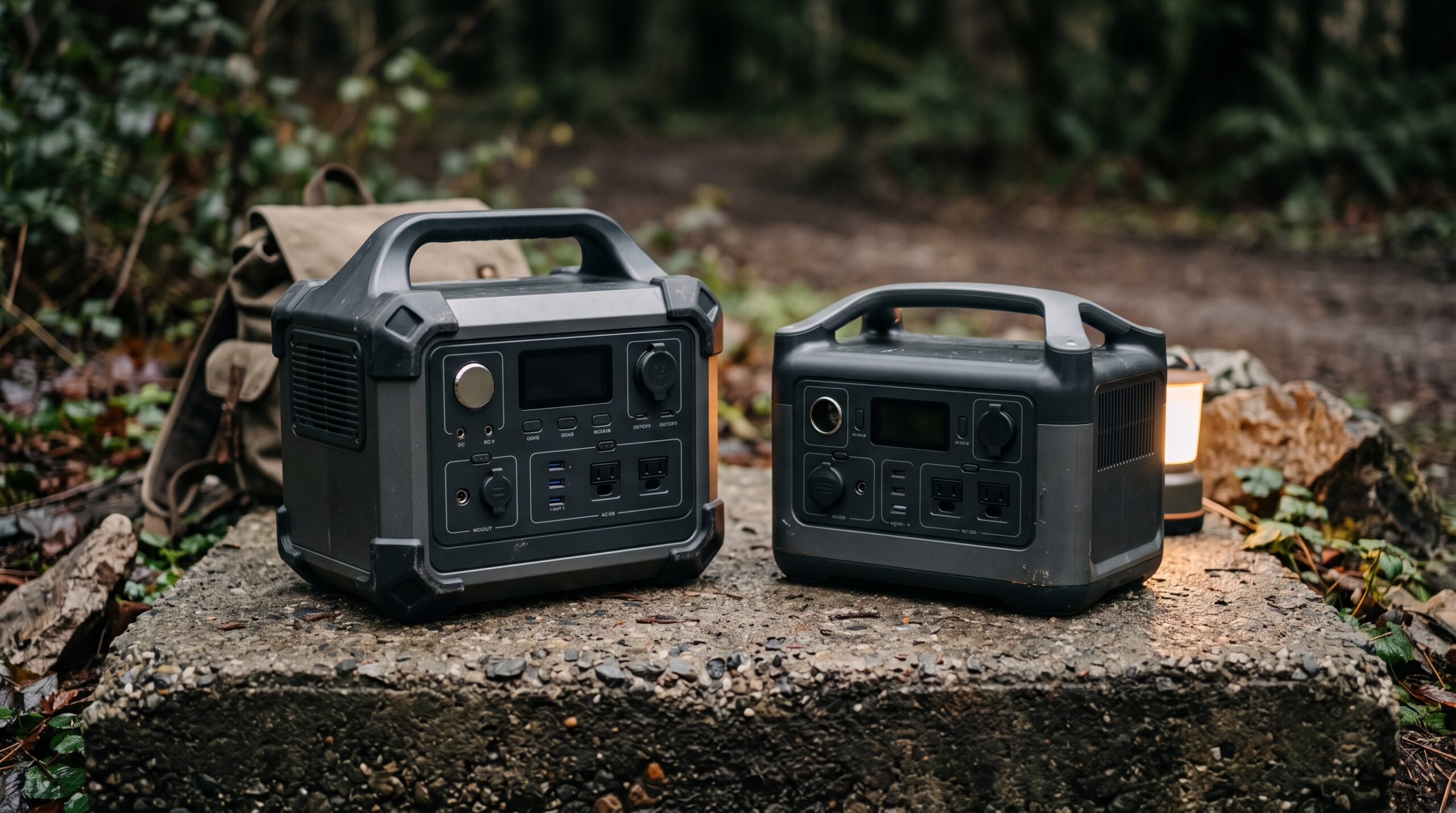
Anker SOLIX and Jackery sit at the top of most “best portable power station” lists, and for backup power they overlap a lot: both now build their main lines around LiFePO4 cells, both make pure sine wave units that run a fridge or CPAP, and both ship phone apps. The short version: pick Anker SOLIX if you want the longest warranty, faster wall charging, and a cleaner price-per-watt-hour at the bigger sizes; pick Jackery if you want a lighter, simpler grab-and-go unit from the brand that has been doing this longest. The bigger truth is that the right capacity for your loads matters more than the badge on the case.
Battery chemistry and lifespan
This used to be the clearest dividing line, and it is narrowing. Anker built the entire SOLIX line on LiFePO4 (lithium iron phosphate) from the start, so every current model uses the chemistry that handles heat better and lasts far longer than older lithium-ion packs. Jackery’s lineup is mixed: its newer “Plus” and “v2” units use LiFePO4, while some legacy Explorer models still ship with NMC lithium-ion. If you are buying a Jackery, confirm the specific model is LiFePO4 before you commit.
On rated cycle life the two are now in the same ballpark. Anker rates models like the C1000 Gen 2 at roughly 4,000 cycles to 80% capacity, and Jackery rates units like the Explorer 1000 v2 at a similar 4,000 cycles. Both translate that into a “10-year lifespan” claim under normal use. For backup power that you cycle occasionally rather than daily, either will outlast the rest of the unit. If you want the underlying tradeoffs, see LiFePO4 vs lithium-ion power stations.
Charging speed and solar input
Anker tends to win on raw wall-charging speed. Compact units like the C1000 Gen 2 advertise a full charge in well under an hour at max AC input, which matters when an outage is rolling in and you want the battery topped off fast. Jackery’s newer units charge quickly too, generally in around an hour, but Anker usually holds the edge at any given size.
For solar, both brands support meaningful input and sell matching folding panels. Jackery has long leaned into the solar-generator bundle and markets high solar input on its larger units, which suits off-grid recharging. Anker matches or beats this at the top of its range. Solar charging is slower and weather-dependent in either case, so plan around real sun hours, not the headline watt number. Our solar calculator estimates realistic recharge times for your panels.
Output, surge, and what each can run
Both brands deliver clean pure sine wave AC, so sensitive electronics, medical devices, and motor-driven appliances are safe on either. At a given price tier, Anker often lists a higher continuous wattage: the C1000 Gen 2 puts out 2,000W continuous, where a comparable Jackery may sit at 1,500W to 2,200W depending on model. That difference decides whether a unit can start a high-draw appliance.
What actually matters is the gap between continuous watts, surge (peak) watts, and the running plus starting draw of your appliances. A fridge or sump pump pulls a brief spike well above its running wattage at startup, and that spike is what trips an undersized unit. Before you compare brands, work out the loads you need to cover with the sizing calculator and read up on running watts vs starting watts.
App, features, and design
Both brands offer Wi-Fi and Bluetooth apps on their current units, letting you monitor charge level, set charging speed, and adjust settings from your phone. Anker’s app is generally seen as the more polished of the two, and its charging controls are a selling point. Jackery offers app control on its Plus and v2 models, though some entry units are screen-only, so check before buying if remote monitoring matters to you.
On design, Anker leans into a cleaner, more modern look with collapsible handles and, on larger units like the F2000, built-in wheels. Jackery’s hallmark orange-and-grey styling is instantly recognizable and the units tend to be compact and easy to grab. Neither design choice changes how well the unit backs up your home; it is mostly about how often you carry it and where you store it.
Warranty, price, and value
Warranty is where Anker has pushed hardest. SOLIX units commonly carry a 5-year full-device warranty as standard. Jackery’s structure is more layered: many units come with a 3-year base warranty that extends to 5 years when you register or buy through official channels, so you can reach the same coverage but you may have to opt in. Read the terms for the exact model and region before you count on five years.
On price, the two trade blows. Anker frequently offers a stronger price-per-watt-hour at the 1,000Wh-plus tier, while Jackery runs aggressive sales that can make a specific model the better deal on any given week. Both brands discount heavily around major sale events, so the “winner” on value often comes down to timing rather than brand.
Anker SOLIX vs Jackery: head to head
| Dimension | Anker SOLIX | Jackery |
|---|---|---|
| Battery chemistry | LiFePO4 across the entire current lineup | LiFePO4 on Plus / v2 models; some legacy Explorers still NMC |
| Rated cycle life | ~4,000 cycles to 80% on newer models; ~10-year claim | ~4,000 cycles to 80% on newer models; ~10-year claim |
| Wall charging | Usually faster; compact units under an hour | Fast (~1 hour) but typically a step behind Anker |
| Output / surge | Often higher continuous watts at a given tier (pure sine) | Solid continuous watts (pure sine); varies by model |
| App | Wi-Fi + Bluetooth; polished, strong charging controls | Wi-Fi + Bluetooth on Plus/v2; some entry units screen-only |
| Design / portability | Modern look; wheels on larger units (e.g. F2000) | Compact, lightweight, recognizable orange styling |
| Warranty | Commonly 5 years standard | 3 years base, up to 5 with registration / official purchase |
| Value | Strong price-per-Wh at 1,000Wh+ tiers | Frequent deep sales; mature, proven product line |
Which should you buy?
Both brands are safe choices, so let your priorities decide:
- Pick Anker SOLIX if you want the longest standard warranty, the fastest wall charging, the better app, and a strong price-per-watt-hour on bigger units. It is the value-and-longevity pick.
- Pick Jackery if you want a simple, light, proven unit from the most mature brand in the category, and you tend to buy around sales. It is the simplicity-and-portability pick.
- Either way, size the unit to your loads first. A right-sized Jackery beats an undersized Anker, and vice versa. For the broader decision, see how to choose a power station.
If you are still weighing the field, it is worth seeing how each stacks up against EcoFlow, the third major brand: Anker vs EcoFlow and EcoFlow vs Jackery. Add Bluetti and you have the full four-way picture in Jackery vs EcoFlow vs Bluetti.
A few buying habits save real money with either brand. Decide on the capacity and continuous wattage you need before you shop, then wait for a sale rather than paying full MSRP, which both brands discount often. Buy from the official store or an authorized retailer so your warranty is valid, register the unit if registration unlocks longer coverage, and confirm the exact model’s chemistry and specs on the spec sheet rather than the headline. We do not run affiliate links or quote live prices here on purpose; prices shift week to week, so check the current number at the source before you decide.
Anker and Jackery, live prices


Jackery Explorer 1000 v2
1,070Wh, 1,500W — light and simple for outages
$499.00Check price on Amazon →

Jackery Explorer 2000 v2
2,042Wh, 2,200W — big capacity, not expandable
$899.00Check price on Amazon →
As an Amazon Associate we earn from qualifying purchases. Prices are pulled automatically from Amazon and may have changed.
Frequently asked questions
Is Anker SOLIX or Jackery better for home backup?
Both work well. Anker SOLIX often edges ahead on warranty length, charging speed, and price-per-watt-hour on larger units, which suits whole-evening backup. Jackery is lighter and simpler if you want a unit you also carry to camp. The deciding factor is whether your chosen model has enough capacity and continuous wattage for your loads, not the brand.
Do both use LiFePO4 batteries?
Anker SOLIX uses LiFePO4 across its entire current lineup. Jackery uses LiFePO4 on its newer Plus and v2 models, but some older Explorer units still use NMC lithium-ion. If long lifespan matters, confirm the specific Jackery model is LiFePO4 before buying.
Which brand has the longer warranty?
Anker SOLIX commonly includes a 5-year warranty as standard. Jackery typically starts at 3 years and extends to 5 years when you register or buy through official channels. You can reach the same coverage with either, but Anker gets you there without extra steps. Always read the terms for your exact model and region.
Can either one run a refrigerator during an outage?
Yes, as long as the unit handles your fridge’s running and starting watts and has enough watt-hours for the runtime you need. Both brands sell pure sine wave units in the 1,000Wh-plus range that comfortably run a typical fridge for many hours. Check the numbers with the runtime calculator first.
Is it worth waiting for a sale?
Usually, yes. Both Anker and Jackery discount their power stations heavily around major sale events, often well below MSRP. If you are not in an emergency rush, decide on the model you want and wait for a markdown rather than paying full price.