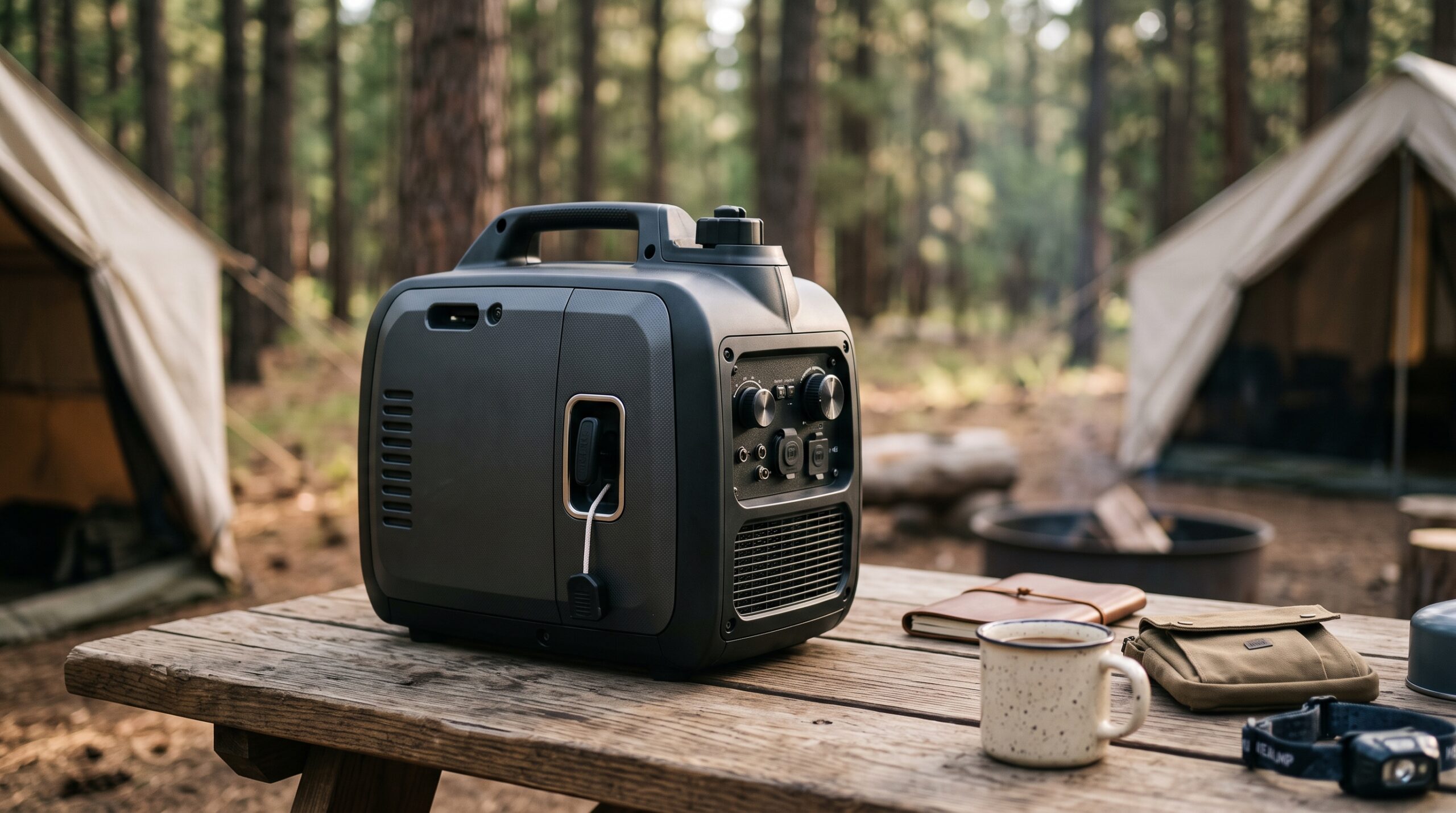
An inverter generator is the right tool when you want clean, steady power that won’t rattle your campsite or your laptop. If you’re powering a few devices for camping or tailgating, an ultraportable 1,000–2,200-watt unit is usually plenty; for an RV or a fridge-plus-essentials backup, a mid-size 2,200–4,000-watt model fits better; and if you need to run several large loads at once, a high-output 5,000–7,000-watt inverter is the size to look at. Below are genuinely popular current models in each tier, with real specs and an honest note on what these machines can and can’t do.
Why choose an inverter generator
A conventional generator runs its engine at a fixed speed and sends that raw power straight to the outlets. An inverter generator instead produces AC, converts it to DC, then rebuilds it into clean, stable AC. That extra step is what makes the difference for anything with a circuit board.
- Clean power for electronics. Most inverter generators put out a true sine wave with low total harmonic distortion (often under 3%), which is what phones, laptops, TVs, and CPAP machines expect. If the difference matters for your gear, see pure sine wave vs. modified sine wave.
- Quieter operation. Because the engine speed varies with the load instead of running flat out, these units are noticeably quieter than open-frame conventional generators. Many sit in the 50s of decibels at light load.
- Better fuel economy at partial load. An eco or economy throttle setting drops engine RPM when you’re only drawing a little power, which stretches run time and saves gas.
- Parallel capability. Most portable inverters can link to a second identical (or compatible) unit with a parallel kit, roughly doubling your output without buying one heavy generator.
The trade-off is cost: inverter generators usually price higher per watt than a basic open-frame model. If you’re weighing the two, our breakdown of an inverter generator vs. a conventional generator covers when each one makes sense.
How to choose an inverter generator
Match the machine to your actual loads, not to the biggest number on the box. A few specs do most of the work:
- Running watts vs. surge watts. Running (rated) watts is what the generator delivers continuously; surge (starting) watts is the brief extra it provides when a motor kicks on. Add up the running watts of everything you’ll run at once, then make sure the surge headroom covers your largest motor start. Here’s the difference between running watts and starting watts.
- Noise. Ratings are often given at 25% load and at a set distance (commonly 7 or 23 feet), so compare on equal terms. Lower is better near campsites and neighbors.
- Run time and tank size. Check run time at 25% load and at 50% load, since real use lands somewhere between. A bigger tank or a propane option extends it.
- Weight and portability. Ultraportables in the 45–50 lb range have a carry handle; mid-size units in the 95–105 lb range need wheels and a telescoping handle.
- Dual fuel. A gas-and-propane model adds flexibility and longer storage life on propane. See dual fuel vs. a gas-only generator to decide if it’s worth it.
- Parallel kit. If you might need more power later, buy into a model line with an available parallel kit rather than oversizing now.
Not sure what wattage you actually need? Run your appliance list through our sizing calculator to get a target, then use the runtime calculator to estimate how long a given fuel load will last. For the bigger-picture decision, how to choose a generator walks through fuel type, transfer switches, and use cases.
Strong options by size tier
These are popular, widely sold models as of 2025–2026, grouped by size. Treat them as solid starting points rather than a ranked list. Specs come from manufacturer listings; prices are approximate and shift often, so confirm current pricing before you buy.
Ultraportable (about 1,000–2,200 watts)
Light enough to carry one-handed, these are the camping, tailgating, and small-job class. They typically run a few essentials, charge devices, and link in parallel when you need more.
- Honda EU2200i — 1,800 running / 2,200 surge watts, around 48–57 dBA, roughly 47 lb. The reliability and quiet-running benchmark in this class, with Honda’s CO-Minder shutoff and a long warranty. It’s also the most expensive option here.
- Westinghouse iGen2200 — 1,800 running / 2,200 surge watts, around 52 dBA, roughly 46 lb. A frequent value pick that delivers similar output to the Honda for a lower price.
- Predator 2000 — 1,600 running / 2,000 surge watts, around 58 dBA, roughly 48 lb. A budget-friendly option from Harbor Freight; a bit louder and lower-output, with a shorter standard warranty.
Mid-size (about 2,200–4,000 watts)
This tier covers most RV setups and a fridge-plus-essentials home backup. Units here usually have wheels, electric or remote start, and often a dual-fuel option.
- Westinghouse iGen4500 / iGen4500DF — about 3,700 running / 4,500 surge watts on gas, around 52 dBA, roughly 98–105 lb. Popular for RVs thanks to its TT-30R outlet, remote start, and long run time; the DF version adds propane.
- Champion 4500W Dual Fuel — about 3,500 running / 4,500 surge watts on gas (slightly less on propane), around 61 dBA at 23 feet, roughly 104 lb. Dual fuel with Champion’s CO Shield auto-shutoff and electric start.
- Predator 3500 — about 3,000 running / 3,500 surge watts, around 57 dBA, roughly 100 lb. A value-priced mid-size unit; lower output than the 4,500-watt models but easier on the wallet.
High-output (about 5,000–7,000 watts)
The biggest portable inverters run several larger loads at once and are popular for fuller home backup and worksites. They’re heavy, so plan for wheels and two-person lifting.
- Westinghouse iGen5000DFc — about 3,900 running / 5,000 surge watts, around 52 dBA, roughly 106 lb. Dual fuel with a built-in CO sensor and remote start; stays comparatively quiet for its output.
- Champion 6250-watt open-frame inverter — 5,000 running / 6,250 surge watts, around 69 dBA at 23 feet, roughly 120 lb. Open-frame design is louder than enclosed models but offers strong output and a 120/240V outlet.
- EcoFlow Smart Generator (Dual Fuel) — a hybrid unit designed to pair with EcoFlow DELTA-series power stations rather than serve as a standalone whole-house generator. Useful if you already run an EcoFlow battery and want auto-start gas/propane backup; not a like-for-like replacement for the inverter generators above.
How the tiers compare
| Model | Running / surge watts | Approx. noise | Weight | Approx. price |
|---|---|---|---|---|
| Honda EU2200i | 1,800 / 2,200 | ~48–57 dBA | ~47 lb | $1,100–1,300 |
| Westinghouse iGen2200 | 1,800 / 2,200 | ~52 dBA | ~46 lb | $500–600 |
| Predator 2000 | 1,600 / 2,000 | ~58 dBA | ~48 lb | $450–550 |
| Westinghouse iGen4500DF | 3,700 / 4,500 | ~52 dBA | ~98–105 lb | $1,000–1,300 |
| Champion 4500W Dual Fuel | 3,500 / 4,500 | ~61 dBA (23 ft) | ~104 lb | $900–1,100 |
| Predator 3500 | 3,000 / 3,500 | ~57 dBA | ~100 lb | $800–1,000 |
| Westinghouse iGen5000DFc | 3,900 / 5,000 | ~52 dBA | ~106 lb | $1,200–1,500 |
| Champion 6250 inverter | 5,000 / 6,250 | ~69 dBA (23 ft) | ~120 lb | $900–1,100 |
Carbon monoxide safety and what an inverter generator won’t do
Every gas or dual-fuel generator, inverter or not, produces carbon monoxide, an invisible, odorless gas that can be deadly. Never run one indoors, in a garage, on a porch, or near open windows, even with doors open. Always operate it outside, well away from the house, and keep a working CO alarm inside. A CO-shutoff feature (Honda’s CO-Minder, Champion’s CO Shield, Westinghouse’s CO sensor) adds a layer of protection but does not replace safe placement. Our guides on using a generator safely and how far a generator should be from the house cover the specifics.
It’s also worth setting expectations: a portable inverter generator is not a whole-home backup system. Even the high-output models in this guide run select circuits or appliances through extension cords or a transfer switch, not your entire panel including central air and electric heat. If you mainly want to keep the essentials going at home, our picks for the best portable generator for home use compare options for that job.
How to buy without overpaying
Start with your load math, then shop the smallest tier that comfortably covers it; oversizing costs more upfront and burns more fuel. If you expect your needs to grow, choose a model with an available parallel kit rather than jumping a full size class. Compare warranty length and CO-shutoff features, not just price, and confirm the outlets you need (a TT-30R for RV use, a 30A locking outlet for a transfer switch). Prices move with season and stock, so check a few retailers before deciding. We don’t carry affiliate links or live pricing, so always verify the current price and specs on the manufacturer’s or retailer’s own page before you buy.
Inverter picks, live prices


Champion 4500W Dual Fuel Inverter
Gas or propane, electric start, RV ready
$988.62Check price on Amazon →
As an Amazon Associate we earn from qualifying purchases. Prices are pulled automatically from Amazon and may have changed.
Frequently asked questions
What size inverter generator do I need?
Add up the running watts of everything you’ll power at once, then leave surge headroom for the largest motor (a fridge or pump) to start. Camping and devices usually fit a 1,000–2,200-watt unit; an RV or fridge-plus-essentials backup fits 2,200–4,500 watts; running several big loads at once points to 5,000 watts or more. The sizing calculator does the math for your specific list.
Are inverter generators safe for laptops, phones, and sensitive electronics?
Yes. That’s their main advantage. Inverter generators produce a clean sine wave with low harmonic distortion, which is the kind of power computers, TVs, and medical devices like CPAP machines are designed for. A conventional generator’s rougher output can be harder on that gear.
Can an inverter generator power my whole house?
Not the whole house at once. Portable inverters run selected appliances or circuits, typically through a transfer switch or extension cords. Whole-home coverage, including central air conditioning and electric heat, usually calls for a standby generator or a much larger system. For essentials-only backup, a mid-size or high-output inverter is often enough.
How loud is an inverter generator?
Enclosed portable inverters commonly rate in the low-to-mid 50s of decibels at light load, roughly the volume of normal conversation. Open-frame models and units under heavier load run louder. Because brands measure at different distances (often 7 or 23 feet) and load levels, compare ratings on the same terms.
Is a dual-fuel inverter generator worth it?
Often, yes, if you want flexibility. Propane stores far longer than gasoline and is easy to keep on hand, while gas gives you slightly more power and is widely available. The trade-offs are a modest price premium and a small drop in output on propane. Our dual fuel vs. gas guide breaks down the math.