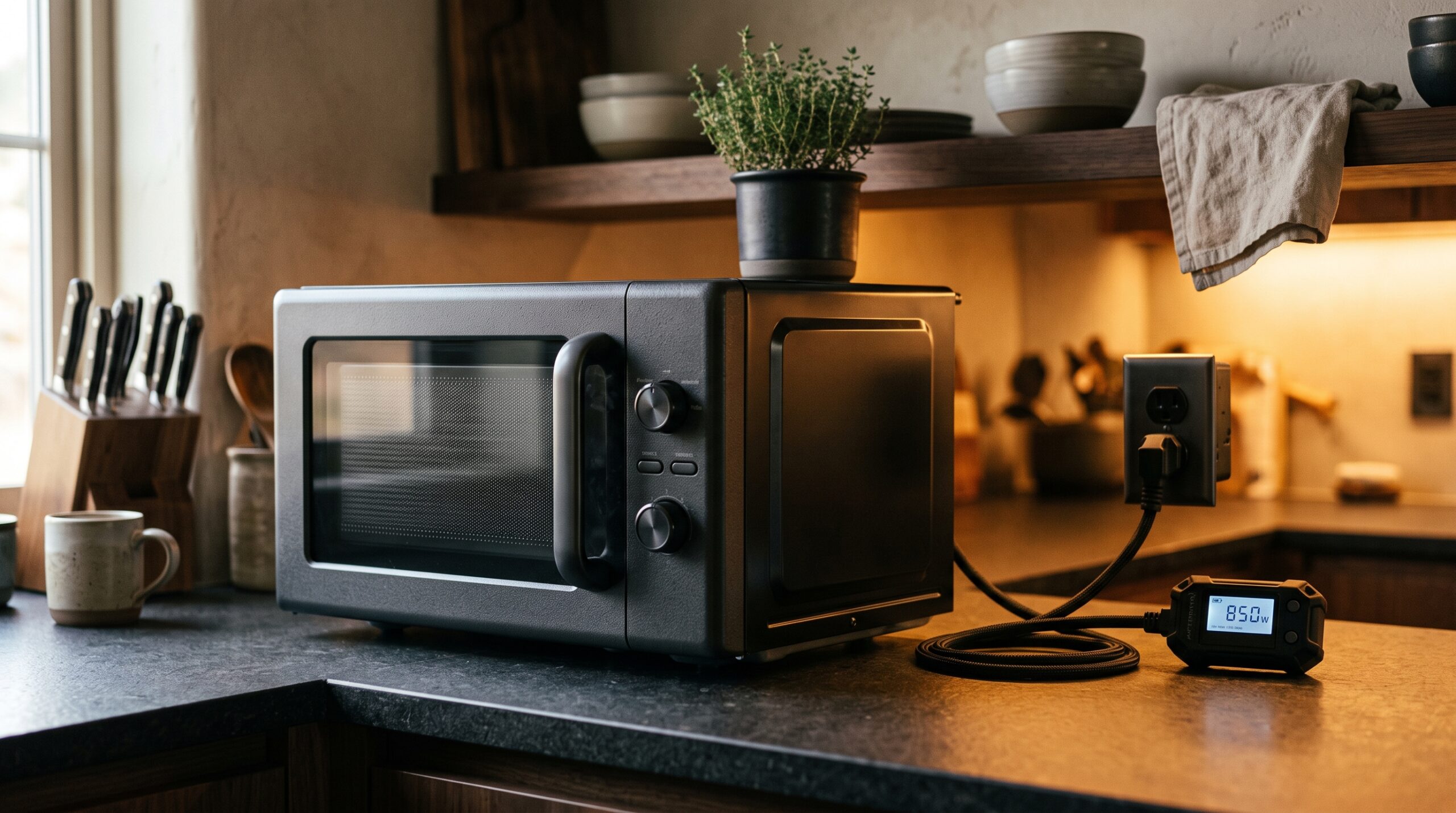
The number printed on the box or door of a microwave, like 700W or 1,000W, is the cooking power it puts into your food, not the power it pulls from the wall. Microwaves are only about 50 to 65 percent efficient, so a “1,000-watt” oven typically draws closer to 1,400 to 1,700 watts from the outlet, plus a brief startup spike. That input number, not the rating on the box, is what your generator, inverter, or power station has to supply.
Cooking watts vs. the watts from the outlet
Microwave makers advertise output wattage because that is what determines how fast your food heats. A 1,000W oven cooks faster than a 700W one. But generating those microwaves with a magnetron wastes energy as heat, and the oven also runs a cooling fan, a turntable motor, a control board, and often an interior light. All of that draws extra current.
A study of 203 microwave models found the average unit is about 71 percent efficient at turning input power into cooking power, though many real-world ovens land in the 50 to 65 percent range. Practically, that means the listed wattage is usually less than three-quarters of what the appliance actually pulls. When you are sizing backup power, you have to plan around the higher input figure, not the friendly number on the front.
How many watts does a microwave use from the wall?
Most countertop microwaves draw somewhere between 900 and 1,700 watts while running. Compact ovens sit at the low end; large 1,100W and 1,200W models sit at the high end. The table below maps the rating on the box to the input power the oven typically pulls and what that means for common power station sizes. Figures are averages from appliance testing, rounded for planning.
| Rating on box (cooking watts) | Typical input watts from outlet | Runs on a 300W station? | Runs on a 1,000W station? | Runs on a 2,000W station? |
|---|---|---|---|---|
| 700W (compact) | ~980W | No | Yes (tight) | Yes |
| 800W | ~1,120W | No | Borderline | Yes |
| 900W | ~1,260W | No | No / surge risk | Yes |
| 1,000W (standard) | ~1,400W | No | No | Yes |
| 1,100W | ~1,540W | No | No | Yes |
| 1,200W (large) | ~1,650W | No | No | Yes (check surge) |
Note the “300W station” column: no household microwave starts on a small power station, no matter how briefly you run it. The continuous draw alone is several times the station’s output. This is the single most common backup-power surprise, so it is worth understanding why before you rely on one in an outage. For a deeper walk-through with specific battery sizes, see how long a power station will run a microwave.
The startup surge most people forget
On top of the steady running draw, a microwave’s magnetron and transformer pull a brief spike of current the instant they fire up. It only lasts a fraction of a second, but it can push the momentary demand a few hundred watts above the running figure. A 1,000W microwave that draws roughly 1,400W while cooking may need a source rated for 1,500 to 1,800W just to start cleanly.
This is the difference between continuous output and peak output. A power station or inverter advertises both numbers, and the microwave has to fit under each. If a unit can handle the running load but not the surge, it will trip and shut off the moment you press start. The same idea applies to motors, pumps, and compressors, which is covered in running watts vs. starting watts.
Why a small power station may refuse to start a microwave
People often assume a 500Wh or 700Wh power station can run “a 1,000W microwave for a little while.” Two separate limits get in the way:
- Power (watts) gates whether it turns on at all. If the microwave’s input draw exceeds the station’s continuous output rating, the inverter overloads and cuts out instantly. A station with a 600W or 800W inverter cannot supply the ~1,400W a standard microwave demands.
- Energy (watt-hours) gates how long it runs. Even a big-enough inverter only runs as long as the battery lasts. A 1,000Wh station feeding a 1,400W load lasts only a few minutes of actual cook time, minus inverter losses.
To start and sustain a typical microwave, you generally want a power station with at least a 1,500 to 2,000W continuous inverter (with headroom for surge) and a battery large enough that a few minutes of cooking does not drain it. If the watts-versus-watt-hours split is fuzzy, what is a watt-hour explains it plainly. To run the numbers for your exact oven and battery, use the runtime calculator.
What this means for backup cooking in an outage
A microwave is one of the most power-hungry things you might want during an outage, so it is rarely the efficient choice for backup cooking. Reheating a single plate for two minutes is fine on a large station. Cooking a full meal, or relying on the microwave repeatedly through a multi-day outage, will drain a battery fast and leave nothing for your fridge, phones, or lights.
- For quick reheating, a 2,000W-class power station handles a standard microwave with surge headroom to spare.
- For real meals during an outage, a propane stove, butane burner, or grill uses far less of your stored electricity. See how to cook without power for safer, lower-draw options.
- If a microwave is a must-have on backup power, size the station to the input watts plus surge, not the rating on the box.
Frequently asked questions
Does a 1,000W microwave really use 1,000 watts?
No. The 1,000W figure is cooking output. The actual draw from the outlet is usually around 1,400 to 1,500 watts, because the oven is only about 60 to 70 percent efficient and also powers a fan, turntable, and electronics.
How many amps does a microwave use?
On a standard 120-volt circuit, a microwave drawing about 1,400 watts pulls roughly 12 amps. That is why manufacturers usually recommend a dedicated 20-amp outlet and advise against sharing the circuit with other appliances.
Where do I find my microwave’s real input wattage?
Look at the data plate, usually a sticker on the back or inside the door frame. It lists “input power” or “rated input” in watts, separate from the “output” or “cooking power.” The input figure is the one to use for backup power planning.
Can a portable power station run a microwave?
Only a large one. You need a continuous inverter rating above the oven’s input draw (often 1,500W+) plus surge headroom, and enough battery capacity that a few minutes of cooking does not drain it. Small 300W to 800W stations cannot start a standard microwave.
How much electricity does a microwave use per day?
Run time is short, so daily energy is modest. About 15 minutes a day on a typical oven works out to roughly 70 to 90 kilowatt-hours a year, often under $15 on average U.S. rates. The high wattage matters for backup sizing; the low total runtime keeps the monthly bill small.
Sources
- EnergySage — How Many Watts Does a Microwave Use?
- EcoCostSavings — Microwave Wattage (203 models studied, input vs. output)
- Energy Use Calculator — Electricity Usage of a Microwave
- Panasonic — 1,200W Inverter Microwave (NN-SN68KS) specifications
- EcoFlow — How Many Watts Does a Microwave Use? (inverter sizing & surge)