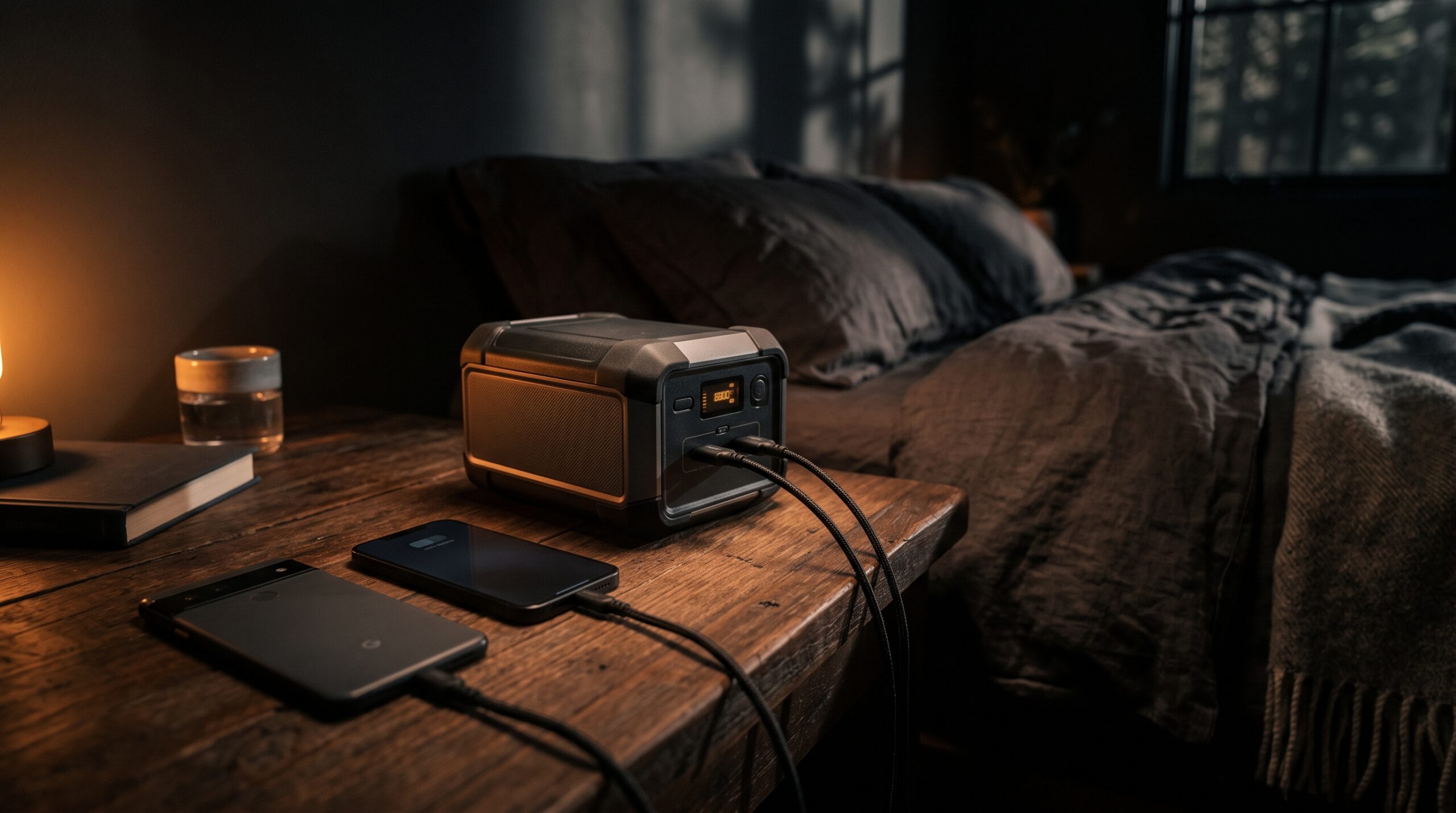
A power station will charge a phone far more times than most people expect. Here is the quick rule of thumb: take the station’s usable watt-hours, multiply by about 0.85 for charging losses, then divide by your phone’s battery size of roughly 16 watt-hours. A 1,000Wh station works out to somewhere around 45 to 60 full phone charges, so for phones alone you are unlikely to run dry during a normal outage.
The quick math behind phone charges
Phone batteries are small. A standard iPhone 15 holds about 13Wh, an iPhone 15 Plus or Pro Max sits near 17Wh, and a big Android with a 5,000mAh cell lands around 19 to 20Wh. Most people can use 16Wh as a fair middle number for a typical modern phone.
The formula is simple:
- Charges ≈ (station Wh × efficiency) ÷ phone Wh
- Efficiency through the USB ports runs about 80 to 90 percent.
- A 16Wh phone needs roughly 18 to 20Wh pulled from the station to go from empty to full, once losses are counted.
If watt-hours are new to you, the watt-hour explainer covers how the rating works and why it matters more than the headline wattage on the box.
How many phone charges by power station size
The table below assumes a 16Wh phone and a real-world efficiency band of 80 to 90 percent through the USB ports. These are ranges on purpose. Phones rarely drain to absolute zero, batteries lose a little capacity with age, and fast charging runs hotter and slightly less efficient.
| Power station size | Approx. full charges of a 16Wh phone |
|---|---|
| 100Wh (small carry unit) | ~4 to 6 |
| 300Wh | ~13 to 18 |
| 500Wh | ~21 to 30 |
| 1,000Wh | ~42 to 60 |
| 2,000Wh | ~85 to 120 |
Want numbers tuned to your exact gear instead of a 16Wh average? Plug your station’s rating and your devices into the runtime calculator for a closer estimate.
Why you won’t hit the theoretical maximum
The advertised watt-hour number is the total stored in the cells, not what reaches your phone. A few things shave it down before any electrons get to your battery.
- Usable capacity is lower than the label. You typically get around 85 to 90 percent of the rated Wh out of a station once its own electronics take their cut.
- Charging itself wastes energy. Voltage conversion and heat eat another slice, which is where the 80 to 90 percent USB efficiency figure comes from.
- Phones don’t start at zero. If you top up at 30 percent, each “charge” only uses about two-thirds of a full cycle, which can make your real-world count look higher.
- Cold and fast charging cost a bit more. A freezing garage or a 45W fast charge is slightly less efficient than a slow top-up at room temperature.
This is also why a station’s stated capacity slowly drifts down over years of use. The power station lifespan guide goes into how cycle count and chemistry affect that.
Use the USB ports, not the AC outlet
How you plug in changes how many charges you get. Charging straight from a USB-A or USB-C port keeps the energy as DC the whole way, which is the efficient path. Using the AC outlet with your wall charger forces the station to run its inverter, flipping DC to AC, and then your charger flips it back to DC. That double conversion typically wastes an extra 10 to 15 percent.
For a phone, the difference can mean several lost charges over the life of a single battery cycle. Skip the wall brick during an outage and use the station’s USB ports directly. The AC outlet earns its keep for things that genuinely need it, not a phone. For a wider set of outage tactics, see how to keep your phone charged during a power outage.
It’s not only phones
The same battery feeds everything small you own. Because these devices hold so little energy, a mid-size station can top them up many times over before it makes a dent.
- Wireless earbuds: well under 1Wh per case charge, so a station holds hundreds of refills.
- Smartwatch: roughly 1 to 2Wh, good for dozens upon dozens of charges.
- Tablet: an iPad runs about 28 to 40Wh, so figure on roughly half the count you’d get from a phone.
- Laptop: 50 to 100Wh, which is where a station’s capacity starts to matter and the AC-versus-USB choice gets more important.
One 500Wh unit can realistically keep a couple of phones, a tablet, and a set of earbuds topped up through a multi-day outage with room to spare.
When a power bank is the smarter buy
If your only goal is keeping phones alive, a power station may be overkill. A pocket 10,000mAh power bank holds about 37Wh and will charge most phones two to three times. It costs a fraction of a power station, fits in a bag, and needs no inverter. Keep one charged in a drawer and it covers the most common short outage.
A power station earns its price when you also need to run lights, a CPAP, a fridge, or other AC gear. If you are weighing the two, the power bank vs power station comparison breaks down which fits which situation.
Sizes that cover phones for days, live prices


As an Amazon Associate we earn from qualifying purchases. Prices are pulled automatically from Amazon and may have changed.
Frequently asked questions
How many times can a 100Wh power station charge a phone?
Roughly 4 to 6 full charges for a typical 16Wh phone, charging through the USB port. A small iPhone gets closer to 6, a big Android closer to 4. The 100Wh size is the common limit for carrying a unit on a plane.
How many times can a 1000Wh power station charge a phone?
About 42 to 60 full charges for an average phone. That is enough to keep a household of phones running for days, which is why phone charging alone rarely justifies a unit this large.
Does charging through USB really beat the AC outlet?
Yes. The AC outlet runs the inverter and your wall charger does a second conversion, wasting about 10 to 15 percent more than charging straight from the station’s USB-C or USB-A port. For phones, always use USB.
Why are these charge counts given as ranges?
Because the real number depends on your phone’s battery size, how low it gets before you plug in, the temperature, and charging losses. A single exact figure would be false precision, so a range is more honest.
Will fast charging drain the station quicker?
Slightly. Fast charging runs warmer and is a touch less efficient than a slow top-up, so you may get a hair fewer charges. The difference is small for phones and not worth worrying about during an outage.