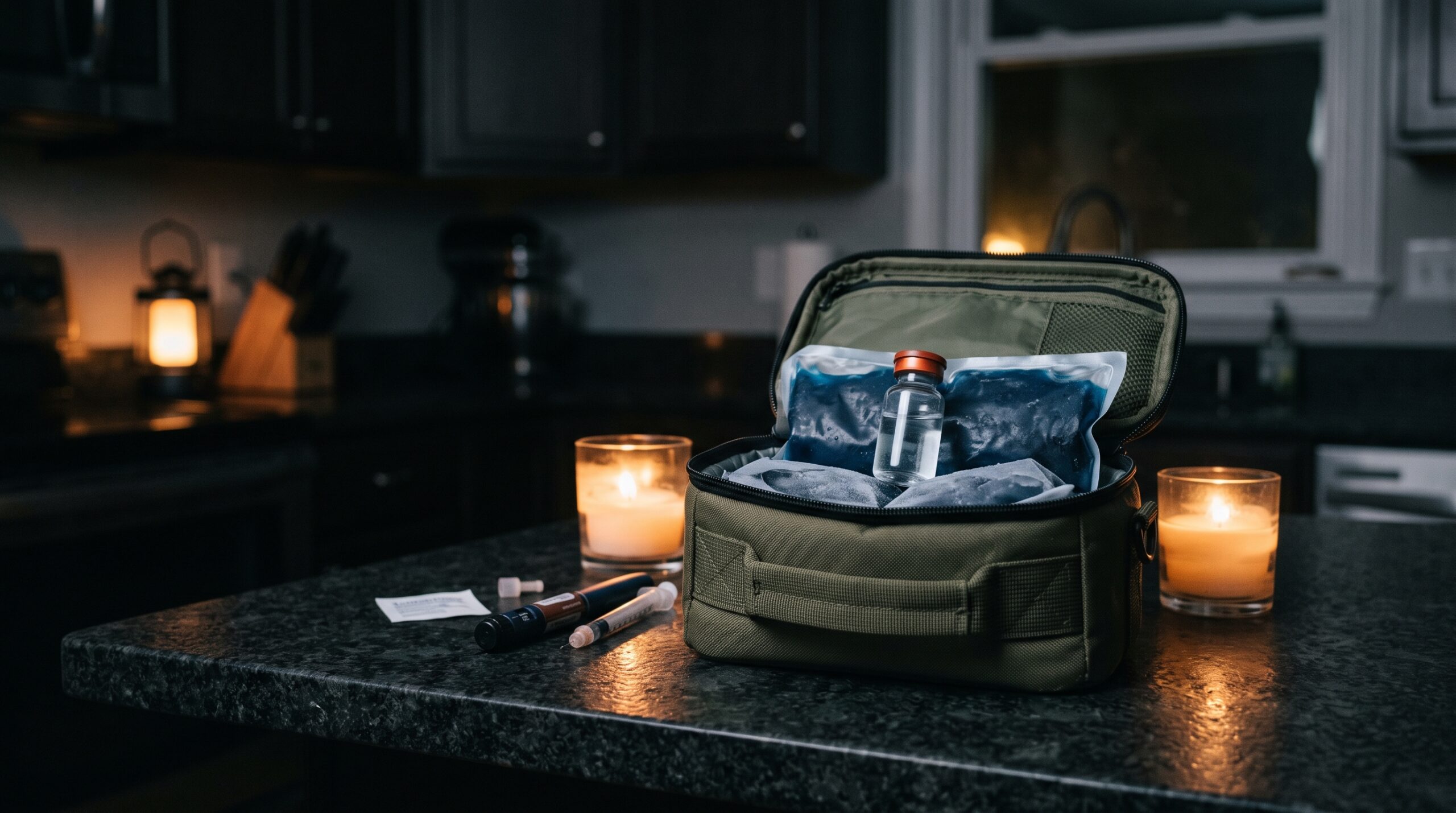
Insulin you are not using keeps best in the refrigerator at about 36 to 46°F (2 to 8°C), while a vial or pen you have already started can usually sit at room temperature between 59 and 86°F for a limited number of days. During a power outage the goal is simple: keep insulin cool without letting it freeze, and follow the storage limits printed on your specific insulin’s label. This article is general information, not medical advice, so check your label and ask your pharmacist or doctor about your own supply.
Insulin storage basics: the temperatures to know
All three major U.S. insulin makers recommend storing unopened insulin in the refrigerator at roughly 36 to 46°F (2 to 8°C), where it stays good until the expiration date on the carton. Once a vial, pen, or cartridge is in use, most products can be kept at room temperature between 59 and 86°F (15 to 30°C), but the number of days varies by product. Many common insulins are good for about 28 days at room temperature; some last longer and a few have shorter limits, so the only number that matters for your supply is the one on your label.
| Insulin state | Temperature | How long |
|---|---|---|
| Sealed / not in use | Refrigerated, 36–46°F (2–8°C) | Until the printed expiration date |
| In use (opened pen or vial) | Room temp, 59–86°F (15–30°C) | Often ~28 days, but varies by product — check your label |
| Frozen | Never freeze | Discard; do not use |
| Hot (above 86°F) | Avoid | Loses potency the longer it is exposed |
What the FDA says about insulin in an emergency
The FDA recognizes that during a disaster or extended outage you may not be able to keep insulin properly refrigerated. Its emergency guidance says that under these conditions you can use insulin in opened or unopened vials that has been kept at room temperature (59 to 86°F) for up to four weeks, even if it was briefly stored above 86°F. The trade-off is potency: insulin loses some effectiveness when exposed to temperature extremes, and the longer the exposure, the weaker it becomes, which can make your blood sugar harder to control.
The FDA and CDC both advise the same follow-up. Use emergency-stored insulin only if you have to, watch your blood sugar more closely, and once a normal refrigerated supply is available again, throw away any insulin that was exposed to those conditions and replace it as soon as you can. If you are unsure whether a specific vial is still good, the manufacturer’s helpline can advise on your product. This is general guidance, not a substitute for your doctor or pharmacist.
How to keep insulin cool without power
The aim during an outage is to hold insulin in a safe range, not to freeze it solid. A few approaches work well, and you can combine them depending on how long the power is out.
- A cooler with ice or gel packs. A standard cooler holds temperature for hours. Keep insulin from touching the ice or frozen packs directly: wrap the vials or pens in a cloth or place them in a sealed container, and add a folded towel as a buffer so nothing freezes. A small thermometer inside the cooler takes the guesswork out.
- Insulated medication travel cases. Padded diabetic cases with a slim gel pack are made to hold insulin near the right range for a day trip or a short outage, again with a barrier between the insulin and the pack.
- Evaporative cooling pouches. Frio-style pouches use water and evaporation rather than ice. You soak them, and they keep contents below room temperature for a couple of days without any power or freezer. They cannot replace a refrigerator for sealed long-term stock, but they are useful for an in-use pen or for travel.
The same keep-it-cool, never-frozen logic applies to other temperature-sensitive prescriptions. Our guide to handling refrigerated medicine during a power outage covers the broader picture, and the food-safety rule that a closed fridge holds its cold for roughly four hours is worth knowing too — see how long food lasts in the fridge without power.
Don’t let insulin freeze, and other mistakes to avoid
Freezing is the error people make when they pack insulin straight against ice. The CDC is direct about it: insulin that has been frozen can break down and will be less effective, and you should not use it even after it thaws. A few other points are easy to get wrong in a rush.
- No direct ice contact. Insulin resting against a frozen pack can drop below freezing even if the cooler air feels fine. Always keep a barrier between them.
- Keep it out of heat and sun. Heat and direct sunlight also degrade insulin, so a hot car, a windowsill, or a closed vehicle is the wrong place during an outage.
- Watch for visible changes. Clear insulins (like most rapid-acting types) should stay clear and colorless. Discard insulin that looks cloudy, discolored, clumpy, or has solid particles, and follow your label’s appearance notes for cloudy insulins.
- Don’t stretch past your limits. Once normal refrigeration returns, replace insulin that sat through extreme conditions rather than gambling on weakened doses.
Using a power station to keep a small fridge running
If outages in your area are common or long, the most reliable fix is to keep a refrigerator running. A portable power station can do this. A small 12V medical or compact mini-fridge typically draws somewhere around 40 to 60 watts and cycles on and off rather than running constantly, so a mid-size power station can keep one cold for many hours to a couple of days, depending on its capacity and the fridge.
To size this properly, estimate the fridge’s average draw and your outage length, then check it against a battery’s watt-hours. Our runtime calculator does that math, and if you are choosing hardware, the guides to the best power station for a refrigerator and backup power for home medical equipment walk through capacity, recharging from solar, and which units suit a medical fridge. Pairing a power station with a small fridge is the closest thing to keeping a normal supply chain through a long outage.
Plan ahead before the next outage
A little preparation removes most of the stress. Keep an extra supply of insulin on hand where your prescription allows, and store a backup cooler with frozen gel packs you can grab fast. Write down your specific insulin’s refrigerated and room-temperature limits, along with the manufacturer’s phone number, and keep that note with your kit. If you rely on a pump or other powered devices, build insulin into a broader plan rather than treating it on its own.
- Know your insulin’s exact room-temperature day limit from its label.
- Keep a cooler plus frozen gel packs ready, with a cloth barrier so nothing freezes.
- Save the maker’s helpline: Lilly 1-800-545-5979, Novo Nordisk 1-800-727-6500, Sanofi 1-800-633-1610.
- For longer outages, plan a power station and a small fridge using the runtime calculator.
One more reminder, because it matters with a medication: this is general information, not medical advice. Your insulin’s package insert and your pharmacist or doctor are the final word on what is safe to use.
Frequently asked questions
How long can insulin stay out of the fridge during an outage?
Most in-use insulins can be kept at room temperature (59 to 86°F) for up to about 28 days, and the FDA says that in an emergency you can use insulin stored this way for up to four weeks. The exact limit depends on your product, so check the label. Insulin loses some potency the longer it stays warm, so use refrigerated supply first when you have it.
Can I use insulin that got too hot or too cold?
Use it only if you have no alternative. Insulin exposed to heat above 86°F or to freezing loses effectiveness, and frozen insulin should not be used at all. The FDA and CDC advise discarding insulin that was stored in extreme conditions and replacing it once a properly refrigerated supply is available. Monitor your blood sugar closely in the meantime and contact your doctor.
Is it safe to put insulin directly on ice?
No. Insulin resting against ice or a frozen gel pack can freeze, which damages it. Keep a cloth or container between the insulin and any frozen item, and use a thermometer to confirm the cooler is staying cool rather than cold enough to freeze.
Will a power station keep my insulin fridge running?
Yes, within its capacity. A small medical or 12V fridge often draws around 40 to 60 watts and cycles on and off, so a mid-size power station can run one for many hours to a couple of days. Use our runtime calculator to match a battery’s watt-hours to your fridge and expected outage length.
Where should I keep insulin if I have no cooler?
Keep it in the coolest indoor spot away from direct heat and sunlight, and out of any hot car. An evaporative cooling pouch or an insulated case can buy time. As long as the temperature stays in your insulin’s room-temperature range, an in-use pen is generally usable for its labeled number of days, but check that label and your appearance notes.
Sources
- U.S. Food & Drug Administration — Information Regarding Insulin Storage and Switching Between Products in an Emergency
- Centers for Disease Control and Prevention — Managing Insulin in an Emergency
- American Diabetes Association — Insulin Storage and Syringe Safety
- Novo Nordisk Medical — Insulins Storage & Stability