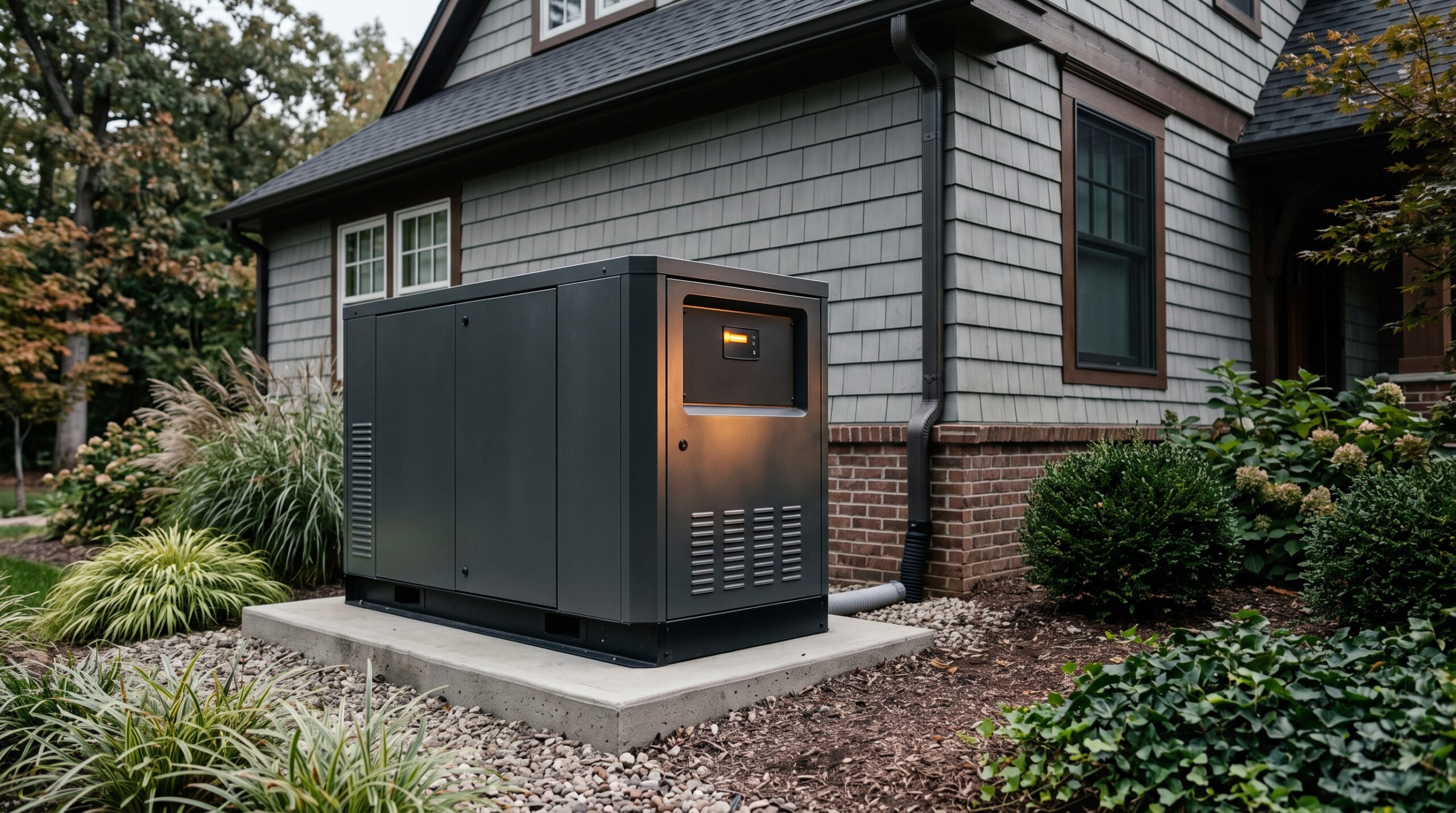
A whole-house standby generator is worth it if your outages are frequent or long and you need the whole home backed up automatically. If your power goes out a few times a year for an hour or two, a unit that costs as much as a small car plus a professional install is usually overkill. The honest answer depends on four things: how often and how long the lights go out, what you actually need to keep running, your budget, and whether you have reliable fuel access.
This guide walks through what a standby generator really costs and includes, when it earns its keep, and when a portable generator or a home battery covers the same need for far less.
What a standby generator costs and includes
A whole-house standby generator is a permanently installed unit that sits outside the home, much like a central air conditioner. It connects to your natural gas line or a propane tank and ties into your electrical panel through an automatic transfer switch. When the grid drops, the transfer switch senses the loss, signals the generator to start, and restores power within seconds, then switches back when utility power returns. You do not have to be home or do anything.
The price is not just the generator. A realistic budget includes several pieces:
- The generator unit. Air-cooled home standby units for a typical single-family home commonly fall in the 10 kW to 26 kW range. Bigger homes or those running central air and electric appliances sit at the higher end.
- The automatic transfer switch. This is what makes the system automatic and safe, and it is usually included with the unit or sold alongside it.
- Professional installation. Labor, the concrete or composite pad, gas line and electrical hookup, and permits often add up to a meaningful share of the total, sometimes rivaling the cost of the unit itself.
- Fuel connection. Tapping an existing natural gas line is simpler; adding or upsizing a propane tank is an extra cost.
All in, a whole-house standby system lands in the highest upfront tier of home backup options, typically well into five figures once installation, the transfer switch, fuel work, and permits are counted. Treat any single number you see online as a starting point, not a quote. The only reliable figure comes from a site survey, where an installer measures your actual electrical load. If you want a rough idea of capacity before you call anyone, our guide to whole-house generator sizing explains how the math works.
When a whole-house generator is worth it
The case for a standby generator gets stronger as your outages get longer and more frequent. It tends to be worth the investment when several of these apply:
- You lose power often, or outages routinely last many hours to several days (think storm-prone regions, ice storms, or wildfire-related shutoffs).
- You need the whole home backed up, not just a few circuits, including central heating or cooling, a well pump, a sump pump, or a home office.
- Someone in the household relies on power for medical equipment or temperature-sensitive medication.
- You have natural gas service, so the generator can run essentially indefinitely while the supply holds.
- You want hands-off operation, with power restored automatically whether or not you are home.
Standby units are also built to last, commonly cited at 15 to 30 years of service life with regular maintenance, which spreads that high upfront cost over a long horizon. For homes that flood, lose power for days at a time, or run critical loads, that reliability is the whole point.
When a portable generator or battery is enough
For many households, a standby generator solves a problem they do not actually have. If your outages are short and occasional, or you only need to keep a fridge, some lights, phones, and a router running, cheaper options cover it.
- Portable generators sit in the lowest upfront tier and can power a handful of essentials. The trade-offs are manual: you wheel it out, refuel it, run it outdoors well away from the home for carbon monoxide safety, and connect it through a proper transfer switch or interlock if you want to feed household circuits. They do not start on their own.
- Portable power stations and home batteries run silently with no fumes and almost no maintenance, which makes them ideal indoors and overnight. The limit is capacity: a battery only holds so many kilowatt-hours, so runtime is finite unless you recharge it from solar or the grid. Pairing a larger battery with solar can stretch that considerably.
If you are weighing quiet battery power against a fuel-burning unit, our comparisons of portable vs home battery backup and a generator vs a power station break down which fits which kind of outage. Many people end up with a portable generator or a battery long before a standby unit ever makes sense.
How the options compare
| Option | Upfront cost tier | Coverage | Install |
|---|---|---|---|
| Portable generator | Low | A few essential circuits or appliances | DIY to use; electrician needed for transfer switch or interlock |
| Portable power station (battery) | Low to mid | Electronics and small appliances, finite runtime | Plug and play, no install |
| Home battery backup | High | Essential circuits up to whole home, limited by capacity | Professional electrician install |
| Whole-house standby generator | Highest | Whole home, runs continuously on fuel | Professional install, licensed electrician, permits |
Install and maintenance
A standby generator is not a do-it-yourself project. Installation ties together a fuel line and a hardwired connection to your electrical panel through an automatic transfer switch, and that work requires a licensed electrician and a professional installer, plus local permits and inspection. Gas and high-voltage connections are exactly where shortcuts cause fires, carbon monoxide hazards, and dangerous backfeed onto utility lines. Have it done by qualified pros, and confirm the unit is sized to your real load with a site survey rather than a guess.
Standby units also need ongoing upkeep. They self-test on a schedule, but plan on roughly an annual service (oil and filter changes, battery checks, and a general inspection), and budget for that recurring cost over the life of the unit. Skipping maintenance is the most common reason a generator fails to start when an outage finally hits.
Fuel considerations
Fuel access is often the deciding factor. Natural gas is the most convenient, because the unit draws from your existing utility line and can run for as long as the supply holds, which is what makes true indefinite backup possible. Propane gives you independence from the gas grid but is capped by your tank size, so a long outage means watching the gauge and arranging refills. Running cost varies with fuel type, unit size, and how heavily you load it, so a generator backing up an entire home costs more per hour than one carrying only essentials.
If you do not have natural gas service and do not want a large propane tank, that alone can tip the decision toward a battery or a portable unit instead.
Size it before you decide
Whether you lean toward a standby generator, a portable unit, or a battery, the smart first step is figuring out how much power you actually need and how long you need it to last. That keeps you from overbuying a unit that is bigger than your home requires, or underbuying one that stalls under load.
- Use the Power-Station Sizing calculator to add up the wattage of everything you want to keep running and see the capacity range that covers it.
- Use the Appliance Runtime calculator to estimate how long a given battery or fuel supply will carry your load during an outage.
Standby, portable and battery compared

Generac 22kW Whole Home
Transfer switch included, cellular monitoring, NG or propane
$6,506.10Check price on Amazon →

Champion 9375W Dual Fuel
Home-backup open frame, electric start, gas or propane
$874.99Check price on Amazon →

As an Amazon Associate we earn from qualifying purchases. Prices are pulled automatically from Amazon and may have changed.
Frequently asked questions
Is a whole-house generator worth it for occasional short outages?
Usually not. If your power goes out only a few times a year for an hour or two, the high upfront and install cost of a standby unit is hard to justify. A portable generator or a battery power station typically covers short, occasional outages for a fraction of the price.
How long can a whole-house standby generator run?
On natural gas, a standby generator can run essentially indefinitely as long as the utility supply holds, which is why it suits multi-day outages. On propane, runtime is limited by your tank size, so a long outage means monitoring the level and arranging refills.
Can I install a standby generator myself?
No. A whole-house standby generator involves a fuel line connection and a hardwired tie-in to your electrical panel through an automatic transfer switch. That work requires a licensed electrician and a professional installer, along with local permits and inspection, for safety and code compliance.
Standby generator or home battery: which is better?
It depends on your outages and priorities. A standby generator runs continuously on fuel and is the better fit for long, frequent outages and whole-home backup. A home battery is quiet, fume-free, and low maintenance, and works well for shorter outages or when paired with solar, but its runtime is limited by capacity.
What size whole-house generator do I need?
It depends on your home’s electrical load, not its square footage alone. Air-cooled home standby units commonly run from 10 kW to 26 kW, with central air and electric appliances pushing you higher. The reliable way to size one is a professional site survey, but the sizing calculator gives you a solid ballpark first.
Sources
- Generac — Portable vs. Home Standby Generators
- Kohler — Home Standby Generators
- Consumer Reports — Portable vs. Standby Generator: Which Is Right for Your Home?
- HomeGuide — Whole House Generator Cost
- Angi — Whole House Generator Cost and Installation