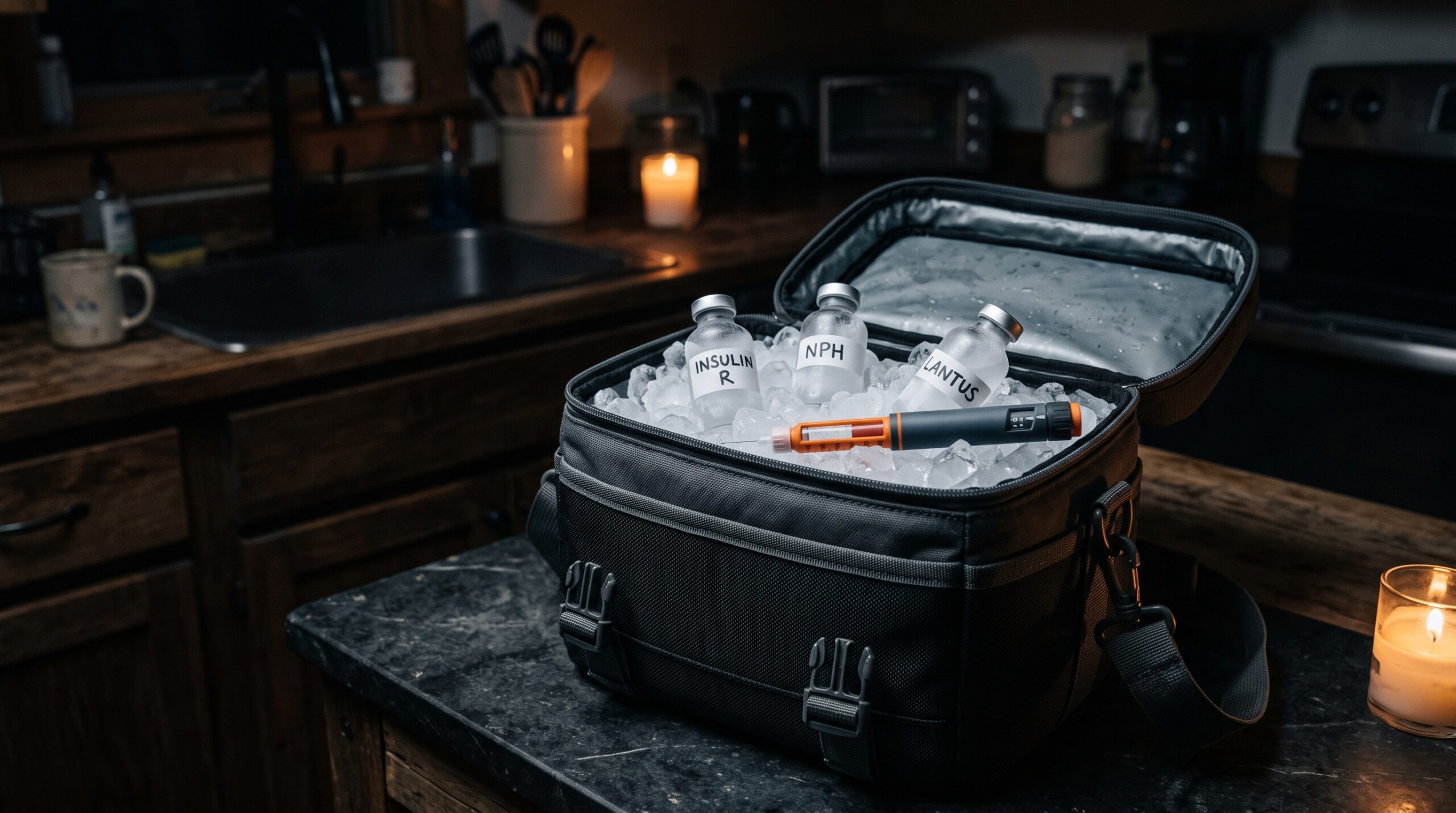
Most refrigerated medicine, including insulin, can usually ride out a typical power outage if you keep the fridge closed and then move it to a cooler with ice packs. The FDA notes that insulin in vials or cartridges, opened or unopened, can sit at room temperature between 59 and 86°F for up to 28 days and still work, so a normal outage rarely spoils it. The one rule that matters most is simple: keep it cool, but never let it freeze.
This guide explains how to protect temperature-sensitive medicine during an outage: keeping the fridge shut, packing a cooler the right way, what the FDA says about insulin held at room temperature, when to replace a dose, and how a battery power station can keep a small medicine fridge running. It is planning information only. What counts as safe for your specific medication is a question for your pharmacist, your doctor, and the label, not an average in an article.
⚠️ This is planning guidance, not medical advice
Follow your medication’s label and your pharmacist or doctor on storage and whether a dose is still safe to use. Do not let insulin freeze, and do not change a prescribed dose or schedule to save power. When in doubt, contact your pharmacist.
Keep the fridge closed first
The first move when the power goes out is to do nothing to the fridge. A closed refrigerator holds its temperature far longer than most people expect, and every time the door opens, cold air spills out and the clock speeds up. The CDC’s food-safety guidance is the clearest benchmark here: with the doors kept shut, a refrigerator stays cold for about 4 hours and a full freezer for about 48 hours. That same buffer is what protects the medicine on the shelf while you decide what to do next.
So before you reach for a cooler, leave the door closed and use that window to get organized. Find your medication labels, locate your ice packs, and check whether the outage is likely to be short or long. The same closed-door discipline that keeps your groceries safe is covered in more depth in our guide to keeping food cold without power, and the physics is identical for the medicine sharing that fridge. Only when the outage looks like it will outlast that 4-hour refrigerator window do you need to move medicine into a cooler.
Use a cooler safely, and never let meds freeze
When the outage stretches past a few hours, move temperature-sensitive medicine into a cooler with ice packs. The goal is to keep it cold without ever letting it freeze, because freezing damages many refrigerated drugs. The CDC is direct about insulin: keep it cool, but make sure not to freeze it, since insulin that has been frozen can break down and will be less effective. Loose ice and dry ice both run that risk, so the way you pack the cooler matters as much as the cooler itself.
Use sealed ice packs or frozen gel packs rather than loose ice, and put a barrier between the medicine and the cold. A towel or a layer of cloth on the bottom and sides keeps vials and pens from resting directly against a frozen pack, which is exactly where freezing damage happens. Keep the insulin or medicine in a sealed bag or box so it stays dry, and drop an inexpensive thermometer in the cooler so you are watching the temperature instead of guessing.
| Do | Don’t |
|---|---|
| Use sealed ice packs or frozen gel packs to hold the cold. | Don’t let vials, pens, or cartridges rest directly on or against ice. |
| Wrap medicine in a cloth and keep it in a sealed bag or box. | Don’t pack insulin in the freezer or against dry ice, which can freeze it. |
| Keep a thermometer in the cooler and aim to stay cold but above freezing. | Don’t open the cooler more than you have to. |
| Store the cooler in the coolest, shadiest spot, away from direct sun. | Don’t assume a dose is fine after exposure without checking the label or your pharmacist. |
One caution worth repeating: the trick of burying insulin in a still-cold freezer can push it below freezing, which ruins it. The American Diabetes Association’s emergency guidance also reminds people not to use insulin that has changed in appearance, such as becoming cloudy when it should be clear, or showing clumps or crystals. If a dose looks wrong, set it aside and ask your pharmacist before using it.
FDA guidance on insulin in an emergency
Insulin is the medicine most people worry about in an outage, and the FDA has specific emergency guidance for it. According to the FDA, insulin products in vials or cartridges supplied by the manufacturer, opened or unopened, may be left unrefrigerated between 59 and 86°F for up to 28 days and continue to work. In plain terms, a typical outage is usually well within insulin’s tolerance, so you often do not need a running fridge to get through it, as long as the insulin stays out of heat and never freezes.
There are limits worth knowing. The FDA also notes that insulin loses some effectiveness when exposed to extreme temperatures, and the longer that exposure lasts, the less effective it becomes, which can mean worse blood-sugar control over time. Insulin that has been altered, such as diluted or removed from the manufacturer’s original vial, should be discarded within two weeks. The CDC adds that if you have to use insulin stored above 86°F during an emergency, you should monitor your blood sugar regularly. None of this replaces your own product’s instructions, so check the label and call your pharmacist with anything specific to your insulin.
Insulin is also a useful reference point for understanding other refrigerated drugs, but it is not a universal rule. Many biologics, some antibiotics in liquid form, certain eye drops, and other specialty medications have their own, often stricter, storage windows. The manufacturer prints those limits on the label and in the package insert, and your pharmacist can tell you how each one behaves in an outage. Treat insulin’s 28-day room-temperature allowance as insulin’s number, not every medicine’s number.
When to replace medicine after an outage
After the power comes back, the safe default is caution. The CDC advises that once you are back to your routine, you throw away insulin that was stored at room temperature or at very high or low temperatures during the emergency, and that you visit your doctor if you have questions about managing your diabetes going forward. The thinking applies broadly: medicine that sat outside its labeled range, especially anything that may have frozen or gotten hot, is a candidate for replacement rather than a gamble.
- Anything that froze. Frozen insulin and many other refrigerated drugs are no longer reliable, even after they thaw. If a dose froze, replace it.
- Anything that got hot or sat out too long. If medicine was held above its labeled range, or unrefrigerated longer than the label allows, ask your pharmacist whether it is still usable before you rely on it.
- Anything that looks or smells wrong. A change in color, clumps, crystals, or particles is a signal to stop and check, not to use the dose.
- When you are not sure. Do not guess with a medication you depend on. Call your pharmacist, and contact your doctor before skipping or stopping a prescribed dose.
If replacing medicine means a trip to the pharmacy during a wider outage, plan that into your timeline rather than waiting until you are out. Your pharmacist can also advise on emergency refills, and for insulin specifically the manufacturer and diabetes organizations run assistance lines during declared disasters.
Powering a medicine fridge with backup power
For a long outage, or for medication with a tight storage window, a battery power station can keep a small medicine fridge running instead of relying on ice. A compact medication or insulin mini-fridge typically draws somewhere around 50 to 100 watts, and because it cycles on and off rather than running flat out, its real energy use over a day is far lower than that peak. That makes it one of the easier loads to cover with a mid-size lithium power station, and it removes the freezing risk that comes with packing a cooler.
The same equipment notes that apply to other health devices apply here. Favor a pure sine wave power station with LiFePO4 chemistry, and confirm you can recharge it during a long event by solar panel or car. If your household runs other essential health equipment too, our guide to backup power for medical equipment walks through sizing several devices at once, and if anyone in the home uses a breathing machine, see running a CPAP during an outage for how to stretch a battery across the night. A medicine fridge is a light load by comparison, but it is one you want covered.
Plan ahead before the next outage
The calls and the small kit you put together now are what make an outage manageable later. Ready.gov puts this first for anyone with electricity-dependent equipment or refrigerated medicine: talk to your medical provider about a power-outage plan before you need it. A short conversation with your pharmacist or doctor tells you exactly how each of your medications behaves without power, which removes the guesswork at the worst possible moment.
- Ask your pharmacist about each refrigerated medicine. How long is it safe out of the fridge, what temperature range matters, and when should a dose be replaced after exposure.
- Keep a cooler and frozen gel packs ready. Store the packs in the freezer so they are already cold, and keep a cloth or sealed bag with them for wrapping medicine.
- Keep a thermometer with the kit. A simple thermometer in the cooler turns “I think it’s still cold” into a number you can act on.
- Keep a small buffer supply. Where your plan and prescription allow, a modest reserve of medicine and supplies covers the gap if you cannot reach a pharmacy right away.
- Consider backup power for tight-window meds. If you depend on medication that cannot tolerate much time out of the fridge, size a power station to a small medicine fridge in advance.
Size backup power to your own fridge
If you decide to keep a medicine fridge running on a battery, size the power station to your real appliance instead of an average. Use our Power-Station Sizing calculator to work from the hours you want to cover back to a capacity target, and the Appliance Runtime calculator to check how long a given battery will hold your fridge. Enter the wattage printed on your fridge’s label rather than a generic figure, and you will get a number you can actually plan around.
Frequently asked questions
How long can insulin stay out of the fridge during a power outage?
The FDA states that insulin in vials or cartridges, opened or unopened, can generally be left unrefrigerated between 59 and 86°F for up to 28 days and still work, so a typical outage usually does not spoil it. Keep it out of direct heat and sunlight, and never let it freeze, because frozen insulin breaks down. These are general figures, so confirm the specifics for your own insulin with your pharmacist, and follow their guidance on what to discard after a long or hot outage.
Can I put my insulin or medicine directly on ice in a cooler?
No. Resting medicine directly on loose ice or against a frozen pack can freeze it, and freezing damages insulin and many other refrigerated drugs. Use sealed ice packs or frozen gel packs, wrap the medicine in a cloth, and keep it in a sealed bag or box so it stays cold and dry without touching the ice. A thermometer in the cooler helps you stay cold but above freezing. Skip dry ice, which is far too cold for medication.
How do I know if my medicine is still safe to use after an outage?
Check it against the label and ask your pharmacist. As a default, the CDC advises throwing away insulin that was stored at room temperature or at very high or low temperatures during an emergency once you are back to your routine. Anything that froze, got hot, sat out longer than the label allows, or looks cloudy, clumped, or discolored is a candidate for replacement. Do not guess with a medication you depend on, and contact your doctor before stopping or skipping a prescribed dose.
Which medicines need to be kept refrigerated?
It varies by drug, and only the label and your pharmacist can tell you for sure. Common refrigerated medicines include insulin, many injectable biologics, some liquid antibiotics, certain eye drops, and a number of specialty medications, but each has its own storage range and its own tolerance for time out of the fridge. Insulin’s 28-day room-temperature allowance is specific to insulin, not a rule for everything. Ask your pharmacist how each of your refrigerated medications behaves without power.
Will a fridge or freezer keep my medicine cold long enough?
For a while, yes. With the doors kept closed, the CDC notes a refrigerator stays cold for about 4 hours and a full freezer for about 48 hours, so a short outage is often covered by the fridge alone. Past that window, move medicine into a cooler with ice packs, or run a small medicine fridge on a battery power station. Keep the doors shut as long as you can, and use a thermometer rather than guessing when the cold is running out.
Sources
- U.S. Food and Drug Administration, insulin storage and switching between products in an emergency: https://www.fda.gov/drugs/emergency-preparedness-drugs/information-regarding-insulin-storage-and-switching-between-products-emergency
- Centers for Disease Control and Prevention, managing insulin in an emergency: https://www.cdc.gov/diabetes/articles/managing-insulin-in-emergency.html
- American Diabetes Association, tips for emergency preparedness: https://diabetes.org/tools-resources/disaster-relief/tips-for-emergency-preparedness
- Centers for Disease Control and Prevention, keep food safe after a disaster or emergency: https://www.cdc.gov/food-safety/foods/keep-food-safe-after-emergency.html
- Ready.gov, power outages: https://www.ready.gov/power-outages
- Eli Lilly, example insulin storage instructions (Basaglar): https://medical.lilly.com/us/products/answers/how-should-basaglar-insulin-glargine-be-stored-26055