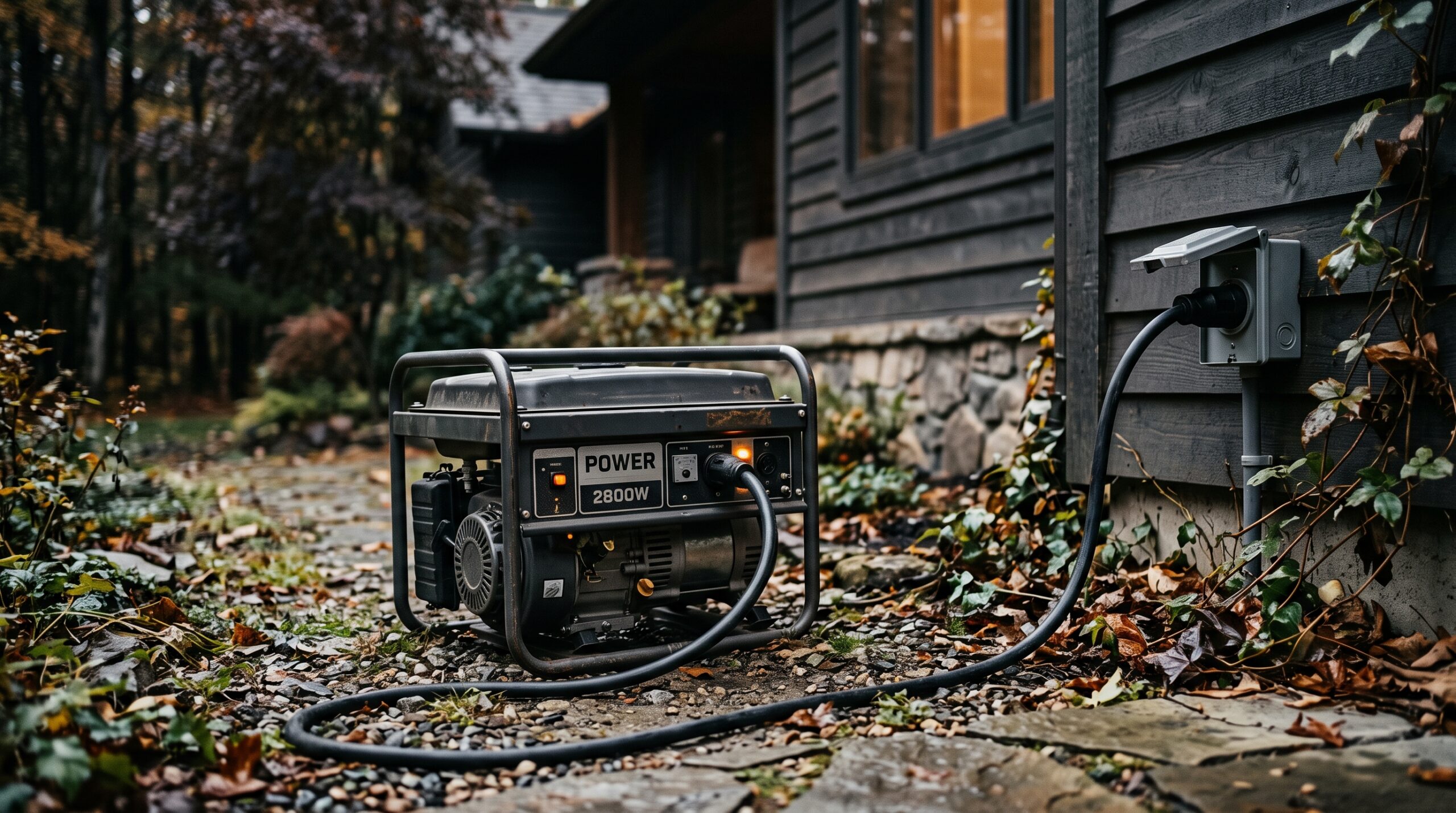
There are only two safe ways to connect a portable generator to your house: run heavy-duty extension cords straight from the generator to individual appliances, or have a licensed electrician install a transfer switch or interlock kit so the generator can power your home’s circuits. Never plug a generator into a wall outlet to “backfeed” the house. It can electrocute utility line workers, start a fire, and destroy your generator. Which method you pick depends on whether you only need a few appliances kept alive or you want hardwired things like a furnace and well pump running.
⚠️ Never backfeed – hire a licensed electrician
Never plug a generator into a wall outlet (backfeeding); it can electrocute utility workers and start fires. Any connection to your panel (transfer switch or interlock) must be installed by a licensed electrician to code. Run the generator outdoors only.
The two safe options at a glance
Both safe methods share one rule: the generator always runs outdoors, far from the house, and only ever connects to your home in a way that keeps your wiring isolated from the utility grid. The difference is how the power gets inside.
Extension cords are the simplest path and require no wiring or permit. You plug cord-and-plug appliances directly into the generator’s outlets and carry the cords to the fridge, a few lamps, or a space heater. Nothing touches your breaker panel, so there is no backfeed risk and no electrician needed. The limit is that you can only reach things you can physically run a cord to, and you cannot power hardwired equipment like a furnace, well pump, or central heat this way.
A transfer switch or interlock kit is the upgrade. A licensed electrician wires a switch into your electrical panel and adds an outdoor inlet box, so a single cord from the generator can feed selected circuits, including hardwired ones. This is the only safe and legal way to power your home’s built-in wiring. It costs more and has to be installed and inspected to code, but it is far more convenient and it removes the temptation to do something dangerous with a wall outlet.
| Method | Best for | Wiring or pro install | Powers hardwired circuits |
|---|---|---|---|
| Extension cords | Fridge, lights, phones, a space heater you can reach with a cord | None; plug and go | No |
| Transfer switch or interlock | Furnace, well pump, sump pump, whole rooms of circuits | Licensed electrician, permit, inspection | Yes |
| Backfeeding a wall outlet | Never do this | Illegal and deadly | Not safe, ever |
Method 1: extension cords straight to appliances
For most short outages, this is all you need, and it is the method safety agencies recommend when you do not have a transfer switch. The idea is to treat the generator like a big outdoor outlet and run cords to the things that matter most. Here is the safe sequence:
- Place and start the generator outdoors, at least 20 feet from the house, with the exhaust pointed away from windows, doors, and vents.
- Use heavy-duty, outdoor-rated extension cords that are undamaged and rated for the wattage of the appliance, ideally with built-in GFCI protection.
- Plug each appliance directly into the generator’s outlets. Plug high-draw items in one at a time so you do not overload the unit.
- Keep cords out of water and out of walkways, and never run them under rugs or through a window gap that pinches the insulation.
- Make sure the total running watts of everything plugged in stays under the generator’s rating, and leave headroom for motor startup surges.
OSHA’s guidance is to use only the manufacturer-supplied cords or proper extension cords that are heavy-duty, outdoor-rated, and undamaged. The trade-off is reach and convenience: you are limited to what a cord can get to, and anything wired into your panel, like a furnace blower or a well pump, is off-limits with cords alone. If that list is short, cords are perfect. If it is long, that is your cue to look at method 2. For the full routine around fueling, placement, and grounding, see our guide on using a generator safely.
Method 2: a transfer switch or interlock (pro install)
To power circuits that are hardwired into your home, the generator has to connect to your electrical panel, and that connection must go through a transfer switch or an interlock kit installed by a licensed electrician. Both devices do the same essential job: they make it physically impossible for utility power and generator power to feed the panel at the same time. That single feature is what protects line workers and your own equipment.
A manual transfer switch is a small sub-panel mounted next to your main breaker box. The electrician wires a chosen set of circuits (furnace, fridge, well pump, a few outlets and lights) into it. During an outage you start the generator, flip those circuits from “line” to “generator,” and only those circuits draw from the generator. It is the most foolproof option and clearly labels exactly what is on backup power.
An interlock kit is a sliding metal plate added to your existing panel. It lets you use a dedicated generator breaker, but its design makes it impossible to switch on that breaker unless the main utility breaker is off first. That mechanical lockout is what prevents backfeed. An interlock can power any circuit in the panel, which makes it flexible, but it demands more discipline from you to shed loads so you do not overload the generator. Either way, the install has to be permitted, inspected, and done to the National Electrical Code and your local rules. This is not a DIY job.
How big a generator you need for this depends on which circuits you put on backup. Heating, well pumps, and sump pumps drive the size more than lights and electronics do. Our breakdown of whole-house generator sizing walks through running watts versus starting surge so you match the generator to the switch.
Inlet boxes and the cord that ties it together
With a transfer switch or interlock, the generator does not plug into the switch directly. The electrician also installs a power inlet box, a small weatherproof box mounted on the outside wall of your house. It has a recessed male inlet that you connect to with a single heavy-duty generator cord (often called a gen cord), with the other end plugged into the generator’s high-output outlet.
So the chain looks like this:
- Generator outlet (outdoors, 20+ feet away) connects by a rated gen cord to the
- Power inlet box on the exterior wall, which feeds the
- Transfer switch or interlock at your panel, which sends power only to the
- Circuits you selected, while keeping the utility grid completely isolated.
The inlet box is what lets you make a clean, weatherproof connection without running a cord through a window or door, and it is part of the same code-compliant install. The gen cord is heavy, with a twist-lock plug, and is sized to the generator’s output. Buy the cord rated for your generator’s outlet, not a lighter household cord.
Why you must never backfeed
Backfeeding means plugging a generator into a regular wall outlet, usually with an illegal double-male “suicide cord,” to push power backward into your home’s wiring. It is the one method that seems clever and is in fact deadly. Do not do it under any circumstances.
There are three reasons it is so dangerous. First, without a transfer switch your home stays connected to the utility grid, so your generator can push power back out through the meter and onto the lines outside. OSHA warns that attaching a generator to a building’s wiring without a properly installed transfer switch can energize those lines “for great distances,” and the Electrical Safety Foundation International puts it plainly: backfeed “can follow wires and harm those nearby, including utility workers making repairs.” Line crews expect a downed line to be dead. Your backfed generator can re-energize it and kill them.
Second, the exposed male prongs on a suicide cord are live whenever the generator runs, so anyone who touches them, including you, can be electrocuted. Third, the connection bypasses your home’s circuit protection, which creates a real fire risk. There is no safe version of this shortcut. The fix is the same one this whole guide points to: extension cords for small loads, or a transfer switch or interlock for your panel.
Sizing and carbon monoxide safety
Two safety points sit underneath both methods. The first is not overloading the generator. Add up the running watts of everything you plan to power at once, then make sure the biggest motor’s starting surge still fits, because fridges, pumps, and AC units can pull two to three times their running watts for a split second when they kick on. Staggering when you turn things on keeps you under the limit.
The second, and the one that actually kills people, is carbon monoxide. A generator’s exhaust contains CO, which is colorless and odorless, and it has caused hundreds of deaths in the United States; CPSC data attributes at least 770 portable-generator CO deaths from 2011 to 2021. Run the generator outdoors only, at least 20 feet from the house, with the exhaust pointed away from windows, doors, and vents. Never run it in a garage, basement, crawlspace, shed, or on a porch, even with the door open, and put working CO alarms inside your home. A battery power station is the only backup that is safe to run indoors, which is one of the bigger differences in our generator vs power station comparison.
Not sure how big a generator your plan needs, or how long it would run your gear? Size it before you buy. Our Power-Station Sizing calculator turns your appliance list into the watts and surge to look for, and the Appliance Runtime calculator shows how long a given setup will hold those loads before you refuel.
Frequently asked questions
What is the safest way to connect a generator to my house?
There are two safe methods. The simplest is to run heavy-duty, outdoor-rated extension cords directly from the generator to individual appliances, with no wiring required. To power hardwired circuits like a furnace or well pump, have a licensed electrician install a transfer switch or interlock kit with an outdoor inlet box. Both keep your wiring isolated from the utility grid. Never plug a generator into a wall outlet.
Can I plug my generator into a wall outlet to power my house?
No. That practice, called backfeeding, is illegal in most places and genuinely deadly. Without a transfer switch it can push power back onto the utility lines and electrocute line workers repairing them, the exposed prongs can shock you, and it bypasses your home’s circuit protection and can start a fire. Use extension cords for small loads, or a transfer switch or interlock for your panel.
Do I need an electrician to install a transfer switch or interlock?
Yes. Both OSHA and electrical-safety authorities are clear that a transfer switch or interlock must be installed by a qualified, licensed electrician and meet the National Electrical Code along with local rules. The install is permitted and inspected. This is not a DIY project, because a wiring mistake reintroduces exactly the backfeed hazard the switch is meant to prevent.
What is a power inlet box?
A power inlet box is a small weatherproof box mounted on your home’s exterior wall that gives your generator a safe, code-compliant place to connect. You run one heavy-duty generator cord from the generator’s outlet to the inlet box, which feeds your transfer switch or interlock inside. It lets you make the connection without snaking a cord through a window or door, and an electrician installs it as part of the transfer-switch job.
How far from the house should the generator run?
At least 20 feet, with the exhaust pointed away from windows, doors, and vents, according to CPSC guidance. A generator must run outdoors only because its exhaust contains carbon monoxide, which is colorless, odorless, and can build to deadly levels in minutes. Never run one in a garage, basement, shed, or on a porch, even with the door open, and keep working CO alarms inside your home.
Sources
- OSHA, “Using Portable Generators Safely” (transfer switch and backfeed guidance)
- Electrical Safety Foundation International, “Don’t Shock the Neighborhood” (generator and transfer-switch safety)
- U.S. Consumer Product Safety Commission, Carbon Monoxide Information Center
- Ready.gov, “Power Outages” (generator safety)
- Generac, “Why You Should Never Back-Feed Your Electric Panel With a Generator”
- CDC, “When the Power Goes Out, Keep Your Generator Outside”