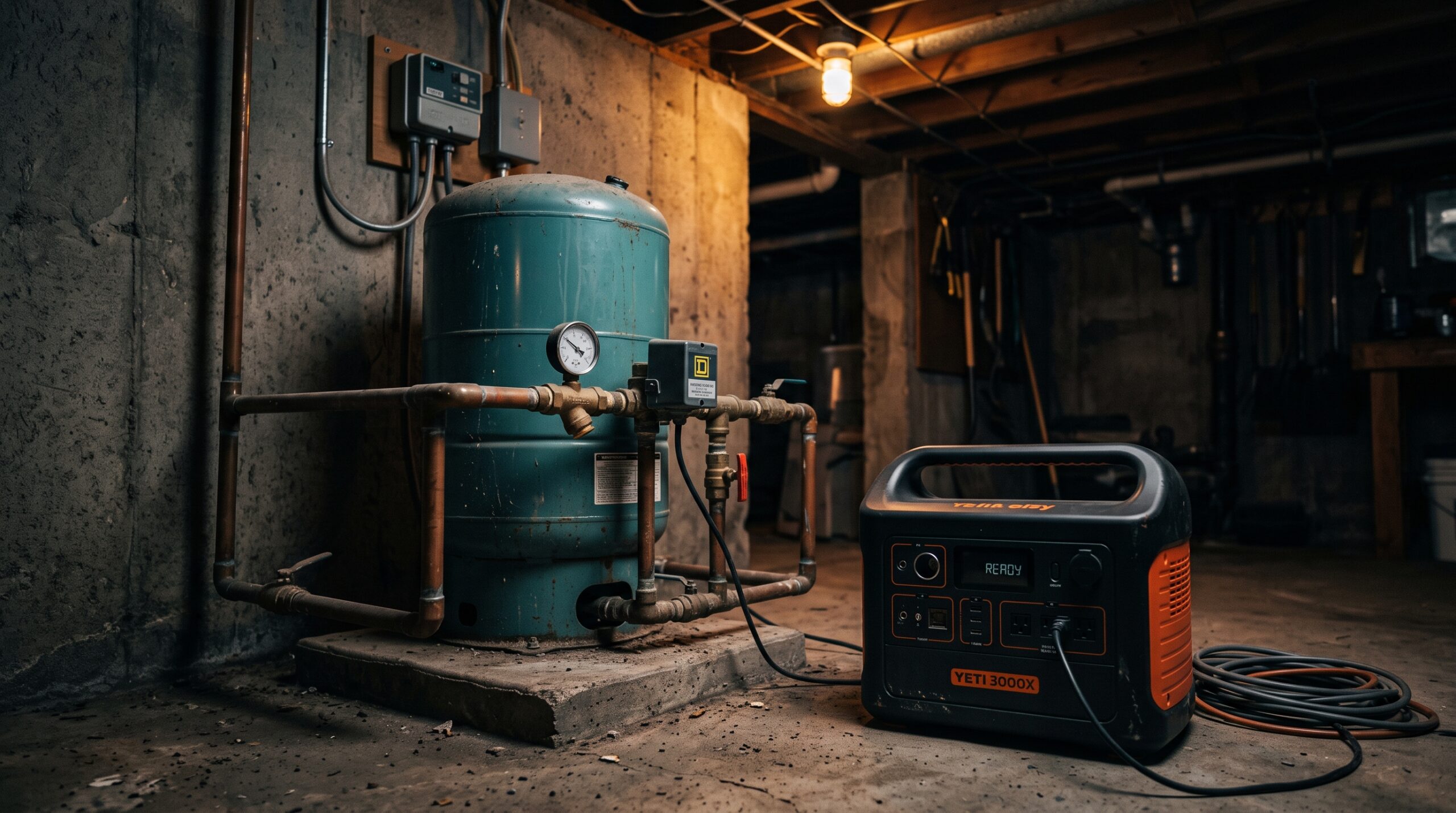
Sometimes yes, often no, and the deciding factor is almost never the one people expect. A well pump is an induction motor, and induction motors pull a huge jolt of current the instant they switch on. That starting surge, not the watts the pump uses while it runs, is what tells you whether a portable power station can handle the job.
The other catch is voltage. Most submersible well pumps run on 240V, and the majority of portable power stations only put out 120V. So before you even think about wattage, you need to know two numbers off your pump: its horsepower and the voltage it runs on.
The starting surge is the real constraint
When a pump motor starts, it briefly draws what electricians call locked rotor amps, the current it pulls in the split second before the rotor is actually spinning. This inrush typically runs five to seven times the motor’s normal running current, and on some motors it spikes even higher. It only lasts a fraction of a second, but a power station has to deliver it cleanly or the motor never gets moving.
This is why a station can comfortably run a pump it can’t start. A midsize unit might handle a 1/2 HP pump’s roughly 900 watts of running draw all day, then trip its overload protection the moment the pump tries to kick on and demands 2,500 watts for half a second. The running number looks fine. The surge is what kills it. If this run-versus-surge distinction is new to you, our breakdown of running watts vs starting watts is worth a read first.
How to find your pump’s HP, voltage, and surge
You can’t size anything until you know what you have. Three places to look:
- The pressure switch or control box. For a submersible pump, the motor itself is hundreds of feet down the well, so the data you need is usually printed on the control box, the pressure switch cover, or a sticker near the pressure tank in your basement or well house.
- The motor data plate. Jet pumps (shallow-well and convertible pumps that sit above ground) have a nameplate right on the motor listing horsepower, voltage (115V, 230V, or “convertible”), and full-load amps.
- The amperage. If the plate lists max load amps but no wattage, multiply amps by volts to get running watts. A pump pulling 8 amps at 230V draws roughly 1,840 watts while running. For the surge, assume three times that as a rough planning figure unless the manufacturer publishes locked rotor amps.
Manufacturers like Franklin Electric and Goulds publish exact figures. Franklin Electric’s submersible motor manual, for example, lists a 1/2 HP 230V single-phase motor at about 32 amps locked rotor, while a 1.5 HP motor jumps to roughly 66 amps. Those amp ratings are what your power station has to survive for an instant. If you want help decoding the rest of the label, see how to read power station specs.
Watts by pump size, and whether a typical station can cope
The table below uses typical figures for common residential pumps. Real numbers vary by brand, well depth, and motor design, so treat these as planning estimates and always check your own data plate. “Typical station” here means a portable lithium power station in the 2,000–3,000W class with a strong surge rating and pure sine wave output.
| Pump size | Running watts | Starting surge | Common voltage | Can a typical station handle it? |
|---|---|---|---|---|
| 1/2 HP submersible | ~800–1,000 W | ~2,000–3,000 W | 230/240V | Rarely — most stations are 120V only, so voltage blocks it before watts do |
| 1/2 HP jet / convertible | ~800–1,000 W | ~2,000–3,000 W | 120V or 240V | Maybe — a strong 2,000W+ station can run it; starting it is marginal without a soft start |
| 3/4 HP | ~1,500 W | ~3,000–4,000 W | 230/240V | Unlikely on portable units — surge and 240V both push you toward a large station or generator |
| 1 HP | ~1,500–2,000 W | ~4,000–6,000 W | 230/240V | No for most stations — needs a large 240V-capable unit or a generator, often with a soft starter |
| 1.5 HP | ~2,000–2,500 W | ~5,000–7,000 W | 230/240V | No — this is generator territory |
The pattern is clear. A 1/2 HP pump is the only size most portable stations have any realistic shot at, and even then only the shallow-well jet type that can be wired for 120V. For a sense of where a midsize unit’s limits actually fall, see what a 2000W power station can run. To pressure-test your specific pump against a specific station, plug the surge number into our sizing calculator.
The 120V vs 240V problem most guides skip
This trips up more people than wattage does. Nearly every submersible well pump at 1/2 HP and above is wired for 240V. The standard portable power station, even a big one, has only 120V outlets. You cannot run a 240V pump from a 120V output, full stop, no matter how many watts the station has.
A handful of large power stations offer a true 240V output (sometimes via a dedicated split-phase outlet, sometimes by linking two units). Those can drive a 240V pump if the surge headroom is there. Shallow-well jet pumps are the friendly exception, since many are convertible and can be wired for 120V. If a 240V pump is your only water source, confirm your station actually produces 240V before you count on it during an outage. Our guide to power outages and well water covers the wider water-access picture, including manual backups.
Soft starters and why pure sine wave matters
If your pump is borderline, a soft starter is the usual fix. It’s a device wired into the pump circuit that ramps the motor up gradually instead of slamming it to full speed, cutting that inrush surge by roughly 40 to 50 percent. Brands like SoftStart and Franklin Electric make units sized for 1/2 to 3.5 HP pumps, and they typically cost far less than buying a much bigger power source. That smaller surge can be the difference between a station that trips and one that starts the pump on the first try.
One honest caveat: a soft starter trims the peak, but the reduced current still lasts longer than a normal surge, and some inverters treat that sustained draw as an overload anyway. They help most when paired with a station that has generous surge headroom to begin with. Check the soft starter’s compatibility with both your pump and your inverter before buying.
Output waveform matters too. Induction motors want clean, pure sine wave power. A modified sine wave inverter can make a motor run hot, hum, lose torque, or simply refuse to start, and over time it can damage the windings. Any power station you use on a pump should be pure sine wave, which nearly all lithium stations are, but it’s worth confirming. Here’s the difference between pure sine wave and modified sine wave and why it matters for motors.
Watt-hours usually aren’t the limiting factor
Here’s the good news once you clear the surge and voltage hurdles. A well pump doesn’t run continuously. It runs in short bursts to refill the pressure tank, then shuts off until you draw enough water to drop the pressure again. A typical household pump might run only 10 to 15 minutes across a whole day, pulling maybe 400 to 700 watt-hours total.
That’s a small amount of energy. A 1,000Wh station holds roughly enough for a day or two of normal household water use, assuming it can deliver the surge each time the pump cycles. So the battery’s capacity rarely runs you out, the surge ceiling is what stops you cold. This is the same logic behind sizing a unit for a sump pump: short, intermittent runs, big startup spikes.
Hard-wired pumps and safety
Most well pumps are hard-wired into your home’s electrical system, not plugged into an outlet you can simply move to a power station. Powering one safely during an outage means a transfer switch or an interlock kit installed by a licensed electrician, never a homemade cord or a connection that could backfeed your panel and energize the utility lines. Backfeeding is dangerous and illegal in most places, and it can kill a lineman working to restore power.
If your pump is hard-wired, treat the electrical work as a job for a pro. Have an electrician confirm your pump’s exact load, whether it’s 120V or 240V, and the right way to connect a backup source. The cost of a proper transfer switch is small next to the risk of getting it wrong.
Sizes with the surge headroom a pump needs


As an Amazon Associate we earn from qualifying purchases. Prices are pulled automatically from Amazon and may have changed.
Frequently asked questions
What size power station do I need to run a well pump?
Size for the surge, not the running watts. A 1/2 HP pump needs a station that can deliver roughly 2,000–3,000 watts of surge; a 1 HP pump can demand 4,000–6,000 watts at startup. You also need matching voltage, so a 240V pump requires a station with a true 240V output. Check your pump’s data plate and run the numbers through a sizing tool before buying.
Can a 2000W power station start a well pump?
It can sometimes start a 1/2 HP jet pump wired for 120V, especially with a strong surge rating or a soft starter. It generally cannot start a 240V submersible pump, both because of the surge and because most 2000W stations only output 120V. Always check your specific pump’s locked rotor amps and your station’s surge spec.
Will a power station ruin my well pump motor?
A pure sine wave station running within its limits won’t harm the motor. The risks come from modified sine wave output, which can overheat induction motors, or from a station that browns out under the startup surge and leaves the motor stalling and drawing locked rotor current. Use pure sine wave power with enough surge headroom and you’re fine.
How long can a power station keep my well water running?
Longer than you’d think, because the pump only runs in short bursts. A 1,000Wh station can typically cover a day or two of normal household water use, since a pump usually runs just 10 to 15 minutes total per day. Capacity is rarely the bottleneck; delivering the startup surge each cycle is.
Do I need a soft starter for my well pump?
You need one if your pump’s surge is just above what your station can deliver. A soft starter cuts inrush by roughly 40 to 50 percent, which can bring a borderline pump within reach. It’s not magic, though, and it works best with a station that already has decent surge headroom. Confirm compatibility with both your pump and inverter first.
Sources
- Franklin Electric — AIM Manual, 60 Hz Submersible Systems (motor amp and locked rotor data)
- Goulds (ITT) — Residential Water Products Technical Data
- SoftStart USA — Water Well Pump Soft Start (inrush reduction specs)
- Jackery — What Size Generator to Run a Well Pump
- Oakville Pump Service — How Much Power Does My Submersible Well Pump Use?