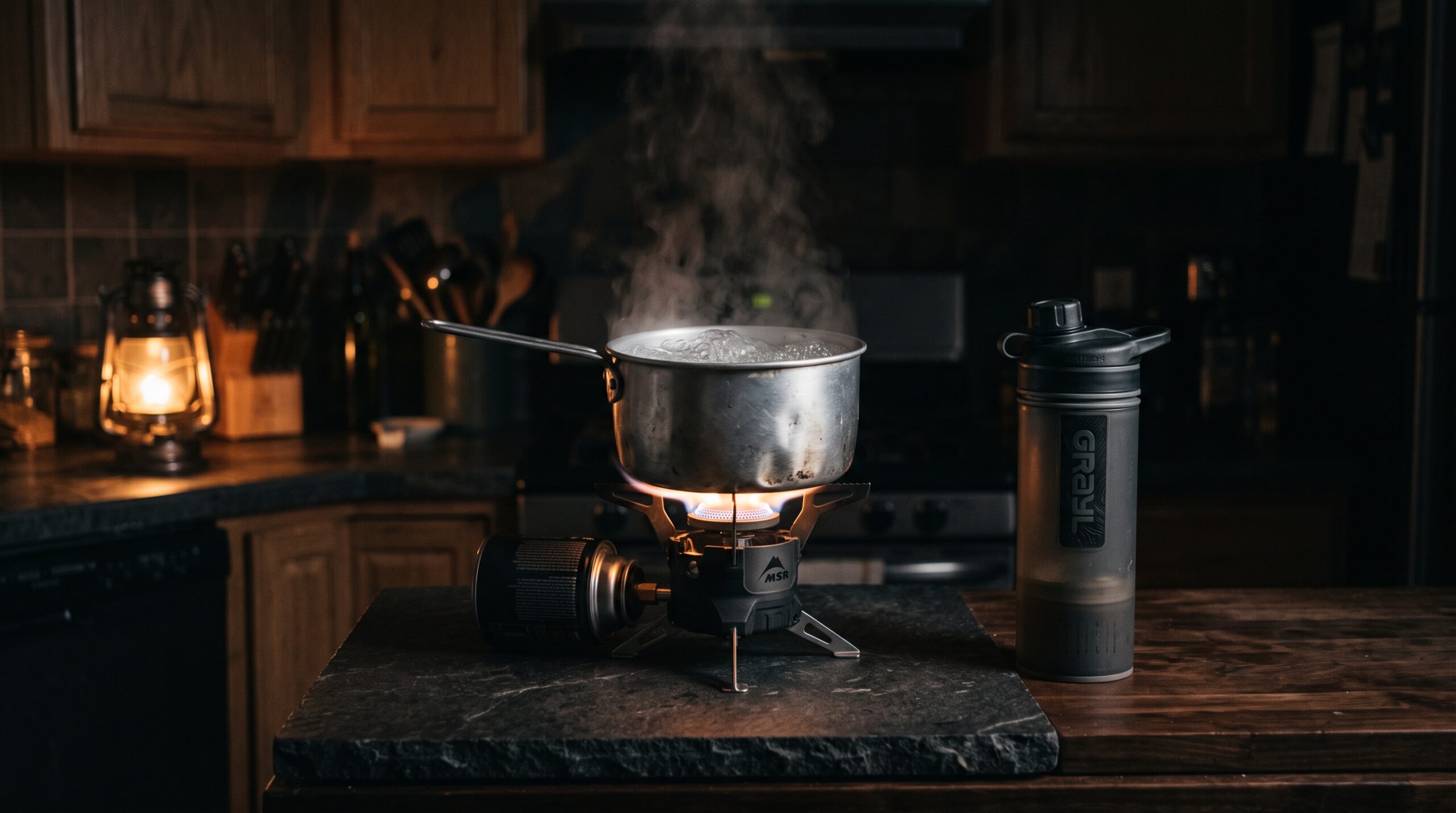
If the tap goes dry or a “boil water” notice lands during an outage, boiling is the most reliable way to make questionable water safe to drink. It kills bacteria, viruses, and the parasites that other methods can miss, and it needs no special gear beyond a heat source and a pot. The other approved methods below (household bleach, purification tablets, and filters) are useful backups, but each has limits you need to know before you trust your water to it.
Treating water is a stopgap, not a substitute for keeping water on hand. If you haven’t already, work out how much water to store for a power outage and how to store water for an emergency so you rarely have to purify on the fly.
Start here: boiling is the most reliable method
The CDC and EPA both rank boiling first because it kills disease-causing organisms across the board, including Cryptosporidium and Giardia, the chlorine-resistant parasites that bleach and tablets struggle with. If the water looks cloudy, let it settle and pour it through a clean cloth, paper towel, or coffee filter first.
- Bring clear water to a rolling boil for 1 minute. At elevations above 6,500 feet, boil for 3 minutes (water boils at a lower temperature up high, so it needs longer).
- Let it cool on its own. Do not add ice to speed this up.
- Store the cooled water in clean, sanitized containers with tight covers.
- Boiled water can taste flat. Pour it back and forth between two clean containers to add air, or add a pinch of salt per quart.
During an outage you can boil on a gas range, a camp stove, or a grill. Never run a fuel-burning stove or grill indoors, since they give off carbon monoxide. Use them outdoors and away from windows and doors.
Disinfecting water with household bleach
If you can’t boil, unscented household chlorine bleach is the CDC- and EPA-backed backup. Use only regular, unscented bleach with sodium hypochlorite as the active ingredient (commonly labeled 5% to 9%). Do not use scented, color-safe, or “splash-less” bleaches, or any product with added cleaners. As with boiling, filter cloudy water through a cloth or coffee filter and let it settle first.
For each gallon of clear water, add 8 drops of bleach, which is a little less than 1/8 teaspoon. The exact drop count depends on the concentration printed on the label:
- 6% bleach: 8 drops per gallon
- 8.25% bleach: 6 drops per gallon
- Cloudy, colored, or very cold water: double the amount
Stir it in, then let the water stand for at least 30 minutes. It should have a slight chlorine smell. If it doesn’t, repeat the dose and wait another 15 minutes. If it still has no chlorine odor after that, discard it and find another source. When in doubt about your specific product, follow the directions printed on the bleach label and the CDC and EPA guidance rather than guessing.
Bleach kills most bacteria and viruses, but it does not reliably kill Cryptosporidium, and it works less well against Giardia. If those parasites are a concern, boil instead.
Water purification tablets
Purification tablets are compact and shelf-stable, which makes them a good fit for a grab-and-go kit. They come in a few chemistries, and that matters:
- Chlorine dioxide tablets will kill Cryptosporidium if you follow the package directions exactly, including the longer wait time these tablets often require.
- Iodine and standard chlorine tablets handle most bacteria and viruses but do not reliably kill Cryptosporidium. Iodine also isn’t recommended for pregnant people, anyone with thyroid problems, or long-term use.
Whichever type you keep, the dose and contact time are set by the manufacturer for that tablet and water volume, so follow the package directions precisely. Check the expiration date, since these lose potency over time. Stocking a fresh supply is worth adding to your power outage emergency kit checklist.
Water filters: what they do and don’t remove
Portable and gravity water filters physically strain out contaminants, and a fine enough filter can remove parasites like Cryptosporidium and Giardia along with many bacteria. The catch: most filters do not remove viruses, which are too small to be trapped by the filter media. Viruses are a bigger worry when water may be contaminated with human or animal waste.
- Look at the pore size. To remove bacteria and parasites, the CDC suggests a filter rated at roughly 1 micron or smaller (look for “absolute,” not “nominal”).
- To cover viruses too, choose a filter that has a built-in purification stage, or follow filtering with bleach or chlorine dioxide.
- A standard pitcher or faucet filter (the kind for taste and chlorine) is not an emergency purifier. It is not designed to make unsafe water safe.
A simple, reliable combination is to filter cloudy water clear, then boil it or treat it with bleach. That covers the gaps any single method leaves.
Which method kills what: quick comparison
Use this table to match the method to the threat. When you don’t know what’s in the water, boiling is the safest default.
| Method | What it kills / removes | How to do it |
|---|---|---|
| Boiling | Bacteria, viruses, and parasites (including Crypto and Giardia) | Rolling boil 1 minute; 3 minutes above 6,500 ft. Cool, then cover. |
| Household bleach | Most bacteria and viruses; not reliable on Crypto, weak on Giardia | 8 drops of 6% bleach per gallon of clear water (6 drops if 8.25%). Double if cloudy. Stir, wait 30 min. |
| Chlorine dioxide tablets | Bacteria, viruses, and Crypto (with correct contact time) | Follow package directions for dose, water volume, and wait time. |
| Iodine / chlorine tablets | Most bacteria and viruses; not reliable on Crypto | Follow package directions. Not for pregnancy, thyroid issues, or long-term use. |
| Filter (≈1 micron) | Parasites and many bacteria; usually not viruses | Filter clear, then boil or disinfect to cover viruses. |
Clear cloudy water first, and what you should never try to purify
Murky water carries particles that shield germs and use up your bleach or tablet dose. Before any treatment, let suspended material settle to the bottom, then pour the clearer water through a clean cloth, paper towel, or coffee filter. Treat the strained water using one of the methods above.
Purifying only handles living organisms. It does not fix chemical or physical contamination. Do not try to boil, bleach, or filter:
- Water you suspect contains fuel, toxic chemicals, pesticides, or radioactive material. Boiling can actually concentrate some chemicals.
- Salt water. Purification doesn’t remove salt; that requires distillation.
- Water with an oily sheen, strong odor, or unusual color. Find another source instead.
Have a well? Flooding and outages can contaminate it, and the system needs power to pump. See power outage and well water for what to do, and once power and water return, run through whether your food is still safe after a power outage before you cook with it.
Frequently asked questions
Is boiling or bleach better for purifying water?
Boiling, if you can do it. It kills bacteria, viruses, and parasites, including the chlorine-resistant ones. Bleach is the right backup when you can’t heat water, but it doesn’t reliably kill Cryptosporidium and is weaker against Giardia.
How much bleach do I add to a gallon of water?
For clear water, add 8 drops of 6% unscented household bleach per gallon (about a little less than 1/8 teaspoon), or 6 drops if your bleach is 8.25%. Double the amount if the water is cloudy, colored, or very cold. Stir, wait at least 30 minutes, and confirm a faint chlorine smell.
Does bleach kill Giardia and Cryptosporidium?
Not reliably. Standard chlorine bleach does not reliably kill Cryptosporidium and works less well against Giardia. To handle those parasites, boil the water or use chlorine dioxide tablets exactly as directed.
Can I purify water with a regular Brita or pitcher filter?
No. Common pitcher and faucet filters are made to improve taste and reduce chlorine, not to make unsafe water safe. They are not rated to remove bacteria, parasites, or viruses. Use boiling, bleach, tablets, or a filter specifically certified for emergency or backcountry use.
How long does treated water stay safe to drink?
Keep treated water in clean, covered, sanitized containers and it generally stays safe for several days. Store it out of direct sunlight, don’t touch the inside of the container or lid, and pour rather than dip to avoid recontaminating it. If it ever looks or smells off, treat it again or replace it.