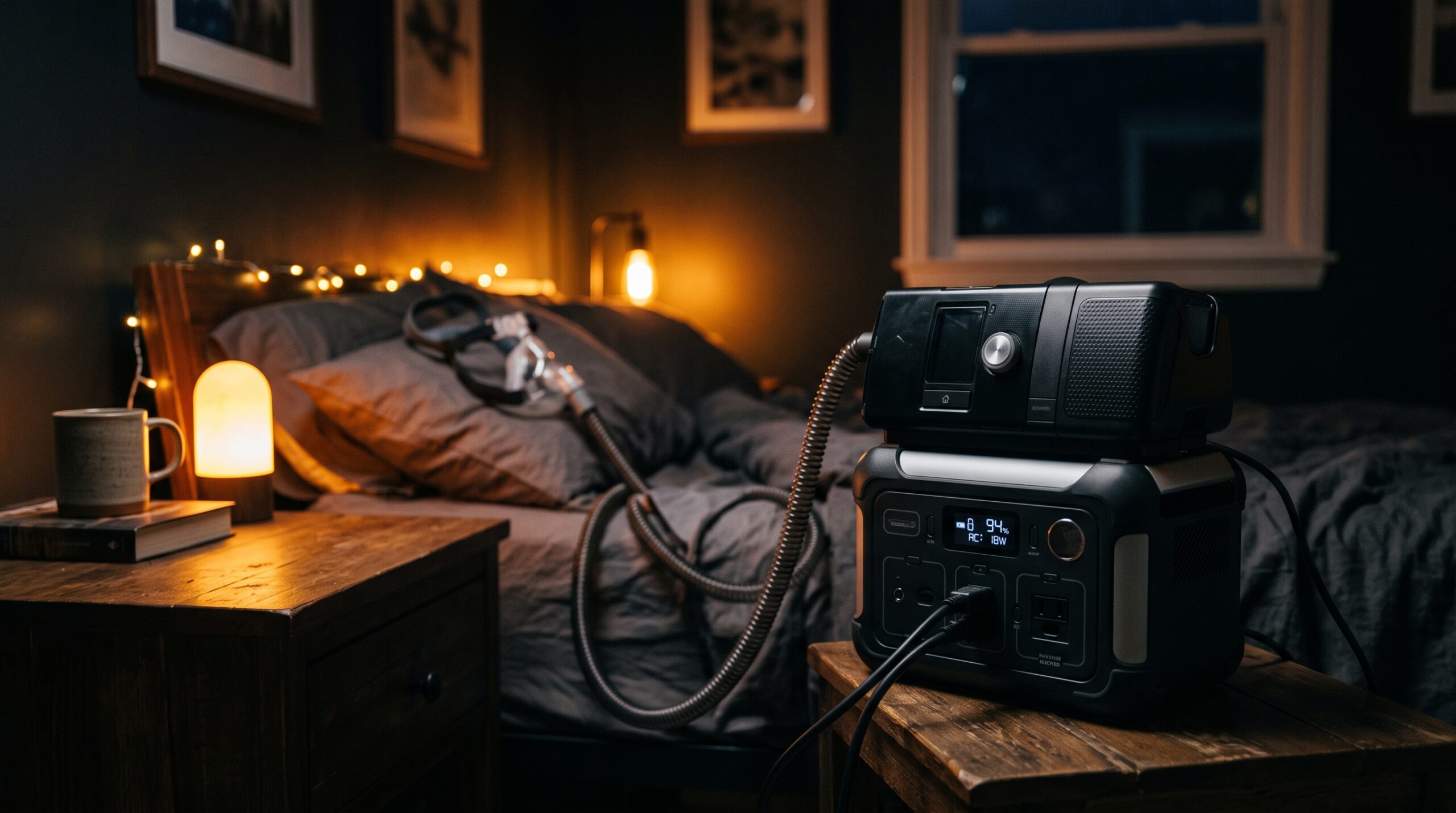
Here is the part most people miss: the CPAP blower itself is a light electrical load, but the heated humidifier and heated tubing are not. With the heat turned off, many machines draw roughly 30-60 watts (and some efficient models far less), while switching on the humidifier and heated hose can push the total toward 60-100 watts or more during peaks. That single setting is the biggest lever you have over how long a battery or power station keeps your therapy running.
This is device-power information, not medical advice. Always follow your machine’s manual for power requirements and never change therapy settings to save energy without talking to your provider first.
The short answer: the blower is small, the heater is big
A CPAP is really two electrical loads sharing one plug. The first is the blower motor that pressurizes your air, which is efficient and steady. The second is a heating element (in the humidifier tank, and sometimes in the hose) that warms water and air, which is where most of the watts go.
- Blower only, heat off: commonly around 30-60W on full-size machines, and as low as 5-25W on efficient or travel-oriented units. A ResMed AirSense 11, for example, averages single-digit watts with the humidifier and heated tube switched off.
- Humidifier on: add roughly 20-35W on average while the heater cycles.
- Heated tube on as well: add more again, with brief peaks that can take the whole machine past 60-100W.
The heating element does not run flat-out all night. It cycles on and off to hold a target temperature, so the average draw is lower than the peak. But across a full night, that cycling still adds up to far more energy than the blower uses on its own.
What changes the number
Two identical machines can pull very different wattage depending on how they are set up and used. The main factors:
- Humidifier and heated tubing: by far the largest factor. Higher heat and humidity settings mean more watts.
- Pressure level: higher prescribed pressure makes the blower work harder, so it draws a little more. The effect is modest next to the heater.
- Ramp: starting at a lower pressure and building up over a few minutes slightly lowers draw early in the night.
- Auto-adjusting (APAP) vs fixed pressure: an auto machine raises pressure only when it detects events, which can mean lower average draw than a fixed high pressure.
- Mask leak: a leaky mask makes the blower compensate, nudging power use up.
- Machine model and age: newer machines tend to be more efficient. Check your own model’s manual for its rated supply.
If you want the wattage-to-energy logic behind all of this, our explainer on what a watt-hour is walks through how watts and run time combine into the watt-hours a battery actually has to deliver.
Watt-hours per night: heat off vs heat on
For backup planning, watts matter less than watt-hours per night (watts multiplied by hours of sleep). The table below uses an eight-hour night and rounds to give planning ranges. Your real numbers depend on your exact machine, pressure, and settings, so treat these as estimates, not promises.
| Setup (8-hour night) | Typical average draw | Energy per night |
|---|---|---|
| Blower only, efficient machine (heat off) | ~5-15W | ~40-120 Wh |
| Blower only, typical full-size machine (heat off) | ~30-45W | ~150-250 Wh |
| Blower + humidifier on low/medium | ~30-50W avg | ~250-400 Wh |
| Blower + humidifier + heated tube | ~40-65W avg | ~300-500+ Wh |
The takeaway is hard to miss: turning off the heat can cut a night’s energy use by half or more. That is the single most effective thing you can do to stretch backup power.
How many nights a power station lasts
To turn watt-hours per night into nights of backup, take the power station’s capacity, knock off some for conversion losses, then divide by your nightly energy use. Running through the wall-style AC outlet (the inverter) loses roughly 10-15%, so usable capacity is lower than the label. The table assumes about 85% usable and two simple scenarios: a lean heat-off night near 90 Wh, and a heat-on night near 350 Wh.
| Power station size | Usable (~85%) | Heat off (~90 Wh/night) | Heat on (~350 Wh/night) |
|---|---|---|---|
| 300 Wh | ~255 Wh | ~2-3 nights | under 1 night |
| 500 Wh | ~425 Wh | ~4-5 nights | ~1 night |
| 1000 Wh | ~850 Wh | ~9 nights | ~2 nights |
| 2000 Wh | ~1700 Wh | ~18 nights | ~4-5 nights |
To plug in your own machine and battery instead of these examples, use the runtime calculator. If you are still deciding what capacity to buy, the sizing calculator works backward from the nights of backup you want.
How to stretch your backup runtime
- Turn the humidifier off, or down. This is the big one. Many people run heat-off comfortably for a night or two, especially in humid climates. Some skip the heated tube and keep only light humidification.
- Use a DC-direct cable when you can. Powering the machine from a 12V or 24V DC outlet through a cable made for your model skips the inverter conversion and its 10-15% loss, so the same battery lasts noticeably longer. Confirm the correct voltage and connector for your machine before buying one.
- Drop the humidifier water before a long outage only if your provider says it is fine, and never modify therapy pressure to save power.
- Recharge during the day. A power station topped up by solar or a generator each day can carry you through a multi-night outage even on a smaller battery.
- Size with margin. Pressure, leak, and cold rooms all push consumption up, so leave headroom rather than sizing to the exact minimum.
For the full battery-and-outage playbook, see keeping a CPAP running during a power outage, and for specific recommended units there is our guide to the best power station for a CPAP.
Frequently asked questions
How many watts does a CPAP use without the humidifier?
With the heated humidifier and heated tube off, most CPAPs draw somewhere around 30-60W, and efficient machines can run on as little as 5-25W. Check your model’s manual for the exact rated power, since figures vary by brand and pressure.
How much does the heated humidifier add?
The humidifier typically adds about 20-35W on average while the heater cycles, and a heated tube adds more on top of that. Together they can roughly double or triple a night’s total energy use compared with running the blower alone.
How many watt-hours does a CPAP use per night?
Over an eight-hour night, a heat-off setup commonly uses somewhere around 40-250 Wh depending on the machine, while a full humidifier-plus-heated-tube setup often lands in the 300-500 Wh range. Multiply your machine’s average watts by your hours of sleep to estimate your own.
Does running on DC save power?
Yes. Powering the machine directly from a 12V or 24V DC outlet through a cable made for your model avoids the inverter conversion, which otherwise wastes roughly 10-15% of the battery. Make sure the cable matches your machine’s voltage and connector.
What size power station do I need for a CPAP?
For one heat-off night, a 300-500 Wh station is usually enough; for humidifier use or several nights, a 1000 Wh or larger unit gives real margin. Enter your numbers in the runtime or sizing calculator to match capacity to the nights of backup you want.