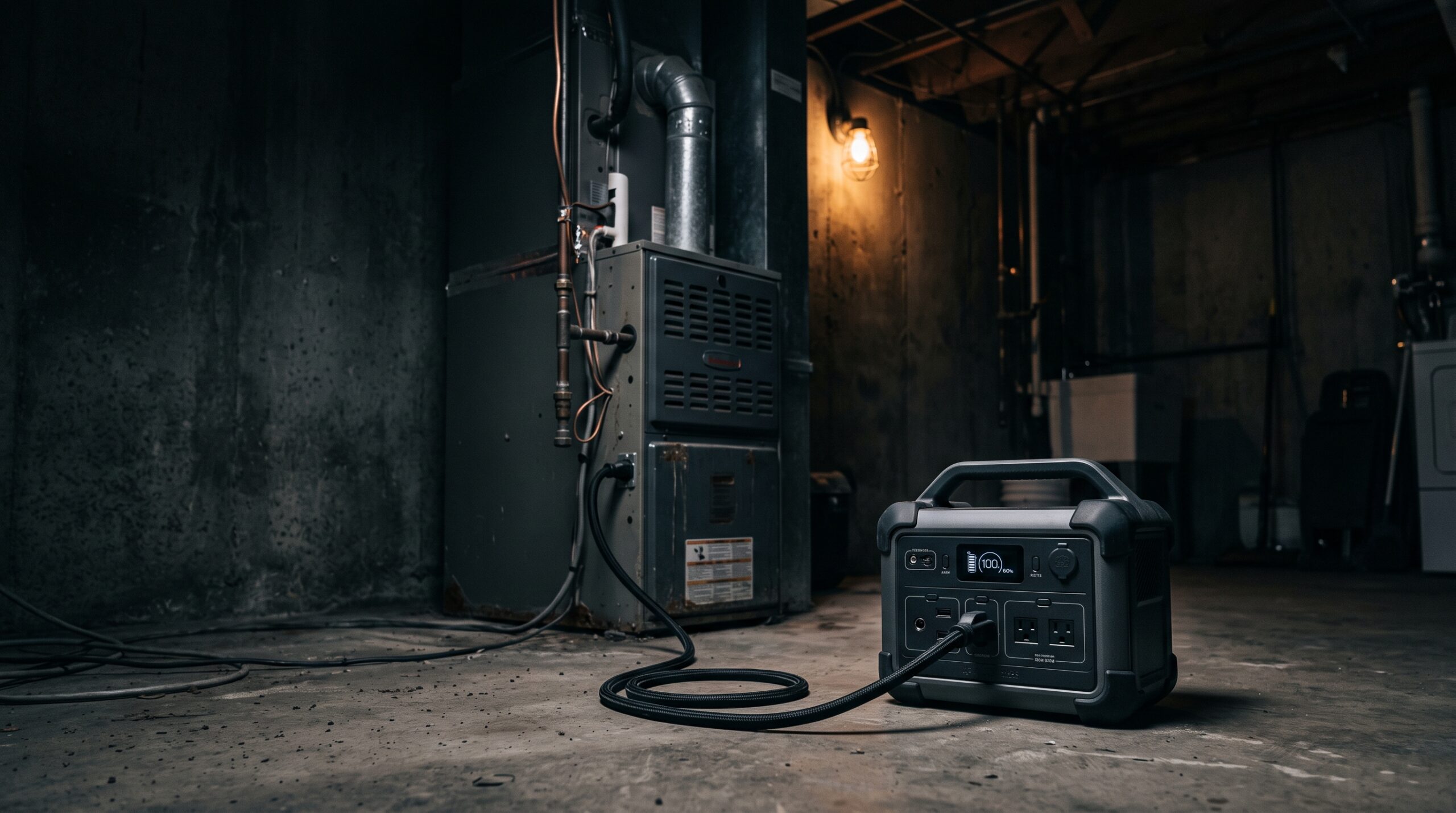
Here’s the short answer: a portable power station can keep a gas or propane furnace running, but only because it powers the blower motor, igniter, and control board. The heat itself comes from fuel. A typical blower pulls around 400 to 800 watts, so a 2,000Wh station gives you roughly 3 hours of continuous blower time and quite a bit more once you account for the furnace cycling on and off. An electric (resistance) furnace is a different story, and the answer there is basically no.
What you’re actually powering
People assume a gas furnace runs on gas. It mostly does, but it still needs electricity to do anything useful. Cut the power and a gas furnace sits there cold. The electric parts are what move the heat into your house, and those are what your power station has to feed.
- Blower motor — by far the biggest draw. It pushes warm air through the ducts and runs the whole time the furnace is heating.
- Hot surface or electronic igniter — a short, high burst at the start of each cycle, often a few hundred watts for a few seconds.
- Control board and gas valve — low and steady, usually 20 to 100 watts, plus a small draw for the thermostat.
So the real question isn’t “how much power does a furnace use” — it’s “how much does the blower use, and can my station handle the startup spike.” If you’re fuzzy on the energy-storage side of this, our explainer on what a watt-hour is is worth two minutes before you shop.
How many watts a furnace blower draws
It depends entirely on the type of blower motor. There are two common kinds, and the gap between them is large.
- PSC (permanent split capacitor) motors — the older, single-speed standard. These run roughly 400 to 800 watts on the heating tap, and some larger units push past 900 watts. They also have a real startup surge, pulling 2 to 3 times their running watts for a moment when the motor spins up.
- ECM / variable-speed motors — newer and far more efficient. On low circulation they can sip 75 to 150 watts, climbing to maybe 400 to 600 watts at full output. They ramp up smoothly, so the startup spike is much gentler.
If you don’t know which one you have, assume PSC and plan for the surge. It’s the conservative call, and a power station that handles a PSC blower will handle an ECM with room to spare. Not sure how to read those two numbers on a spec sheet? Here’s the difference between running watts and starting watts — it’s the single most important thing to get right for furnace backup.
Runtime by power station size
The math is simple: usable watt-hours divided by average watts. Real stations deliver about 85% of their rated capacity through the inverter, so the table below uses that. It assumes a 500W PSC blower (a reasonable midpoint) and shows both continuous run time and a more realistic figure that accounts for the furnace cycling.
| Power station | Usable energy (~85%) | Continuous blower run @ 500W | Realistic coverage with cycling* |
|---|---|---|---|
| 500 Wh | ~425 Wh | ~0.8 hours | ~2–3 hours (surge risk — see below) |
| 1,000 Wh | ~850 Wh | ~1.7 hours | ~5 hours |
| 2,000 Wh | ~1,700 Wh | ~3.4 hours | ~10 hours (an overnight) |
| 3,600 Wh | ~3,060 Wh | ~6.1 hours | ~18 hours |
That cycling point matters more than anything else here. A furnace heats in bursts, then the blower shuts off until the house cools a degree or two. If the blower is only running about a third of each hour, a 2,000Wh station that shows 3.4 continuous hours can actually carry you through most of a winter night. If you have an efficient ECM motor drawing closer to 150 watts, multiply those run times by three or four. Want to plug in your own station and blower wattage? Run the numbers in our runtime calculator.
The surge problem most people miss
Watt-hours tell you how long. They don’t tell you whether the station can start the motor at all. A PSC blower’s inrush can hit 1,000 to 2,000 watts for a fraction of a second, and a small 500Wh power station often has an inverter rated for only 300 to 600 watts continuous. It has the energy to run the furnace for an hour, but it will trip on the very first startup and shut down.
Check two numbers on any station before you trust it with a furnace: the continuous inverter rating (should comfortably exceed your blower’s running watts) and the surge rating (should clear the startup spike). One more thing — use a pure sine wave station. Furnace control boards and ECM motors can misbehave or throw errors on a cheap modified sine wave inverter, so the pure sine vs. modified sine distinction is not optional for this job.
Why an electric furnace won’t work
If you have an electric resistance furnace, a power station is not a realistic option, and it’s important to be blunt about that. These furnaces make heat by running current through heating elements, and that draws enormous power — a 10kW furnace pulls about 42 amps at 240 volts, and a 20kW unit roughly 84 amps. That’s 10,000 to 20,000 watts, many times what any portable station can deliver. You’d drain a large 2,000Wh unit in under ten minutes, and most stations can’t even start the load.
If electric heat is all you’ve got, don’t try to run the furnace. Power a small, station-friendly heat source instead and seal off one room. Our guides on running a space heater from a power station and staying warm during a power outage cover the realistic options.
Getting the most heating hours out of a station
- Lower the thermostat. The furnace cycles less, the blower runs less, and your runtime climbs.
- Close doors and zone off unused rooms so the heat you make goes further per cycle.
- Wire the furnace to the station through a transfer switch or a dedicated outlet — running it off the existing circuit safely usually means a licensed electrician, not a stack of extension cords.
- Recharge during daylight if you have solar panels, so the same station can cover multiple nights.
- Compare the furnace to other loads you might want at the same time. A blower is steady and modest; see how it stacks up against a spiky load like a microwave when you’re budgeting capacity.
Sizes that cover a gas furnace blower, live prices


As an Amazon Associate we earn from qualifying purchases. Prices are pulled automatically from Amazon and may have changed.
Frequently asked questions
Will a 1000Wh power station run my gas furnace overnight?
It can stretch a long way if your blower is efficient and the furnace cycles normally. At a 500W PSC draw you’d get under two hours of continuous run, but with typical cycling that’s closer to five hours of real coverage. A milder night or an ECM blower can take you through to morning.
How many watts does a furnace blower use?
A single-speed PSC blower runs about 400 to 800 watts, with a startup surge two to three times higher. A variable-speed ECM motor is far thriftier, often 75 to 150 watts on low and up to 400 to 600 watts at full speed.
Can a power station run an electric furnace?
No, not in any practical sense. Electric resistance furnaces draw 10,000 to 20,000 watts, far beyond what a portable station can supply, and they’d flatten even a large battery in minutes. Use a small heater and a closed-off room instead.
Why does my power station shut off when the furnace starts?
That’s the startup surge tripping the inverter’s overload protection. The blower’s inrush can briefly hit 1,000 to 2,000 watts, exceeding a small station’s surge rating even though it has plenty of stored energy. You need a station with a higher continuous and surge wattage.
Do I need a pure sine wave power station for a furnace?
Yes. Furnace control boards and modern variable-speed motors are sensitive electronics, and a modified sine wave inverter can cause errors, noise, or refusal to start. Stick with a pure sine wave station for anything with a circuit board.
Sources
- LearnMetrics — How Many Watts Does a Gas Furnace Use? (Blower Wattage)
- North NJ HVAC — Gas Furnace Starting Watts: How Much Power Is Needed to Start a Furnace
- HVAC School — Blower Fan Watt Draw Considerations for ECMs
- EnergySage — How Many Watts Does an Electric Furnace Use?
- Energy Use Calculator — Electricity Usage of an Electric Furnace