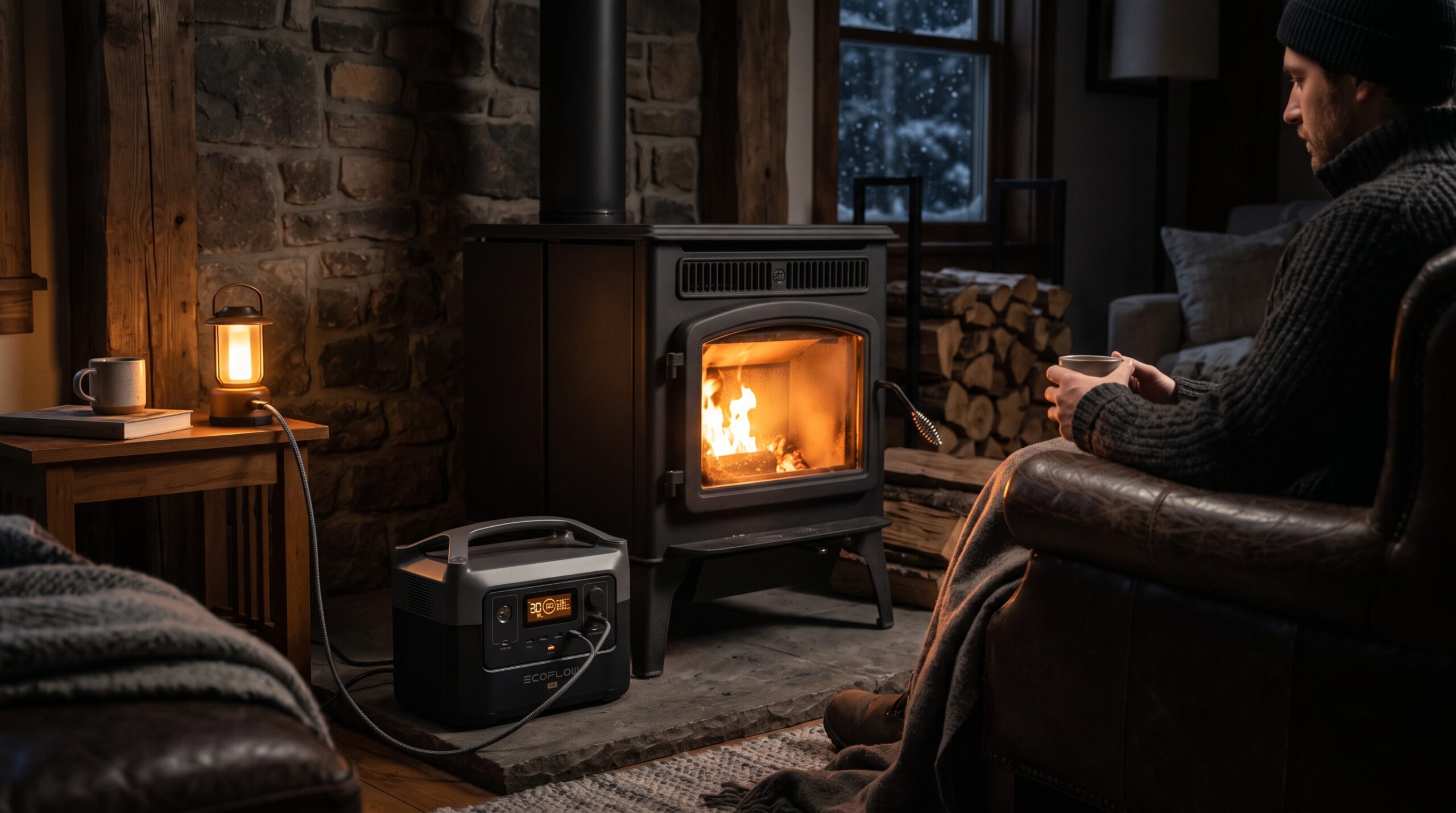
Yes. A pellet stove burns wood pellets for heat, and electricity only runs the mechanical parts, so a portable power station can keep one going for many hours on a single charge. The one thing to plan around is the startup igniter, which pulls roughly 300 to 500 watts for the first several minutes before the stove settles down to a much lower running draw of about 100 to 150 watts.
The short version
Pellet stoves are one of the better winter-outage heat options precisely because the heat comes from fuel, not from electricity. The power station never has to produce heat itself. It just spins the auger that feeds pellets, runs the combustion and room-air fans, and powers the control board. That mechanical load is small, which is why a mid-size station can run a pellet stove far longer than it could ever run an electric space heater. If staying warm is the goal, this is a strong setup to have ready before the lights go out. For the bigger picture, see our guide on how to stay warm during a power outage.
What the electricity actually runs
A pellet stove has four electrical parts. None of them is a heating element except the igniter, and the igniter only fires at the very start:
- Auger motor — slowly turns to drop pellets into the burn pot. Tiny draw, runs in short cycles.
- Combustion (exhaust) fan — pulls air through the fire and pushes smoke out the vent. Runs continuously.
- Convection (room) blower — pushes warm air into the room. Usually the largest steady draw, especially on high.
- Control board and display — a few watts to manage everything.
- Igniter — a ceramic heating element that lights the pellets. This is the big draw, and it only runs during startup.
Startup vs running: the igniter is the spike
This is the part that trips people up. The igniter is essentially a small heater, so for the first 5 to 15 minutes it pulls several hundred watts. Once the pellets catch, the igniter shuts off and the stove coasts on the auger and fans alone. Manufacturer ratings reflect this gap: ComfortBilt lists its igniter at about 3.9 amps (roughly 470 watts at 120V), and Quadra-Fire’s Classic Bay 1200 manual lists a start rating of 3.75 amps and a run rating of 1.88 amps. Real-world meter readings on a Harman stove showed about 360 watts at ignition dropping to roughly 80 watts averaged once running.
Note that the igniter draw is a sustained pull for several minutes, not a momentary motor surge. There is no large inductive spike here the way there is with a fridge compressor, so you do not need huge headroom for an instantaneous jolt. You just need a station whose continuous output comfortably clears the igniter wattage. If the difference between a brief startup load and steady running is new to you, our explainer on running watts vs. starting watts covers it.
| Phase | Typical draw | How long |
|---|---|---|
| Startup / igniter | ~300–500 W | First 5–15 minutes |
| Steady running (auger + fans + controls) | ~100–150 W | The whole time it’s lit |
| Running with room blower on high | ~150–200 W | Varies with heat setting |
| Idle / standby controls | A few watts | Between burn cycles |
Actual numbers vary by model and heat setting, so check the data plate or manual for your specific stove. Most residential pellet stoves land inside these ranges.
How long a power station will run a pellet stove
Once the stove is lit, runtime is just battery capacity divided by the running draw. The table below assumes about 120 watts of steady draw and leaves a little margin for inverter losses. Higher heat settings with the blower on full will shorten these times; a low, efficient burn will stretch them.
| Power station size | Approx. run time after lit |
|---|---|
| 300 Wh | ~2–2.5 hours |
| 500 Wh | ~3.5–4 hours |
| 1,000 Wh | ~7–8 hours |
| 1,500 Wh | ~10–12 hours |
| 2,000 Wh | ~14–16 hours |
The takeaway: the igniter sets the minimum station you need, and the watt-hours set how long it lasts. A 1,000-watt-class station handles the igniter without strain and runs the stove most of the night. To sanity-check what else a unit that size can power, see what a 1000W power station can run, and run your own numbers with the sizing calculator.
Use a pure sine wave power station
Pellet stoves run on circuit boards, and sensitive electronics can behave unpredictably on a modified sine wave inverter — you may see error codes, erratic fan speeds, or a control board that refuses to start. Stick with a pure sine wave power station, which most modern lithium units already are. If you’re not sure what your unit produces, our breakdown of pure sine wave vs. modified sine wave explains how to check and why it matters.
How to dodge the igniter spike
If your station is on the small side, or you simply want to save battery, you can avoid the 300–500 watt startup draw entirely. Many stoves have a setting to light the pellets manually instead of using the electric igniter. You add a fire-starter gel or cube to the burn pot, light it by hand, and let the combustion fan take over. With the igniter off, the stove never pulls more than its running load, so even a modest station can keep it going. Check your owner’s manual for the manual-light procedure before you rely on it.
Sizes that handle the ignition surge, live prices


As an Amazon Associate we earn from qualifying purchases. Prices are pulled automatically from Amazon and may have changed.
Frequently asked questions
Will a 500Wh power station run a pellet stove?
It can, as long as its continuous output clears the igniter draw (most 500-watt-class stations do). Expect roughly 3.5 to 4 hours of run time after the stove is lit. Lighting the stove manually with the igniter off stretches that further.
How many watts does a pellet stove use?
About 300 to 500 watts during the first few minutes while the igniter runs, then roughly 100 to 150 watts for normal operation. The room blower on a high setting can push the running figure toward 200 watts.
Does a pellet stove produce heat without electricity?
Not on its own. The fire makes the heat, but a standard pellet stove needs electricity to feed pellets and run the fans. Without power, the auger stops and the blower can’t move warm air, so you need a battery, power station, or generator to keep it running during an outage.
Can I charge the power station while it runs the stove?
Yes, if your station supports pass-through and you have a charging source such as solar panels or a running generator. During daylight, a couple of solar panels can offset much of the stove’s modest running draw and extend your runtime considerably.
Is a power station better than a generator for a pellet stove?
For a single pellet stove, a power station is quiet, runs indoors safely, and produces clean pure sine wave power, which suits the stove’s electronics well. A generator makes sense if you also need to power larger loads or run for days, but it has to stay outside and far from the house.
Sources
- ComfortBilt — How Much Electricity Does My Pellet Stove Consume?
- Quadra-Fire — Classic Bay 1200 Pellet Stove Owner’s Manual (electrical ratings)
- Modern Survival Blog — How Much Electricity Does a Pellet Stove Use? (real-world meter readings)
- Hearth.com Forums — Harman P43/P61 off-grid power consumption and run times
- Magnum Heat — How Much Electricity to Run a Pellet Stove