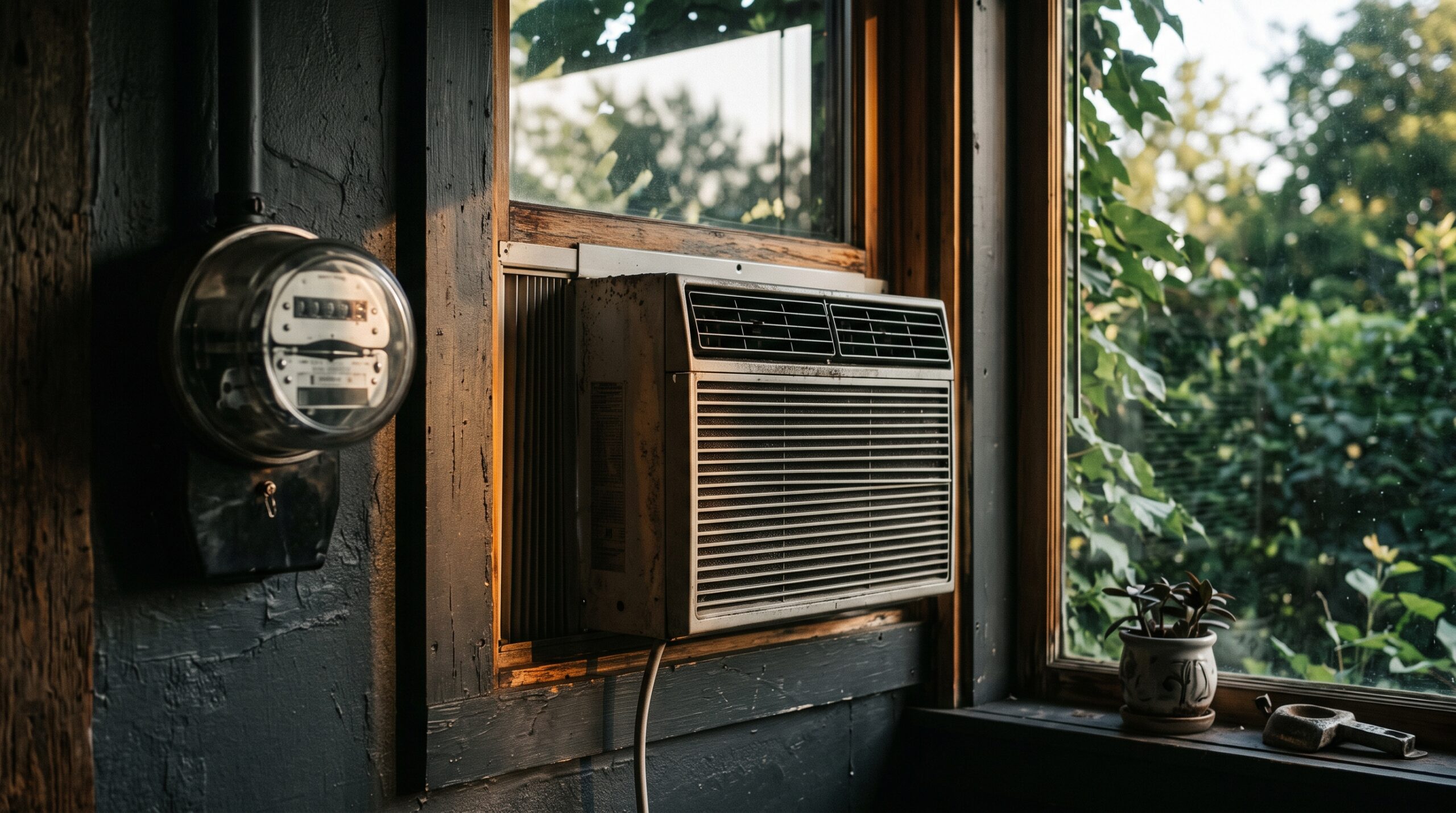
Most air conditioners draw somewhere between 500 and 1,500 watts while running, but the type and size matter a lot: a small window unit might sip 400 watts, while central air pulls 3,000 watts or more. The number that trips people up is the startup surge. When the compressor kicks on, it briefly demands two to three times its running watts, and that spike is what makes air conditioners hard to run on a battery or undersized generator.
The short answer: running watts by AC type
Running watts are what the unit pulls once the compressor is spinning steadily. Here is the rough lay of the land:
- Window units: about 400 to 1,500 watts (roughly 5,000 to 14,000 BTU). A 5,000 BTU bedroom unit runs near 400 to 500 watts; a 12,000 BTU unit runs closer to 1,000 to 1,200 watts.
- Portable units: about 1,000 to 1,500 watts. They are less efficient than window units, so they pull more watts for the same cooling.
- Through-the-wall units: similar to window units, roughly 500 to 1,500 watts.
- Ductless mini-splits: about 600 to 2,000 watts depending on capacity, but they ramp up gently instead of surging.
- Central air conditioners: about 3,000 to 5,000 watts and up. A 2-ton system runs near 2,000 to 2,500 watts, a 3-ton near 3,000 to 4,000 watts, and a 4-ton near 4,000 to 5,000 watts.
These are real-world figures for cooling mode. A unit’s nameplate may list a higher maximum, and an older, low-efficiency unit pulls more watts than a new Energy Star model of the same size.
How to convert BTU to watts
Air conditioners are sold by cooling capacity in BTU per hour, not by watts, so you have to convert. The formula is simple:
Running watts = BTU ÷ EER
EER is the Energy Efficiency Ratio printed on the yellow EnergyGuide label or the spec sheet. A higher EER means fewer watts for the same cooling. Most window and portable units land between EER 9 (older or budget) and EER 12 (efficient). As a quick mental shortcut, dividing the BTU number by 10 gets you close to the running watts for a typical unit.
| Cooling capacity | At EER 9 (older unit) | At EER 12 (efficient unit) |
|---|---|---|
| 5,000 BTU | ~555 W | ~415 W |
| 8,000 BTU | ~890 W | ~665 W |
| 10,000 BTU | ~1,110 W | ~835 W |
| 12,000 BTU | ~1,335 W | ~1,000 W |
| 14,000 BTU | ~1,555 W | ~1,165 W |
The startup surge: why your AC needs 2-3x its running watts for a second
The compressor uses a motor, and motors draw a big jolt of current the instant they start, before the rotor begins spinning. On a spec sheet this is the LRA, or Locked Rotor Amps. For a small window or portable unit, that surge is commonly two to three times the running watts (sometimes more) and lasts only a fraction of a second, often under half a second.
So a window unit that runs at 1,000 watts may spike to 2,000 to 3,000 watts when it cycles on. Central air is in another league: a single-phase compressor’s LRA can be several times its full-load amps, so a 3-ton system that runs around 3,500 watts can briefly demand 10,000 to 20,000 watts or more. That is the figure that determines whether a generator or power station can start the unit at all. If you want the full breakdown of why the spike happens, see running watts vs. starting watts.
Inverter-driven units, including most mini-splits and some newer window models, are the exception. They ramp the compressor up gradually, so the startup surge is small or practically absent.
Watts and surge by AC type
This table puts running watts, the typical startup surge, and what it realistically takes to power each type in one place.
| AC type & size | Running watts | Typical startup surge | What it takes to run |
|---|---|---|---|
| Window, 5,000 BTU | ~400–500 W | ~900–1,500 W | Mid-size or larger power station |
| Window, 8,000 BTU | ~700–800 W | ~1,500–2,400 W | Large power station (2,000 W+ output) |
| Window, 10,000–12,000 BTU | ~900–1,200 W | ~2,000–3,500 W | Large station with high surge headroom or a soft start |
| Portable, 8,000–14,000 BTU | ~1,000–1,500 W | ~2,000–4,000 W | Large power station or inverter generator |
| Mini-split (ductless) | ~600–2,000 W | Low (inverter ramps up) | Station sized to running watts |
| Central AC, 2-ton | ~2,000–2,500 W | ~6,000–12,000 W+ | Large portable or standby generator |
| Central AC, 3-ton | ~3,000–4,000 W | ~10,000–20,000 W+ | Standby generator, not a power station |
| Central AC, 4-ton+ | ~4,000–5,000 W+ | Very high | Whole-house standby generator |
What it takes to run each type on backup power
Two numbers decide whether a backup source can run an AC. First, can it survive the surge without tripping? Second, can it sustain the running watts long enough to matter? Air conditioners fail backup power on both counts more often than almost any other appliance, because the surge is high and the runtime needs are long.
- Small window units (5,000–8,000 BTU): a workable match for a large portable power station, as long as the station’s surge rating clears the startup spike. Honest about runtime: even a 1,000 Wh battery only runs a 500-watt unit for roughly an hour and a half.
- Larger window and portable units (10,000+ BTU): need a station with a genuine 2,000 watt or higher inverter and strong surge headroom. Runtime is short unless you size the battery up.
- Mini-splits: the friendliest type for batteries because of the soft ramp, but you still need enough watt-hours for meaningful runtime.
- Central air: the surge alone rules out portable power stations. Central AC is generator territory, and usually a standby unit wired into the panel. We cover the limits in detail in can a power station run an air conditioner.
To size a battery or generator against your specific unit, run the numbers through the sizing calculator, then check how long it will actually last with the runtime calculator. If you are mainly trying to ride out a hot day without AC, the guide to staying cool during a power outage has lower-draw options.
How a soft start changes the math
A soft start (also called a soft starter) is a small device that ramps the compressor’s current up over a second or two instead of letting it hit full LRA at once. It can cut the startup surge by 50 to 70 percent. That is often the difference between a power station tripping on the spike and starting the unit cleanly.
Soft starts are most common on RV and mini-split air conditioners and can be added to many central systems. They do not lower running watts, only the surge, so they help with starting the unit, not with how long your battery lasts. One more thing worth checking: most AC compressors prefer a clean power source, which is why a pure sine wave inverter is the safer choice for running them.
Frequently asked questions
How many watts does a 12,000 BTU air conditioner use?
A 12,000 BTU unit typically runs at about 1,000 to 1,400 watts, depending on efficiency. An efficient model around EER 12 lands near 1,000 watts, while an older EER 9 unit pulls closer to 1,330 watts. Expect a startup surge of roughly 2,000 to 3,500 watts.
How many watts does a central air conditioner use?
Central air conditioners generally run between 3,000 and 5,000 watts: about 2,000 to 2,500 for a 2-ton, 3,000 to 4,000 for a 3-ton, and 4,000 to 5,000 for a 4-ton. The compressor’s startup surge can momentarily be several times that, which is why central air usually needs a standby generator rather than a portable battery.
Why does an air conditioner use more watts to start than to run?
The compressor motor draws a large burst of current at the instant it starts, before the rotor spins up. This is the Locked Rotor Amps, and it can be two to three times the running watts on small units and several times higher on central systems. It lasts only a fraction of a second but determines what your backup source has to handle.
Can a portable power station run an air conditioner?
A large power station can run a small window or portable unit if its inverter and surge rating clear the startup spike, but runtime is usually short. Central air is out of reach for portable stations because of the surge and the sustained draw. A soft start helps with the spike but not the runtime.
How many watts does a 5,000 BTU window AC use?
A 5,000 BTU window unit runs at about 400 to 500 watts, with a brief startup surge in the 900 to 1,500 watt range. It is the easiest air conditioner to pair with a battery, though even then runtime depends entirely on the size of the battery.
Sources
- Energy Star — Room Air Conditioners (efficiency and CEER)
- EnergySage — How Many Watts Does an Air Conditioner Use?
- PickHVAC — Window and Room AC Watts by BTU
- PickHVAC — Central Air Conditioner Running Watts by Tonnage
- EcoFlow — LRA, Surge Power, and Starting an AC on Battery