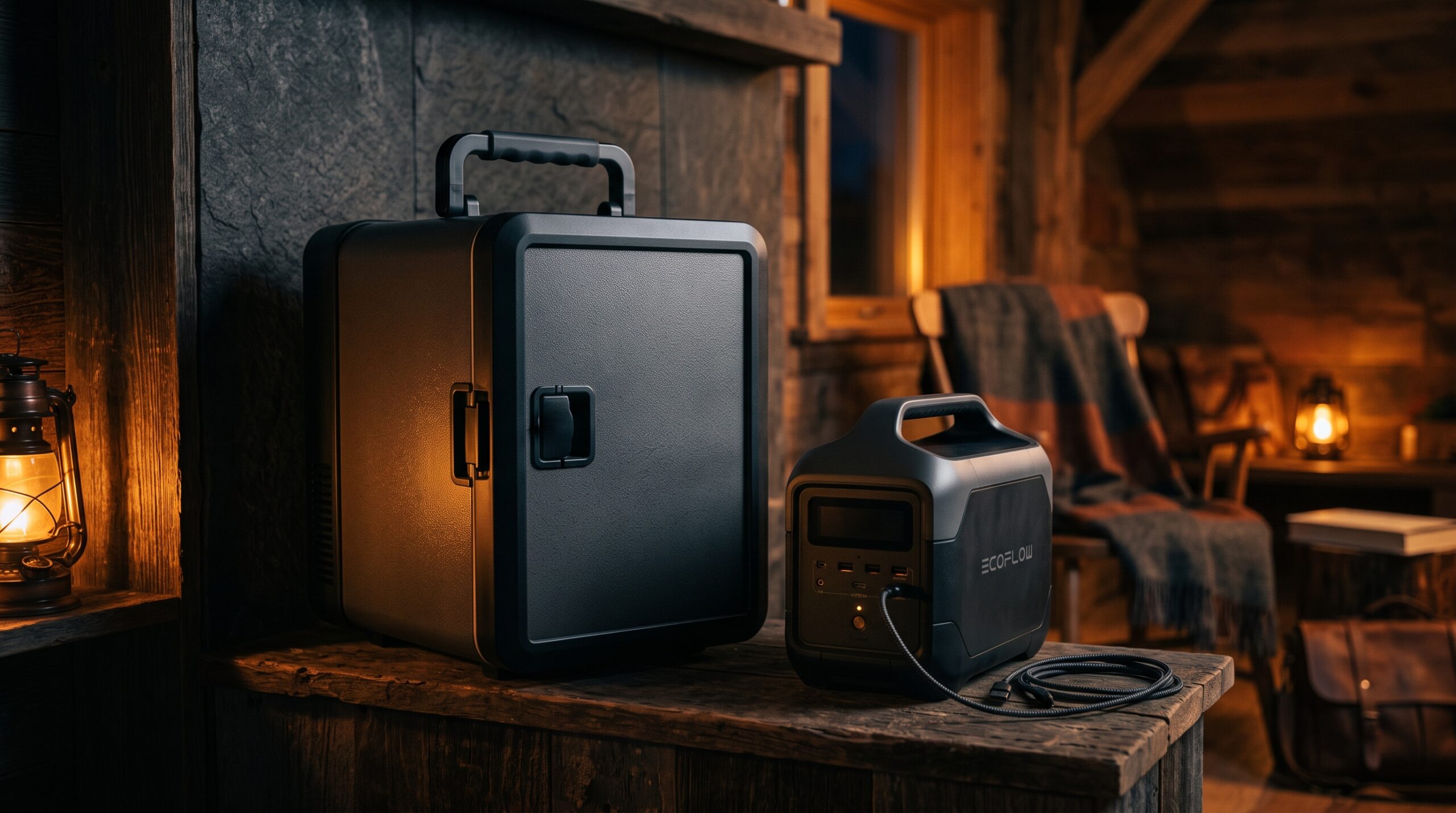
A mini fridge with a compressor draws roughly 50 to 100 watts while it runs, but it only runs about a third of the time, so its real pull averages closer to 20 to 30 watts. That means a 500Wh power station keeps one cold for most of a day, and a 1,000Wh or larger station runs it for a full day and then some. The math that gets you there is usable watt-hours divided by the running wattage times the duty cycle, and the rest of this guide walks through it.
How long a power station runs a mini fridge
For a typical dorm-style mini fridge, plan on roughly 14 to 20 hours per 500 watt-hours of battery, and about a day or more once you hit 1,000Wh. The table below assumes a small compressor unit that pulls 50 to 100 watts when running and cycles on roughly a third of the time, which works out to an average draw near 25 watts. It also accounts for the 10 to 20 percent of battery capacity you lose to inverter overhead and rounding.
| Power station capacity | Estimated mini-fridge runtime | Roughly |
|---|---|---|
| 256–300Wh | ~8–12 hours | Overnight |
| 500Wh | ~14–20 hours | Most of a day |
| 768Wh | ~22–30 hours | About a day |
| 1,000Wh | ~28–40 hours | A day plus |
| 1,500Wh | ~45–60 hours | About 2 days |
| 2,000Wh+ | ~60–80 hours | 2.5 to 3 days |
These are starting points, not guarantees. A bigger compact fridge, a hot garage, or a door that keeps opening will all shorten the runtime. For a side-by-side look across battery sizes, the runtime calculator lets you plug in your own numbers.
How much power a mini fridge actually uses
The label or spec sheet usually lists a running wattage, but that single number hides three things that matter for runtime: the steady draw, the startup surge, and how often the compressor cycles.
- Running watts: Most mini fridges draw 50 to 100 watts while the compressor is on, with newer Energy Star models sitting at the low end. See how many watts a refrigerator uses for the full breakdown by size.
- Startup surge: When the compressor kicks on it briefly needs two to three times its running draw, a spike of roughly 300 to 600 watts that lasts a second or two. This is the figure that decides whether a station can even start the fridge, so any unit with a 300W or larger inverter is usually safe.
- Duty cycle: The compressor does not run constantly. It cycles on to cool, then shuts off, running only about a third of the time in a normal room. That is why a 60-watt fridge averages closer to 20 watts over a full hour.
Put those together and a small mini fridge uses roughly 150 to 400 watt-hours per day. Larger compact units rated by Energy Star at about 200 to 310 kWh per year draw more, closer to 550 to 850 watt-hours a day, which is why fridge size changes the answer so much.
The runtime formula
Runtime comes down to one equation:
Runtime (hours) = usable watt-hours ÷ (running watts × duty cycle)
Usable watt-hours is your station’s rated capacity minus inverter losses, so multiply the rating by about 0.85. If watt-hours are new to you, what a watt-hour is explains the unit in plain terms. Here is a worked example for a 1,000Wh station and a 75-watt fridge that runs a third of the time:
- Usable capacity: 1,000Wh × 0.85 = 850Wh
- Average draw: 75W × 0.33 = ~25W
- Runtime: 850Wh ÷ 25W = ~34 hours
Swap in your own fridge wattage and station size and you get a realistic number. Drop the duty cycle to 0.5 for a warm room or a fridge that opens often, and the runtime falls accordingly.
What shortens your real-world runtime
The table numbers assume good conditions. Several everyday factors push the compressor to run more often, which raises the average draw and drains the battery faster.
- Warm rooms: A hot garage or summer outage makes the compressor work harder and cycle more, so duty cycle climbs from a third toward half.
- Opening the door: Every time you open it, cold air spills out and the fridge has to recover. Keeping the door shut is the single easiest way to stretch runtime.
- How full it is: A fridge packed with cold items and drinks holds temperature better between cycles than a near-empty one.
- Inverter overhead: The power station’s own electronics use a little energy, which is already baked into the 0.85 usable factor above.
If you want to match a battery to a specific fridge with margin to spare, see what size power station to run a refrigerator.
Compressor mini fridge vs thermoelectric mini cooler
Not every small “mini fridge” is the same inside, and the difference changes the math. A compressor unit behaves like a normal fridge: it surges on startup and cycles on and off. A thermoelectric mini cooler, the kind often sold as a 6-can or skincare fridge, has no compressor and no moving parts.
Thermoelectric coolers have no startup surge, so a tiny power station can run one. The catch is that they run continuously instead of cycling, often drawing 40 to 60 watts the whole time. Because they never shut off, a thermoelectric cooler can actually empty a battery faster than a compressor fridge that only runs a third of the time. They also cool to a fixed number of degrees below room temperature rather than to a set temperature, so they are weaker in a hot room. For runtime planning, treat a thermoelectric cooler as a steady continuous load with no duty-cycle discount.
Keeping insulin, meds, and food cold during an outage
A mini fridge on a power station is a practical way to protect temperature-sensitive items during an outage. Its low average draw means even a mid-size battery buys you a day or more, which covers most short outages without a generator running. For drinks and snacks that is convenience; for insulin or other refrigerated medication it can matter a great deal.
If meds are the reason you are reading this, confirm the storage range your medication needs and keep the door closed as much as possible. The guide on how to keep insulin cold during a power outage covers the temperature targets and backup options in more detail. A larger station, or one you can recharge from solar or a car, turns a few hours of cooling into a multi-day buffer.
Sizes that cover a mini fridge, live prices


As an Amazon Associate we earn from qualifying purchases. Prices are pulled automatically from Amazon and may have changed.
Frequently asked questions
Can a 500Wh power station run a mini fridge?
Yes. A 500Wh station typically runs a small compressor mini fridge for about 14 to 20 hours, enough to get through a night and most of the next day. Make sure the station’s inverter is rated for at least 300 watts so it can handle the startup surge.
How long will a 1,000Wh power station run a mini fridge?
Plan on roughly 28 to 40 hours for a small mini fridge, or a full day plus. The exact number depends on the fridge’s wattage, how warm the room is, and how often you open the door.
Will the startup surge damage my power station?
No, as long as the inverter can supply the surge. A mini fridge briefly needs two to three times its running watts, often 300 to 600 watts for a second or two. Most power stations rated 300 watts or higher handle this without trouble and simply ignore the brief spike.
Does keeping the door shut really make a difference?
It makes a large difference. Every door opening lets cold air out and forces the compressor to run longer to recover, which raises the average draw and shortens runtime. During an outage, decide what you need before you open it and close it quickly.
Is a mini fridge or a thermoelectric cooler better on battery?
A compressor mini fridge is usually more efficient over a full day because it cycles off, while a thermoelectric cooler runs nonstop and can drain the battery faster despite its lower instantaneous draw. Thermoelectric units win only on having no startup surge, which lets the smallest power stations run them.