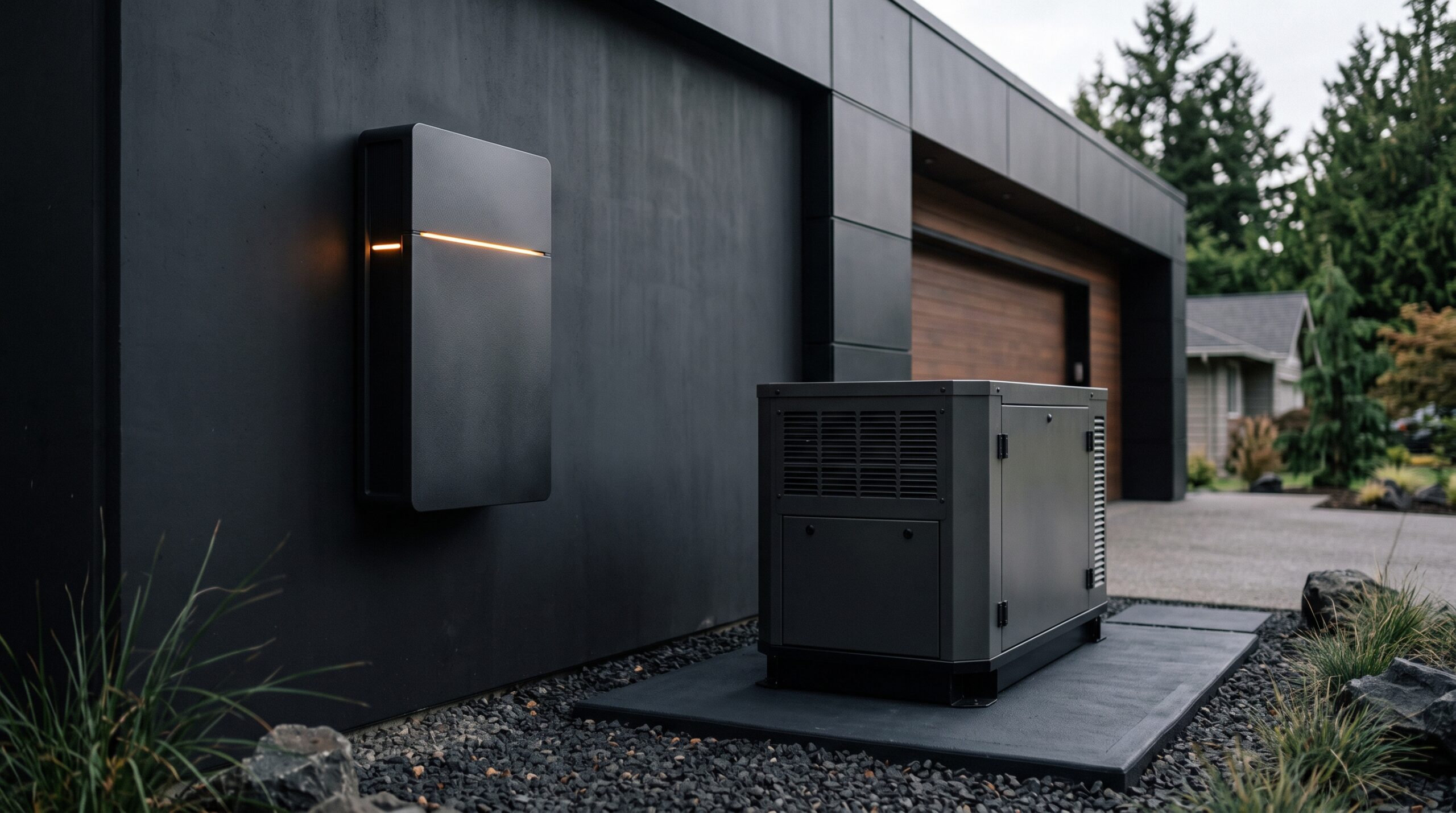
A Tesla Powerwall and a standby generator both keep the lights on when the grid fails, but they solve the problem in opposite ways: one stores quiet, fuel-free electricity and refills from solar, the other burns natural gas or propane to make power on demand for as long as the fuel holds out. The short verdict is that a generator usually wins for frequent, multi-day outages where you have no solar and reliable fuel, while a battery wins for shorter, frequent outages when you want silence, no emissions, and a solar recharge loop. Plenty of homeowners who can afford it end up running both.
What you are actually choosing between
A home battery like the Tesla Powerwall 3 is a wall-mounted lithium-iron-phosphate (LFP) battery with a built-in inverter. According to Tesla’s published specs reported by industry reviewers, one Powerwall 3 stores 13.5 kWh of usable energy and delivers 11.5 kW of continuous output, and it can stack with expansion units up to roughly 54 kWh. It charges from the grid when power is cheap and from rooftop solar when the sun is out, then discharges silently during an outage.
A whole-house standby generator is a permanently installed engine, usually 18 to 26 kW, wired to your electrical panel through an automatic transfer switch and fed by a natural gas line or a large propane tank. It does nothing day to day. When it senses an outage it starts within seconds and runs until the fuel runs out or the grid returns. If you are still weighing the broader category question, our guide on whether you need a generator or a power station breaks down the smaller portable options too.
Upfront and installed cost
Both systems are major home investments, and the installed price matters more than the sticker price because labor, permits, and electrical work are a large share of the total.
- Tesla Powerwall 3: Multiple 2025–2026 pricing roundups put a single unit at roughly $15,000 to $16,000-plus installed before incentives, with each added expansion unit costing several thousand dollars more. Coastal markets with higher labor and permit costs tend to run on the higher end.
- Whole-house standby generator: Cost guides from HomeAdvisor and others generally cite $7,000 to $15,000 fully installed for a typical home, with larger units and complex installs climbing past $20,000. A common 22 kW Generac, for example, is frequently quoted in the low-to-mid five figures once the transfer switch, gas hookup, pad, and labor are included.
These are ranges, not quotes. Your real number depends on your panel, your fuel situation, local permit fees, and how many circuits you want to back up. For a deeper breakdown of battery pricing see our home battery backup cost guide, and for the generator side, how much a whole-house generator costs.
How long each one lasts in an outage
This is where the two technologies diverge the most. A generator’s runtime is limited by fuel, and a battery’s runtime is limited by stored energy and how fast it can recharge.
A single Powerwall holds 13.5 kWh. A typical household drawing 1 to 1.5 kW of backed-up loads can stretch that across most of a day; run the air conditioner, electric range, or well pump and you will drain it far faster. EnergySage notes that most home batteries store 10 to 20 kWh, enough to cover essential appliances for roughly one to three days depending on how careful you are. Add solar that can legally power your home in an outage and the battery refills each sunny day, which is what makes multi-day off-grid backup possible.
A standby generator, by contrast, can run for days. On a natural gas line the fuel supply is effectively unlimited as long as the utility’s gas system stays pressurized; on propane, runtime depends on tank size and load, often a few days to over a week on a large tank. That endurance is the generator’s core advantage in long disasters. If you want to know how long different outages actually tend to last, that planning context lives in our outage-prep material.
Fuel, sunshine, noise, and maintenance
The day-to-day experience of owning each is very different, and it often decides the choice more than the spec sheet does.
- Fuel dependence vs sunshine dependence: A generator needs a steady fuel supply. Natural gas usually keeps flowing during outages, but propane and any gasoline-based option can run dry mid-event. A battery needs charge, and to refill during a long outage it needs sun and a solar system designed for backup. Both have a failure mode: no fuel for the generator, cloudy weeks with a dead battery and no genset.
- Noise: A battery is silent. A standby generator runs an engine that produces steady noise for the entire outage, which is a real factor in dense neighborhoods and overnight.
- Emissions and safety: Generators burn fossil fuel and emit exhaust, including carbon monoxide, so placement and clearances matter. A battery produces no on-site emissions or fumes.
- Maintenance: Generators have oil, filters, spark plugs, and a self-test cycle, and they generally need periodic servicing to stay reliable. Batteries are largely maintenance-free, though they degrade slowly over a warrantied lifespan of around 10 years.
Automatic switchover and the solar catch
Both modern systems handle the outage automatically. A standby generator’s transfer switch detects the grid loss and starts the engine within seconds. A Powerwall switches over even faster, typically in a fraction of a second, fast enough that sensitive electronics rarely notice.
The point most people get wrong is solar. Grid-tied solar panels alone do not power your home during an outage. Federal safety standards require solar inverters to shut down when the grid goes down, a feature called anti-islanding that protects utility crews from backfeed on the lines. To actually use your panels during a blackout you need a battery with an islanding-capable inverter that disconnects from the grid and forms its own local microgrid. In other words, if running your house on sunshine during an outage is the goal, the battery is not optional. We cover this in detail in do solar panels work during a power outage.
Powerwall vs standby generator, head to head
| Dimension | Tesla Powerwall 3 | Whole-house standby generator |
|---|---|---|
| Installed cost (typical) | ~$15,000–$16,000+ for one unit | ~$7,000–$15,000+; more for large/complex jobs |
| Energy / power | 13.5 kWh usable, 11.5 kW continuous (stackable) | 18–26 kW common; near-continuous output |
| Runtime, short outage | Hours to ~1 day on essentials per unit | Indefinite while fuel/gas supply lasts |
| Multi-day outage | Needs solar to recharge, or it depletes | Strong; runs days on gas, days-plus on large propane |
| Energy source | Grid + solar charging | Natural gas line or propane/gasoline |
| Recharge during outage | Yes, from solar (sun-dependent) | N/A; refuel propane as needed |
| Noise | Silent | Continuous engine noise |
| On-site emissions | None | Exhaust, including carbon monoxide |
| Maintenance | Minimal; ~10-year warranty, slow degradation | Oil, filters, plugs, periodic service |
| Automatic switchover | Near-instant (sub-second) | Automatic, starts within seconds |
| Incentives | May have qualified for federal credit (see note) | Generally none |
Incentives and the tax-credit picture
For years, home batteries with at least 3 kWh of capacity could qualify for the 30% federal residential clean energy tax credit, which meaningfully narrowed the gap with cheaper generators. Standby generators generally did not qualify. However, multiple 2025–2026 sources report that this 30% federal residential credit expired at the end of 2025, so the picture has changed. Because tax law and utility programs shift and vary by state, treat any credit as something to verify, not assume. Before you buy, confirm the current federal rules and check your state and local utility for storage rebates that may still apply. This is a cost decision with real money attached, so get the incentive math confirmed in writing from your installer.
Which one fits your situation
There is no single winner. Match the tool to your outage pattern and priorities:
- Generator edge: Frequent, long, multi-day outages, no solar, and access to natural gas or a big propane tank. If you must run heavy loads like central AC or a well pump for days at a time, the generator’s endurance is hard to beat. See whether a whole-house generator is worth it.
- Battery edge: Shorter, frequent outages, existing or planned solar, and a priority on silence, clean operation, and instant switchover. A battery also earns its keep on normal days by storing cheap or solar energy, which a generator never does.
- Both: Many homeowners who can afford it pair a battery for everyday silent backup and the first hours of any outage with a generator as the long-haul backstop for week-long events. The battery handles the common case; the generator handles the worst case.
If your needs are more modest, a smaller portable unit may be enough. Our comparison of a portable power station vs home battery backup covers that middle ground without the five-figure install.
How to buy, and where to start
Start by listing the circuits you actually need during an outage (fridge, a few lights, internet, medical devices, maybe heat or AC) and add up their watt-hours. That number tells you whether one battery is enough or whether you need a generator’s open-ended runtime. Then get at least two or three itemized installed quotes from licensed local installers, ask each to spell out the transfer switch, fuel or solar requirements, permits, and warranty, and confirm any incentive in writing. We do not sell hardware or post live prices, so use the ranges here for planning and let local quotes set your real budget.
Generator and battery options, live prices

Champion 9375W Dual Fuel
Home-backup open frame, electric start, gas or propane
$874.99Check price on Amazon →

Generac GP8000E
8,000 running / 10,000 starting watts, electric start
$1,299.00Check price on Amazon →


As an Amazon Associate we earn from qualifying purchases. Prices are pulled automatically from Amazon and may have changed.
Frequently asked questions
Is a Tesla Powerwall cheaper than a whole-house generator?
Usually no, on upfront cost. A single Powerwall 3 commonly runs around $15,000–$16,000-plus installed, while a standby generator often lands between $7,000 and $15,000 installed. Incentives historically narrowed that gap for batteries, but reporting indicates the 30% federal credit expired at the end of 2025, so confirm current rules before counting on it.
How long will a Powerwall power my house in an outage?
One Powerwall’s 13.5 kWh typically covers essential loads for several hours up to about a day, depending on what you run. Heavy appliances drain it quickly. With solar designed for backup, it can recharge each sunny day, which is what enables multi-day coverage.
Can solar panels alone power my home during a blackout?
No. Standard grid-tied solar shuts off during an outage because of anti-islanding safety rules that protect utility workers. You need a battery with an islanding-capable inverter to use your panels when the grid is down.
Which is better for a multi-day outage?
For long, multi-day events with heavy loads and no solar, a standby generator on natural gas generally has the edge because it runs as long as fuel lasts. A battery shines for shorter outages and, when paired with solar, can also sustain lighter loads across longer events.
Do I really need both a battery and a generator?
Not necessarily, but many people with the budget choose both: the battery delivers silent, instant, everyday backup, and the generator is the long-duration backstop for rare extended outages. Most households are well served by one or the other once they match the choice to their outage pattern.
Sources
- EnergySage — Home Battery Backup Power vs. Generators
- SolarReviews — Tesla Powerwall 3 cost and specs analysis
- HomeAdvisor — Cost to install a whole-house generator (2025 data)
- EnergySage — Islanding and batteries: what you need to know
- pv magazine USA — Home battery versus generator