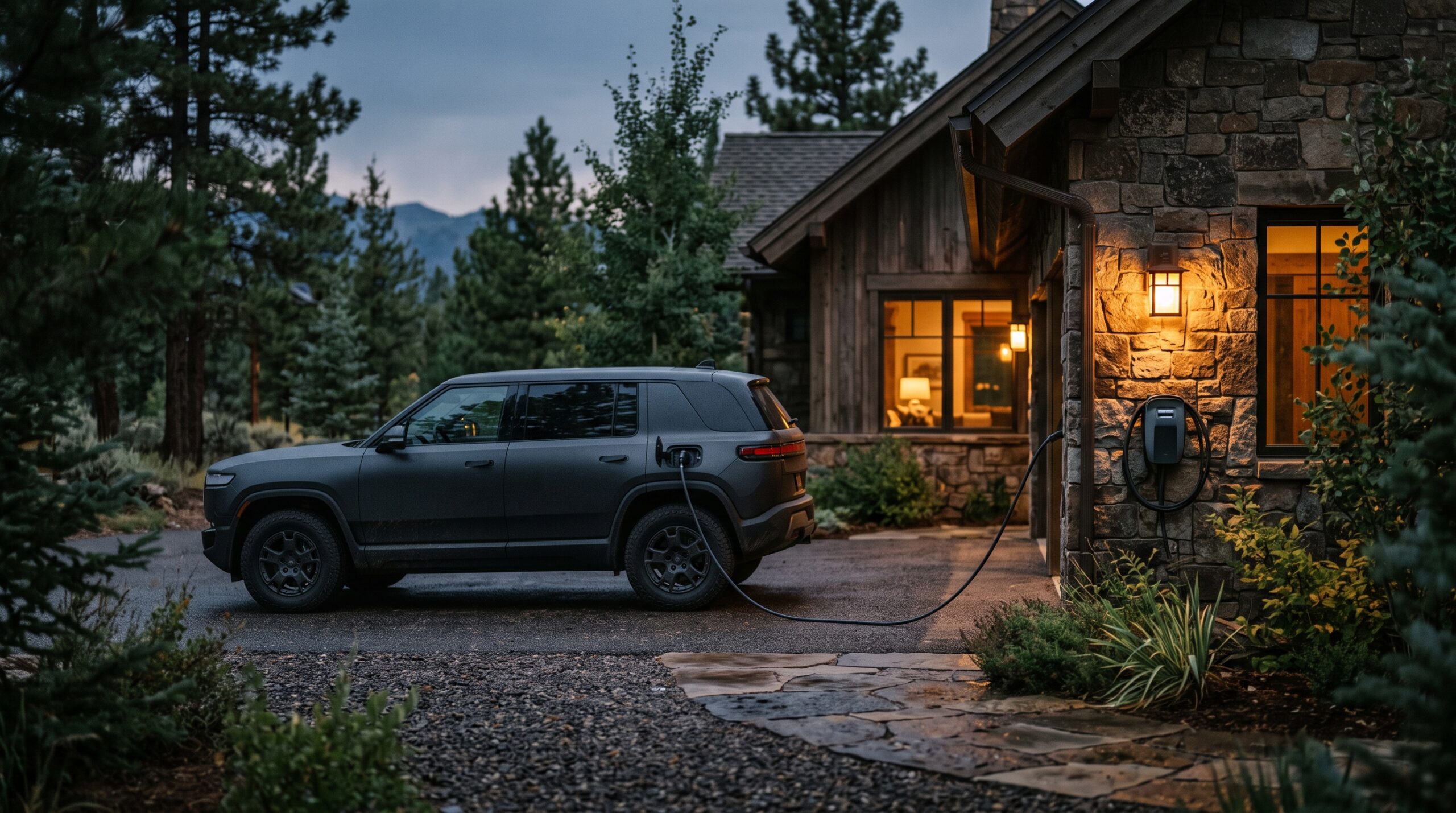
In short: yes, some EVs can power your house during an outage, either through V2L (vehicle-to-load), which runs appliances straight from an outlet or adapter, or through V2H (vehicle-to-home), which can back up a whole home but needs special equipment and a licensed-electrician install. A large EV battery holds far more energy than a portable power station, so the battery is rarely the limit. What decides it is whether your specific vehicle supports the feature and whether you have the gear to deliver that power safely.
Not every EV qualifies, and the two methods are very different in what they can run and what they cost to set up. Here is how V2L and V2H differ, which vehicles support each, the hardware you need, how long a car battery could realistically last, and the limits to plan around before you count on your car as a backup source.
V2L vs V2H explained
The two terms sound similar but describe very different setups. V2L, vehicle-to-load, lets the car act like a giant power bank: you plug an adapter into the charge port (or use a built-in interior outlet on some models) and run appliances or tools directly from the car’s battery. There is no home wiring involved, nothing to permit, and you can use it the day you take delivery. The tradeoff is that you are limited to what you can plug into that outlet.
V2H, vehicle-to-home, is a different animal. Instead of feeding individual appliances, the car feeds your home’s electrical panel through a bidirectional charger and a transfer system, so selected circuits keep running when the grid goes down. That can power a meaningful share of a house, but it requires dedicated equipment and a licensed-electrician install. You may also see V2G, vehicle-to-grid, which sends power the other direction, back to the utility, sometimes for bill credits through a supported program. For outage backup, V2L and V2H are the two that matter.
Which EVs support it
V2L is the more common of the two. The Hyundai Ioniq 5 and Ioniq 6, the Kia EV6 and EV9, and other vehicles on Hyundai and Kia’s E-GMP platform support it, with the onboard charger running in reverse to deliver roughly 3.6 kW of AC power. The Tesla Cybertruck offers a higher ceiling through its Powershare feature. To use V2L from the charge port you typically need a V2L adapter, which converts the port into a standard 120-volt outlet; Hyundai’s factory adapter runs around $550, and aftermarket versions cost less.
True V2H whole-home backup is offered by fewer vehicles and usually tied to the maker’s own equipment. The Ford F-150 Lightning supports it through Ford’s Intelligent Backup Power system. GM Energy enables it on the Chevrolet Silverado EV and other Ultium-platform vehicles. The Nissan Leaf has long supported home backup and grid export through its CHAdeMO port in compatible setups. Capability varies by model year, trim, firmware, and region, and some base trims drop the feature entirely, so confirm V2L or V2H on your exact vehicle before you rely on it.
What hardware you need
For V2L, the hardware list is short. You need a V2L-capable EV and the V2L adapter. Plug the adapter into the charge port, plug your appliance into the adapter, and you have power. No panel work, no permit, no electrician. This is the grab-and-go option, and for most people it covers a fridge, some lights, phones, and a few small devices.
V2H is a full installation. The Ford F-150 Lightning needs the Ford Charge Station Pro, an 80-amp bidirectional charger, paired with a Home Integration System sold through Ford’s partner Sunrun, which Ford has priced around $3,895 and which includes an inverter, an automatic transfer switch, and a small battery to start the system. GM’s path uses the GM Energy PowerShift Charger (about $1,699) plus the GM Energy V2H Enablement Kit (about $5,600), roughly $7,299 for the bundle before installation. In both cases the maker requires professional installation by an approved installer, with permits, because this is whole-house backup sizing territory and the wiring ties directly into your home’s panel.
How long an EV could power a home
This is where an EV’s scale stands out. A portable power station typically stores 1 to 2 kWh (1,000 to 2,000 watt-hours). A modern EV battery holds something like 60 to 130 kWh, and some electric trucks carry even more. That makes a full EV battery roughly 30 to 100 times the energy of a common power station. The reserve is large enough that runtime is usually measured in days, not hours.
Manufacturers put real numbers on it. Ford estimates that a fully charged F-150 Lightning with the extended-range 131 kWh battery can power a typical home for up to three days, or up to about ten days if you ration usage, based on roughly 30 kWh per day; the standard-range pack holds about 98 kWh and covers proportionally less. GM says a 2026 Silverado EV with the Max Range battery can help power a properly equipped home for up to five days. Treat these as ranges, not guarantees, because your actual runtime depends on how many circuits you keep live and how cold it is. One catch worth planning for: every kilowatt-hour you pull for the house is a kilowatt-hour you cannot drive on, and many systems stop drawing the pack down past a set floor so you are not left stranded. If you want a backup source you never have to move or refuel, a dedicated home battery is the alternative worth weighing; see portable vs home battery for how those options compare.
The limits, and why V2H wiring needs a licensed electrician
V2L’s main limit is output, not capacity. On Hyundai and Kia vehicles the outlet shares a 15-to-16-amp circuit, so even though the system is rated around 3.6 kW, a single 120-volt outlet gives you a practical ceiling near 1.8 kW. That comfortably runs a refrigerator, lights, a laptop, and a phone charger, but it will not start a central air conditioner or a well pump, and you should avoid stacking several heavy appliances on one outlet at once.
V2H removes the per-outlet limit but adds a hard requirement: it must be wired in by a licensed electrician under permit. A whole-home system needs proper transfer equipment so the car’s power cannot backfeed onto the grid, which would put utility line workers at risk. That is the same reason a standby generator needs a transfer switch. It is also why the equipment and install run into the thousands of dollars. Beyond cost, remember that not every model or trim supports the feature, battery capacity falls in the cold, and using the car as a backup source adds charge cycles over time, the same wear factor covered in battery lifespan. For many households, a power station sized to essentials is the simpler answer, and an EV is the heavy reserve behind it.
| Capability | What it does | What you need |
|---|---|---|
| V2L (vehicle-to-load) | Powers appliances and devices straight from an outlet or adapter on the car | A V2L-capable EV plus the V2L adapter; no home wiring or electrician |
| V2H (vehicle-to-home) | Backs up your home’s circuits during an outage, often for days | A V2H-capable EV, a bidirectional charger, a transfer/inverter kit, and a licensed-electrician install with a permit |
| V2G (vehicle-to-grid) | Sends power back to the grid, sometimes for utility bill credits | A V2G-capable EV and enrollment in a supported utility program |
| Power station (for comparison) | Runs essentials from a self-contained battery with no install | A power station sized to your loads; plug and play |
An EV can be a large reserve, but you still need to know which loads you want to keep alive and for how long. Size the job first with the Power-Station Sizing calculator to turn your essential appliances into the capacity and continuous-watt rating you need, then use the Appliance Runtime calculator to see how long a given number of watt-hours runs your fridge, lights, or medical gear. Those numbers tell you whether V2L’s roughly 1.8 kW per outlet is enough or whether you are really in V2H territory.
Frequently asked questions
Can every electric car power your house?
No. Only EVs that support V2L (vehicle-to-load) or V2H (vehicle-to-home) can do it, and the feature varies by model, trim, and region. Vehicles like the Hyundai Ioniq 5, Kia EV6 and EV9, Tesla Cybertruck, Ford F-150 Lightning, and Chevrolet Silverado EV support some form of it, but many EVs offer no power export at all. Always confirm the capability on your specific vehicle before planning to use it for backup.
What is the difference between V2L and V2H?
V2L powers individual appliances and devices through an outlet or adapter on the car, with no home wiring required, so you can use it right away but you are limited to what fits on that outlet. V2H backs up your home’s circuits through your electrical panel, which can power much more of the house, but it needs a bidirectional charger, transfer equipment, and a licensed-electrician install under permit.
Do you need an electrician to use an EV for backup power?
For V2L, no. You plug the V2L adapter into the charge port and run appliances directly, with no panel work. For V2H whole-home backup, yes. It must be installed by a licensed electrician under permit, with proper transfer equipment so the car’s power cannot backfeed onto the grid and endanger utility workers. Ford and GM both require professional installation by an approved installer for their V2H systems.
How long can an EV power a home during an outage?
It depends on the battery size and how much you run. Ford estimates a fully charged F-150 Lightning with the extended-range battery can power a typical home for up to three days, or up to about ten days with rationing. GM says a Silverado EV with the Max Range battery can help power a properly equipped home for up to five days. These are manufacturer estimates, not guarantees, and every kilowatt-hour you use for the house reduces your driving range.
Is an EV better than a power station for outages?
They are different tools. An EV battery holds roughly 30 to 100 times the energy of a typical 1-to-2 kWh power station, so it is a far larger reserve. But V2L is capped near 1.8 kW per outlet, and V2H needs costly equipment and a licensed install. A power station is simpler and immediate for essentials, while an EV is the heavier backup behind it. Sizing your actual loads first tells you which one you need.
Sources
- Ford: What is Ford Home Backup Power? (Intelligent Backup Power, Charge Station Pro, professional install)
- Solar Power World: F-150 Lightning 131 kWh battery as home backup (up to 9.6 kW, up to 3 days full home / 10 days rationed, Sunrun Home Integration System)
- GM Energy: Vehicle-to-Home (V2H) solutions (PowerShift Charger + V2H Enablement Kit, professional install)
- GM Energy: V2H Bundle (PowerShift Charger + V2H Enablement Kit pricing and components)
- Electrek: GM bidirectional charger and Silverado EV home backup (up to 5 days, Qmerit install)
- Kia EV6 owner’s manual: Vehicle to Load (V2L) (reverse onboard charger, ~3.68 kW, 120 V output)
- Recharged: Hyundai Ioniq 5 V2L explained (3.6 kW rating, ~15-amp practical ceiling, adapter)