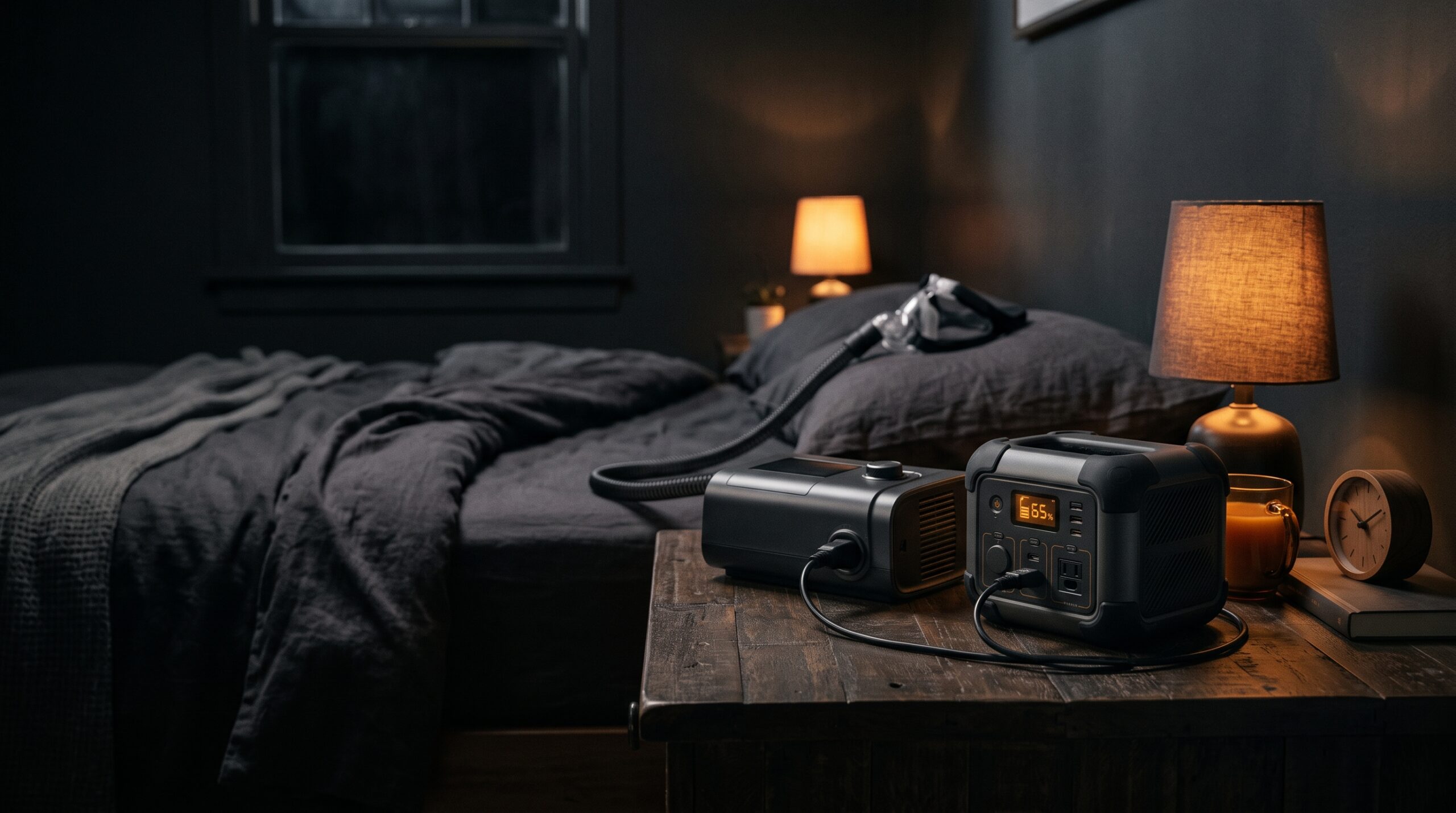
If you rely on a CPAP and want it to keep running through an outage, the short version is this: size your power station by watt-hours for the number of nights you want to cover, run the humidifier off to stretch that runtime dramatically, and choose a pure sine wave unit so your machine sees clean, grid-like power. A small station around 300–500Wh covers a night or two with the humidifier off; a medium unit near 1,000Wh covers several nights, or fewer nights if you keep humidification on. The exact math depends on your specific machine, so confirm the numbers below against your own setup before you buy.
⚠️ This is planning guidance, not medical advice
Confirm your CPAP’s exact power needs and backup options with your equipment supplier (DME) and clinician, read the device manual, and register with your utility’s medical-priority or medical-baseline program if your therapy is essential. If your sleep apnea therapy is medically necessary, treat any battery as a supplement to a documented plan, not a substitute for one.
Size by watt-hours and nights
Power stations are rated in watt-hours (Wh), which tells you how much energy they hold. Your CPAP’s draw is rated in watts (W), which tells you how fast it uses that energy. Divide one by the other and you get rough runtime. A useful planning formula is: usable watt-hours ÷ your CPAP’s average watts = hours of runtime. Most stations deliver only about 85–90% of their rated capacity after conversion losses, so a 500Wh unit gives you closer to 425–450 usable watt-hours in practice.
A typical CPAP without heated humidification draws roughly 30–40W, which works out to about 240–320Wh across an eight-hour night. Add a heated humidifier or heated tubing and the same machine can pull 60–90W, or roughly 480–720Wh a night. Those are class-level ranges, not a promise for your unit. Your prescribed pressure, your mask, ambient temperature and your humidifier setting all move the number, which is why the manual and a quick check with your provider matter more than any chart online. For the bigger picture on staying powered when the grid drops, see our guide on keeping a CPAP running during an outage.
Humidifier off saves the most
If you change one thing for outage nights, change this. The heated humidifier is usually the single largest load in a CPAP setup, and turning it off (or switching to a passover/cool setting) is the most effective way to stretch a battery. Reported figures vary, but turning humidification off commonly cuts total draw by around 30%, and some guides describe runtime improving by 40–60% once the heater and heated tube are out of the equation. The blower motor that actually delivers your therapy pressure is the smaller load; the heat is what drains the battery.
Practically, that means a station you would expect to last one night with full humidification can often cover two or more nights with the humidifier off. Many users keep a little distilled water in the chamber for passive (unheated) humidification on outage nights, which adds some comfort at almost no power cost. Confirm with your provider whether running without heat is appropriate for you, especially if you have nasal or airway sensitivity.
Why pure sine wave matters
CPAP machines run sensitive electronics, and many manufacturers recommend a pure sine wave power source. Pure sine wave inverters reproduce the smooth, grid-like waveform your machine expects, while cheaper modified sine wave inverters output a blockier approximation that can cause buzzing, run the blower less efficiently, or in some cases trip an error on the device. For a health-adjacent load you plan to sleep next to, the clean waveform is worth it. Nearly every quality LiFePO4 power station today is pure sine wave, but always confirm the spec before you buy. We break down the difference in detail in pure vs modified sine wave.
One more efficiency note: if your CPAP offers a DC power option (a 12V or 24V cord, or a barrel adapter), powering it from the station’s DC output skips the inverter entirely and avoids the AC conversion loss, which can be up to about 15%. DC delivery often buys you noticeably more runtime from the same battery. Check your manual or ask your supplier whether a DC cord exists for your model before counting on it.
Small tier: a night or two
A small power station in the 300–500Wh range is the entry point for CPAP backup. With the humidifier off, a 30–40W machine can typically run a single eight-hour night from a 300Wh unit and roughly one to two nights from a 500Wh unit. These stations are light (often well under 20 lb), quiet, and easy to keep on a nightstand. The trade-off is little headroom: turn humidification on and a small unit may not finish a single night. This tier suits short, common outages and travel, where you mostly need one reliable night and can recharge the next day from the wall, a car, or solar.
Medium tier: several nights or with humidifier
A medium station around 1,000Wh is the sweet spot for most people who want real outage coverage. With the humidifier off, a 40–50W machine can run on the order of several nights from a 1,000Wh unit; with a heated humidifier on, that same unit may cover roughly one to two nights instead. This tier gives you the flexibility to keep some humidification and still get more than one night, or to go heat-free and ride out a multi-day event. Units this size are heavier (often around 20–30 lb) but usually accept solar input, so you can top up during a long outage. If you depend on more than one device, our overview of backup power for medical equipment covers sizing for a whole setup.
Other features that matter
Beyond capacity and waveform, a few specifics make a station better for nightstand use:
- Pure sine wave output — clean, grid-like AC that sensitive CPAP electronics expect.
- Quiet operation — look for a unit whose fan stays off or near-silent at low CPAP loads, since you are sleeping beside it.
- A DC output that fits your machine — for the most efficient, inverter-free runtime if your CPAP supports it.
- LiFePO4 chemistry — longer lifespan and better safety for a battery you keep charged and ready year-round.
- Pass-through charging — the ability to power the CPAP while the station itself recharges, so a brief grid blip doesn’t interrupt your night.
- Solar input — useful for multi-day outages so you can recharge without the grid.
Plan ahead and confirm the numbers
Pick a target first: how many nights do you want to cover, and will you run the humidifier? Then size up from your machine’s real draw, leave a margin for the 85–90% usable-capacity reality, and round up rather than down. Test the whole setup before you need it: run your CPAP off the station for a full night, note how much charge it used, and confirm there are no errors or buzzing. Keep the station charged and stored at a sensible level, and recharge it on a schedule.
Finally, build the battery into a documented plan rather than treating it as the whole plan. If your therapy is essential, register with your utility’s medical-baseline or medical-priority program, keep your equipment supplier’s contact details handy, and confirm with your clinician what to do if therapy is interrupted. The numbers here are planning ranges for a product class, not guarantees for your specific device.
| Power station capacity | Nights (humidifier off) | Nights (with humidifier) |
|---|---|---|
| ~300Wh (small) | About 1 night | Often less than 1 night |
| ~500Wh (small) | About 1–2 nights | Roughly 1 night |
| ~1,000Wh (medium) | Several nights | About 1–2 nights |
Want exact figures for your machine? Plug your CPAP’s watts and your station’s watt-hours into our Appliance Runtime calculator to estimate hours per charge, or work the other direction with the Power-Station Sizing calculator to find the capacity that covers the nights you need.
CPAP-friendly picks, live prices

Jackery Explorer 300
292Wh, 300W — the cheapest way into a real power station
$259.00Check price on Amazon →


As an Amazon Associate we earn from qualifying purchases. Prices are pulled automatically from Amazon and may have changed.
Frequently asked questions
What size power station do I need for my CPAP?
It depends on your machine’s draw and how many nights you want to cover. As a planning guide, a 300–500Wh station covers a night or two with the humidifier off, while a 1,000Wh station covers several nights off, or about one to two with humidification on. Check your CPAP’s watts in the manual and confirm the math with your equipment supplier.
Does turning off the humidifier really matter?
Yes. The heated humidifier and heated tube are usually the largest load in a CPAP setup. Turning humidification off commonly cuts total power draw by around 30% and can improve runtime by roughly 40–60%, so it is the most effective way to stretch a battery during an outage. Ask your clinician whether running without heat is appropriate for you.
Do I need a pure sine wave power station for a CPAP?
Pure sine wave is recommended. CPAP machines run sensitive electronics, and many manufacturers advise a pure sine wave source so the device sees clean, grid-like power. Modified sine wave can cause buzzing, reduced efficiency, or device errors. Most quality LiFePO4 stations are pure sine wave, but confirm the spec before buying.
Can I run my CPAP on DC to save power?
If your machine supports a 12V or 24V DC cord, powering it from the station’s DC output skips the inverter and avoids the AC conversion loss of up to about 15%, which often adds runtime. Not every CPAP has a DC option, so check your manual or ask your supplier for the correct cord before relying on it.
Is a power station enough if my therapy is essential?
Treat a battery as one layer, not the whole plan. If your CPAP therapy is medically necessary, register with your utility’s medical-baseline or medical-priority program, keep your equipment supplier’s contact details accessible, and confirm with your clinician what to do if therapy is interrupted. Major outages can last days, so plan for recharging and redundancy.
Sources
- UDPOWER — How Long Will a CPAP Run on a Battery Backup? Real Runtime Chart & Expert Guide
- UDPOWER — CPAP Power Consumption: How Much Power Does Your CPAP Use?
- Retirement Living — How Many Watts Does a CPAP Use?
- Jackery — CPAP Power Supply: Can a Solar Generator Power a CPAP?
- Outbound Power — Best Portable Power Stations for CPAP Machines
- PG&E — Medical Devices and Power Outage Preparedness (Medical Baseline)