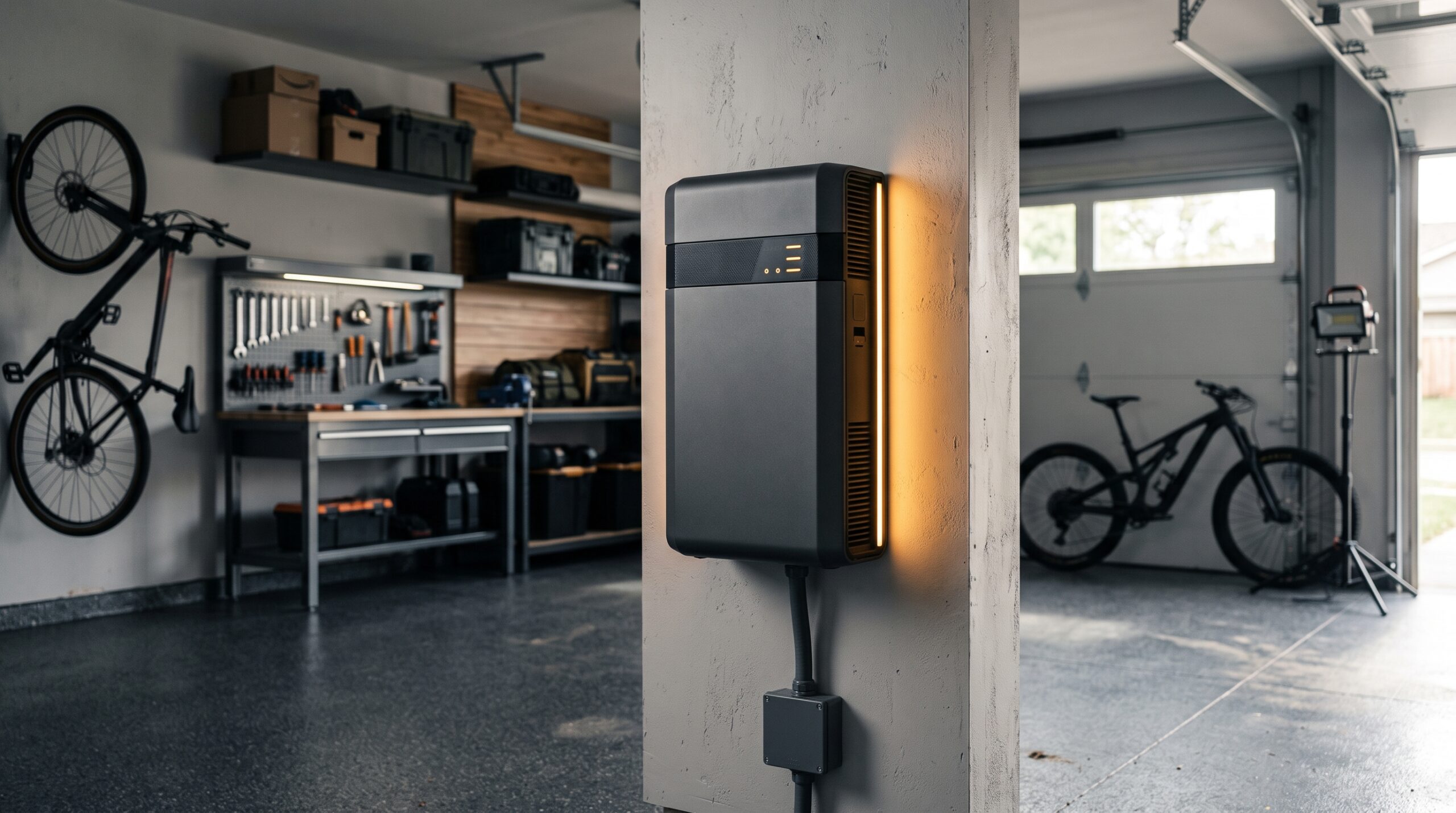
Short answer: a whole-home battery is a major investment, far more than a portable power station. A single Powerwall-class system, installed, sits in the low-to-mid five figures, and the total scales with how much capacity (in kWh) you buy, how many battery units you stack, how complicated the install is, and whether you pair it with solar. A portable station that runs a few essentials costs a small fraction of that.
Below is what actually moves the number, the cheaper options if a whole-home system is more than you need, how to think about incentives, and whether it pays off for your situation.
What drives the cost
A home battery quote is really four costs bundled together: the battery hardware, the inverter and control gear, the backup wiring (a transfer switch or smart panel), and labor plus permits. Marketplace data from EnergySage puts fully installed residential storage in the rough range of $1,000 to $1,600 per usable kWh before any incentives, which is why the headline figure climbs fast as you add capacity. The main factors that push a quote up or down:
- Capacity (kWh): more stored energy means a higher price, close to linear once you pass one battery.
- Number of battery units: covering a whole home for more than a few hours usually means stacking two or more.
- Backup scope: backing up your entire panel costs more than wiring only essential circuits.
- Install complexity: an older home that needs a panel upgrade or long conduit runs costs more than a clean install on a modern 200-amp panel.
- Solar: adding (or already having) panels changes both the price and what the battery can do during a long outage.
- Brand and inverter type: AC- vs DC-coupled designs and premium brands carry different price tags.
Capacity and number of batteries
Capacity is the biggest lever. A single battery in the roughly 10 to 13.5 kWh class (a Tesla Powerwall is in this range) can keep a fridge, lights, internet, and a few outlets running for many hours, but it will not run central air or an electric range and a whole house at once for long. If you want true whole-home coverage or multi-day resilience, you are usually looking at two, three, or more units, and the cost roughly tracks the number of batteries.
The honest way to size this is to start from what you actually need to power and for how long, not from a battery model. Our Power-Station Sizing calculator and Appliance Runtime calculator help you turn your real appliance list into a kWh target before anyone quotes you hardware.
Installation
Installation is a real chunk of the total, not a rounding error. A home battery has to be tied into your electrical panel, and most whole-home setups add a gateway or smart panel so the system can island (disconnect from the grid and run your home safely during an outage). On top of the gear, you pay for an electrician, permits, inspection, and sometimes a service-panel upgrade.
This is not DIY work. A grid-tied battery backup has to be installed by a licensed professional and pass local inspection, both for safety and to keep your warranty and any incentives valid. A simple install on a newer home sits at the lower end of the range; an older home that needs panel work or complex wiring sits well above it.
Adding solar
A battery on its own just stores grid power: it charges when the grid is up and discharges when it is down or when rates are high. That is useful, but in a long outage the battery only lasts until it is empty. Pairing the battery with solar lets it recharge during the day, which is what turns a one-day backup into something that can ride out a multi-day outage. The trade-off is a much larger upfront project, since you are buying panels, racking, and an inverter on top of the battery. If you only care about backup and not bill savings, a battery without solar can still make sense; just plan its runtime around a fixed charge.
Incentives and tax credits (general)
Incentives can meaningfully change the net cost, but they vary by location and they change over time, so treat any number you see as a starting point and confirm what is current before you sign. At the federal level, a residential clean-energy tax credit has historically covered a share of qualifying battery storage (generally batteries above a small capacity threshold), but recent law changes have narrowed or ended that credit for many homeowners depending on when the system is placed in service. On top of (or instead of) any federal credit, many states, utilities, and local programs offer rebates or performance payments, especially in areas with high outage risk or time-of-use rates.
Because eligibility and amounts shift, check the IRS guidance for current federal rules and the DSIRE database for state and local programs before you assume any discount. An installer should be able to confirm what you actually qualify for in writing.
Cheaper alternatives
A whole-home battery is the most expensive way to keep the lights on. If the budget is the problem, there are two well-proven middle options and one situational one:
- Portable power station: a battery in a box you plug appliances into. It covers a fridge, phones, CPAP, lights, and Wi-Fi for a fraction of the price, with no electrician. The trade-offs are smaller capacity and no automatic switchover. See our full portable vs home battery comparison.
- Standby or portable generator: a whole-house generator runs on natural gas or propane and can power the home for days, but it is its own major install. Our guide on whether a whole-house generator worth it breaks down the tradeoffs against batteries.
- An EV you already own: some electric vehicles can back up a home through V2L or V2H. If you have a capable EV, using an EV for backup can cover a lot of the same ground without a separate battery purchase.
Is it worth it
A whole-home battery makes the most sense when several things line up: you lose power often or for long stretches, you have or plan to add solar, you face time-of-use rates the battery can arbitrage, or you simply value silent, automatic, fuel-free backup highly enough to pay for it. If outages are rare and short, a portable station or a generator usually covers the same need for far less money. The smart move is to price the battery against those alternatives for your real outage history, not against a worst-case scenario you may never see.
| Option | Cost tier | Coverage | Notes |
|---|---|---|---|
| Portable power station | Low (hundreds to low thousands) | Fridge, lights, devices, CPAP for hours | No install, no electrician; manual plug-in, limited capacity |
| Whole-home battery (single unit) | High (low five figures installed) | Essential circuits for many hours | Automatic switchover; licensed install required |
| Whole-home battery (multi-unit + solar) | Highest (mid-to-high five figures) | Whole home, potentially multi-day with sun | Largest project; solar enables recharge during outages |
| Standby generator | Mid-to-high | Whole home for days on fuel | Needs gas/propane, install, and maintenance; runs noisy |
Tiers are general ranges, not quotes. A grid-tied battery must be installed by a licensed professional, and available incentives vary by state, utility, and year, so confirm both with a local installer before budgeting.
Frequently asked questions
How much does a whole-home battery backup system cost?
A single Powerwall-class system, fully installed, generally lands in the low-to-mid five figures, and marketplace data puts installed residential storage in the rough range of $1,000 to $1,600 per usable kWh before incentives. Stacking multiple batteries or adding solar pushes the total higher.
Is a single battery enough for a whole house?
One battery in the 10 to 13.5 kWh class can run essential circuits (fridge, lights, internet, outlets) for many hours, but it usually cannot power the entire home, including heavy loads like central air or an electric range, for long. True whole-home or multi-day coverage typically needs two or more units.
Do I need solar to use a home battery?
No. A battery can charge from the grid alone and back up your home during an outage. But without solar it only lasts until it is empty, while pairing it with panels lets it recharge during the day, which is what extends backup through a multi-day outage.
Are there still tax credits or incentives for home batteries?
It depends on where and when you install. A federal residential clean-energy credit has historically covered qualifying battery storage, but recent law changes have narrowed or ended it for many homeowners, and state, utility, and local programs vary widely. Check current IRS guidance and the DSIRE database, and have your installer confirm what you qualify for in writing.
Is a home battery cheaper than a generator?
Usually not for whole-home coverage. A standby generator often costs less upfront than a multi-unit battery system and can run for days on fuel, but it needs fuel, maintenance, and produces noise and emissions. A battery is quieter, automatic, and fuel-free, which is why the choice comes down to outage length, budget, and whether you also want solar or bill savings.
Sources
- EnergySage, Solar battery cost guide: https://www.energysage.com/energy-storage/how-much-do-batteries-cost/
- EnergySage, Tesla Powerwall review and pricing: https://www.energysage.com/energy-storage/best-home-batteries/tesla-powerwall-battery-complete-review/
- Tesla, Powerwall product page: https://www.tesla.com/powerwall
- NREL Annual Technology Baseline, residential battery storage: https://atb.nrel.gov/electricity/2024/residential_battery_storage
- IRS, Residential Clean Energy Credit: https://www.irs.gov/credits-deductions/residential-clean-energy-credit
- ENERGY STAR, Battery storage technology tax credit: https://www.energystar.gov/about/federal-tax-credits/battery-storage-technology
- DSIRE, Database of State Incentives for Renewables and Efficiency: https://www.dsireusa.org/