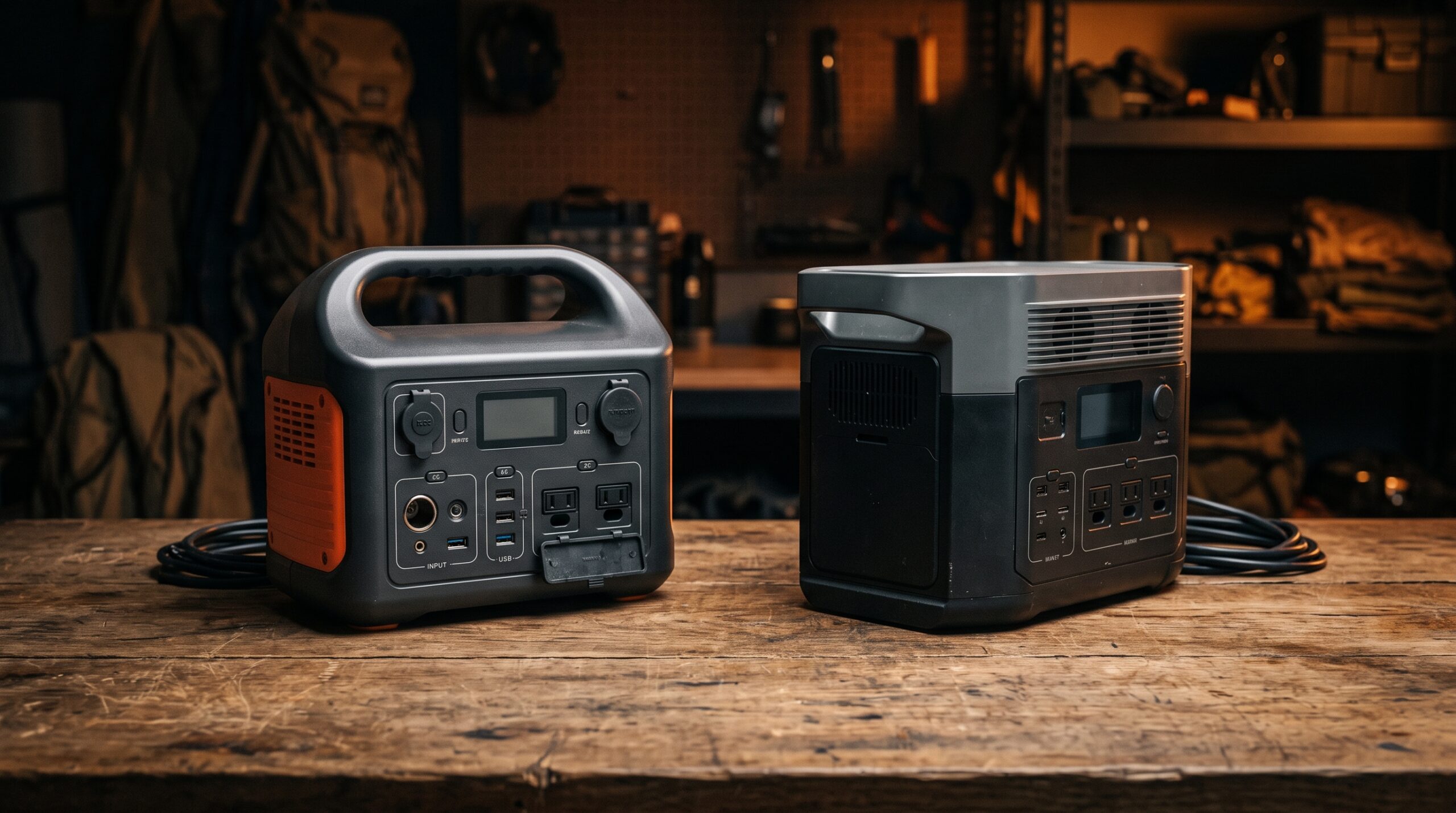
EcoFlow and Jackery are the two names most people weigh when they buy their first portable power station, and the honest answer is that both make good gear. The short version: pick EcoFlow if you want the fastest wall-outlet recharge and the most app-driven control, and pick Jackery if you want a simpler, lighter, no-fuss unit that often costs a little less. The bigger decision is sizing the battery to your actual loads, which matters far more than the badge on the front.
The short version
These brands have converged a lot over the past two years. Both now build their main models around LiFePO4 (lithium iron phosphate) batteries, both have proper phone apps, and both have closed the charging-speed gap that EcoFlow used to win outright. What’s left are differences in emphasis: EcoFlow leans into fast charging, expandability, and feature depth; Jackery leans into portability, simplicity, and value. Here’s how they stack up on the things buyers actually care about.
| What you weigh | EcoFlow | Jackery |
|---|---|---|
| AC charging speed | X-Stream fast charging; flagship LiFePO4 units hit 0–80% in roughly 50 minutes | Newer “v2” models charge fast too (0–80% in about an hour); older models slower |
| Battery chemistry | LiFePO4 across the current lineup; rated around 3,000+ cycles | LiFePO4 on Pro/Plus/v2 models (rated up to ~4,000 cycles); some legacy units still lithium-ion |
| App and features | Wi-Fi + Bluetooth; deeper controls (adjustable charge rate, UPS, integrations) | Wi-Fi + Bluetooth; simpler, easier to learn |
| Output and surge | X-Boost can run some higher-watt resistive devices above rated output | High peak/surge headroom on larger models (e.g. 2,200W rated, 4,400W surge) |
| Solar input | Generally higher solar input ceilings on comparable models | Solid solar input; ceilings often a bit lower per model |
| Design and portability | Premium feel, good displays; larger units are heavier | Famously ergonomic folding handle; light for the capacity |
| Warranty | 5 years on many LiFePO4 models | 3 years standard + 2 years extended (registration) on newer models |
| Lineup breadth | Wider: small River units up to whole-home Delta Pro systems | Focused Explorer line, small to large, expanding into bigger systems |
Charging speed
This used to be EcoFlow’s headline advantage, and it’s still where they shine. EcoFlow’s X-Stream technology pushes a lot of watts through the wall input, so a flagship like the Delta 2 reaches roughly 0–80% in about 50 minutes and a full charge in around 80 minutes from a standard outlet. That’s genuinely useful if you’re topping up between trips or want a fast refill before a storm hits.
The gap has narrowed, though. Jackery’s newer “v2” models added fast AC charging. The Explorer 2000 v2, for example, claims a full charge in well under two hours and 0–80% in about an hour, with an emergency super-charge mode toggled in the app. So if fast recharge is your only deciding factor, EcoFlow still tends to edge ahead, but Jackery is no longer slow. Just be aware that older, cheaper Jackery units charge much more slowly, so check the specific model rather than the brand.
Battery chemistry and lifespan
Both brands have moved their main models to LiFePO4 batteries, and that’s good news for buyers. LiFePO4 cells handle far more charge cycles than the older lithium-ion (NMC) chemistry (typically a few thousand full cycles versus several hundred), and they tolerate heat better. EcoFlow’s current units are rated around 3,000+ cycles to 80% capacity; Jackery rates several of its newer models even higher, up to about 4,000 cycles. In practice both translate to roughly a decade of regular use.
The catch is that Jackery still sells some older Explorer units that use lithium-ion (often rated near 500 cycles). If long-term lifespan matters to you, confirm the model is LiFePO4 before buying. If you want the full breakdown of why this matters, see LiFePO4 vs lithium-ion power stations, and our guide to reading power station specs so the cycle and capacity numbers actually mean something.
Output, surge handling, and solar input
Both brands publish a continuous (running) wattage and a higher surge (starting) wattage, and both use pure sine wave inverters that are safe for sensitive electronics. The practical differences:
- Continuous output scales with model size on both brands. A 1,000Wh-class unit runs most small appliances; a 2,000Wh-class unit can handle a fridge plus several other devices.
- Surge handling is where motor-driven and high-draw resistive loads matter. EcoFlow’s X-Boost feature can run some higher-watt devices (like certain heaters or hair dryers) above the rated output by gently lowering voltage. Larger Jackery models lean on generous surge ceilings instead.
- Solar input tends to favor EcoFlow on comparable models, with higher maximum solar wattage, which means faster recharge from panels. Jackery’s solar input is solid but the ceilings are often a touch lower model-for-model.
The point that gets lost in brand debates: the right capacity for your loads matters more than the logo. A correctly sized Jackery beats an undersized EcoFlow every time, and vice versa. Run your numbers with our sizing calculator and runtime calculator before you compare price tags; it’s the single best way to avoid buying too little (or overpaying for too much).
App, design, warranty, and value
Both apps connect over Wi-Fi and Bluetooth and let you monitor charge level, watch input/output in real time, and tweak settings. EcoFlow’s app is the more feature-rich of the two, letting you adjust charge speed, set UPS behavior, and tie into its larger ecosystem, while Jackery’s app is simpler and quicker to learn. If you like to tinker, EcoFlow wins; if you want to set it and forget it, Jackery’s restraint is a feature, not a flaw.
On design, Jackery’s folding-handle, briefcase-style build is still the benchmark for grab-and-go portability and is usually light for its capacity. EcoFlow units feel a bit more premium with better displays, but the bigger models get heavy. Warranties are now close: EcoFlow offers 5 years on many LiFePO4 models, while Jackery typically gives 3 years plus a 2-year extension if you register. On value, both sit in the mid-to-premium tier and go on sale often; Jackery is frequently the cheaper sticker, but a discounted EcoFlow can flip that, so compare the specific models you’re choosing between, not the brands in the abstract. For a three-way look that adds a strong value contender, see Jackery vs EcoFlow vs Bluetti, and if you’re cross-shopping Anker too, Anker vs EcoFlow.
Which brand should you buy?
Both are safe choices. Match the brand to how you’ll actually use it:
- Pick EcoFlow if you want the fastest wall recharge, the most control through the app, higher solar input, or a path to expandable home backup. It rewards people who like features and plan to grow their setup.
- Pick Jackery if you want simplicity, a lighter unit that’s easy to carry, and often a friendlier price, especially for camping, RV trips, and straightforward outage backup where you just want reliable power without a menu.
- Either works for home backup. Decide on capacity and output first, then choose the brand whose model hits those numbers at the best price. Our best power stations for home backup and best power station under $1,000 guides line up specific models, and how to choose a power station walks through the full decision.
How to buy without overpaying
A few honest notes so you don’t overspend: both brands run frequent sales (holiday weekends and Prime Day are the deepest), so the “list price” is rarely what you should pay. Buy the specific model that matches your sized load (not the biggest unit you can afford), and confirm it’s a LiFePO4 version if longevity matters. Register the product to lock in the full warranty, since Jackery in particular ties coverage to purchases from official or authorized sellers. Prices and exact specs shift between model years, so always check the current listing on the maker’s own site before you commit.
EcoFlow and Jackery, live prices


EcoFlow DELTA 2 Max
2,048Wh, 2,400W — fast solar, runs most of a kitchen
$1,049.00Check price on Amazon →

Jackery Explorer 1000 v2
1,070Wh, 1,500W — light and simple for outages
$499.00Check price on Amazon →

Jackery Explorer 2000 v2
2,042Wh, 2,200W — big capacity, not expandable
$899.00Check price on Amazon →
As an Amazon Associate we earn from qualifying purchases. Prices are pulled automatically from Amazon and may have changed.
Frequently asked questions
Is EcoFlow or Jackery better?
Neither is universally better. EcoFlow generally wins on charging speed, app features, and solar input ceilings; Jackery generally wins on portability, simplicity, and sticker price. For most buyers the deciding factor should be which specific model has the right capacity and output for their loads, and which is cheaper on the day you buy.
Do both brands use LiFePO4 batteries?
On their current main models, yes. EcoFlow’s lineup is LiFePO4, and Jackery uses it across its Pro, Plus, and v2 models. The exception is some older or budget Jackery Explorer units that still use lithium-ion, which last far fewer cycles. Always confirm the chemistry on the exact model’s spec sheet.
Which charges faster from a wall outlet?
EcoFlow, in most head-to-head comparisons, thanks to its X-Stream fast charging, with flagship units hitting 80% in under an hour. Jackery’s newer v2 models have closed much of the gap and also charge quickly, but older Jackery units are noticeably slower. If recharge speed is critical, check the model’s stated AC charge time, not just the brand.
Can either one run a refrigerator during an outage?
Yes, if you size it right. A roughly 1,000Wh unit can keep a typical fridge cold for several hours; a 2,000Wh-class unit can stretch that much longer, especially paired with solar. What matters is the fridge’s running and startup wattage versus the station’s output and capacity, so run the math with our calculators before assuming any single model is enough.
Are the warranties really comparable?
They’re close now. EcoFlow offers up to 5 years on many LiFePO4 models. Jackery typically provides 3 years standard plus a 2-year extension when you register, reaching a similar total. Read the fine print: coverage usually requires buying from the maker or an authorized seller, and registering the unit.
Sources
- EcoFlow: DELTA 2 portable power station (specs, X-Stream charging, warranty)
- Jackery: Explorer 2000 v2 (2042Wh LiFePO4, charge time, app)
- OutdoorGearLab: The best power stations, tested
- Gear Patrol: Best portable power stations (Anker, EcoFlow, Jackery)
- Outdoor Life: Best portable power stations, tested and reviewed