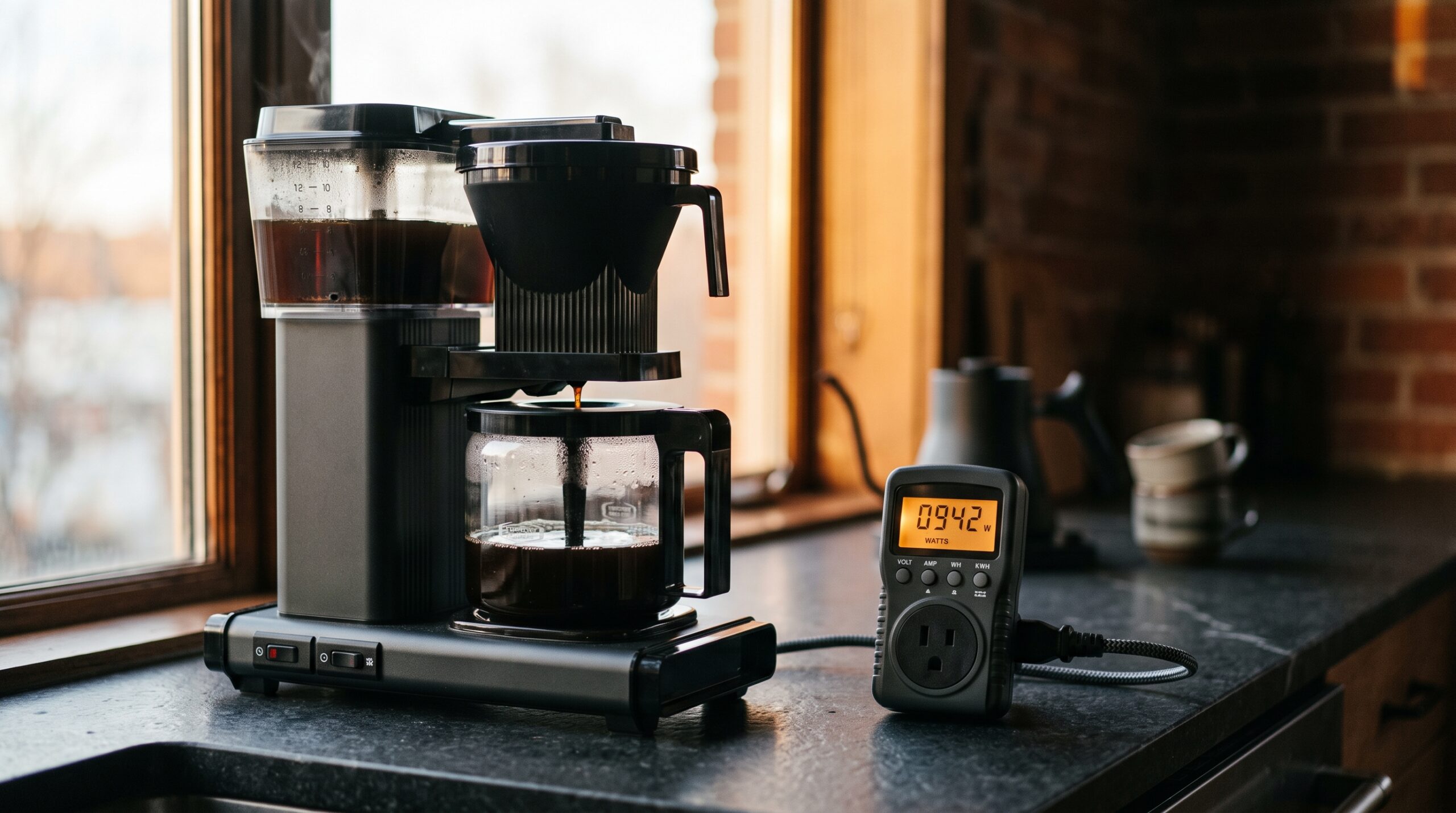
Most home coffee makers pull between 600 and 1,500 watts, but that number only applies for the minute or two when the machine is actively heating water. A standard drip brewer spikes to roughly 800 to 1,200 watts during the brew cycle, then drops to about 50 to 100 watts once the carafe sits on the warming plate. Keurig and other pod machines run higher on the heating spike (around 1,200 to 1,500 watts), and home espresso machines can reach 1,000 to 1,800 watts.
How many watts a coffee maker uses
A coffee maker has two very different power states, and confusing them is where most sizing mistakes happen. The first is the heating draw: the wattage the machine pulls while it boils water through the heating element. The second is the warming or idle draw: the much smaller wattage used to keep an already-brewed pot hot, or to keep a pod machine’s internal tank up to temperature between cups.
The label on the bottom of the machine or in the manual lists the maximum rated wattage, which is the heating number. For a typical 12-cup drip maker that figure is usually printed as something like 900W or 1,100W. The warming plate is rarely listed separately, but measured tests put it in the 50 to 100 watt range for most models, with some aggressive “keep hot” plates climbing higher.
Coffee maker wattage by type
Wattage varies more by brewing method than by brand. Pod machines and espresso makers heat a small amount of water very fast, which means a high momentary draw. Drip makers heat a larger volume more slowly. The table below shows typical heating watts, the lower warming or idle draw, and roughly how much energy a single brew actually consumes.
| Coffee maker type | Heating watts (brewing) | Warming / idle watts | Energy per brew |
|---|---|---|---|
| Basic drip (4–5 cup) | 550–900 W | 50–80 W | ~60–120 Wh per pot |
| Standard drip (8–12 cup) | 900–1,200 W | 60–100 W | ~100–200 Wh per pot |
| Single-serve pod (Keurig style) | 1,200–1,500 W | 1–15 W idle, 200–400 W reheat | ~25–60 Wh per cup |
| Home espresso machine | 1,000–1,800 W | 50–150 W standby | ~40–100 Wh per shot |
| Standalone warming plate | — | 50–100 W | ~50–100 Wh per hour kept on |
Treat these as planning ranges, not exact specs. A Mr. Coffee basic model has been measured at about 600 watts, while a faster flash-heating version of the same brand draws around 1,300 watts. Keurig models range from roughly 1,470 watts on a K-Mini down to a few watts at idle, and the K-Supreme carries a 1,520-watt UL rating. Always check your own machine’s label before you size anything around it.
Why the heating spike matters more than the average
The reason coffee makers trip up battery and inverter sizing is that the heating element is a resistive load. It does not have a motor, so there is no large startup surge the way there is with a fridge or a pump. But the heating draw itself is high and sustained for the full brew, and your inverter has to deliver that full wattage continuously, not the lower average.
So if your drip maker is rated at 1,100 watts, the inverter or power station has to handle 1,100 watts of continuous output for the brew cycle, even though the machine only does that for a few minutes. A unit rated for 1,000 watts continuous will struggle or shut off on a 1,100-watt brewer. This is different from a starting surge, which you can read more about in running watts vs starting watts. A coffee maker is a continuous-watts problem, not a surge problem.
Energy per brew is smaller than the wattage suggests
High wattage sounds alarming for battery backup, but the brew is short, so the actual energy used is modest. Energy is watts multiplied by time, measured in watt-hours. A 1,000-watt drip maker running for ten minutes uses about 167 watt-hours (1,000 W × 0.167 hours). A single Keurig cup, which heats only one mug of water, often lands under 50 watt-hours. If the term is unfamiliar, the watt-hour explainer covers the math.
The hidden cost is the warming plate. A 75-watt plate left on for two hours after brewing adds 150 watt-hours, which can equal or exceed the energy of the brew itself. During an outage, pour the coffee into a thermos and switch the machine off rather than letting the plate drain your battery. To see how this translates into hours of backup, the power station coffee maker runtime guide walks through real examples.
Sizing a power station or inverter for a coffee maker
Two specs decide whether a coffee maker will run on backup power: the continuous output rating in watts, and the battery capacity in watt-hours. The output rating has to clear your machine’s heating wattage with margin, and the battery has to hold enough watt-hours for as many brews as you want.
- Continuous output: Pick a unit rated at least 200 to 300 watts above your coffee maker’s heating wattage. For a 1,500-watt pod machine, that means a power station rated for 1,800 watts or more.
- Battery capacity: At roughly 100 to 200 watt-hours per pot, even a 500Wh power station handles several brews. Capacity is rarely the limit; output is.
- Inverter quality: A clean output helps the heating element and any electronics behave normally, which is covered in pure sine wave vs modified sine wave.
If your machine sits near the upper limit of a power station’s rating, the brief heating spike is what pushes it over. Plug your real numbers into the runtime calculator to estimate brews per charge, and use the sizing calculator to confirm the output rating is high enough before you buy. Microwaves create the same continuous-watts challenge, which you can compare in how many watts a microwave uses.
How to find your coffee maker’s exact wattage
You do not need to estimate. The exact heating wattage is usually printed on a sticker on the base of the machine, near the cord, or inside the manual. If the label lists volts and amps instead of watts, multiply them: 120 volts times 11.5 amps equals about 1,380 watts. For a metered reading, a plug-in watt meter shows the live draw, including the warming plate, which most manuals leave out. That measured number is the one to size your backup power around.
Frequently asked questions
How many watts does a Keurig use?
Most Keurig models draw 1,200 to 1,500 watts while heating water for a cup, with many landing around 1,100 to 1,300 watts. Between cups they sit at 1 to 15 watts when idle, but they pull 200 to 400 watts when reheating the internal tank. The heating spike is the number that matters for inverter sizing.
Does a coffee maker use a lot of electricity?
Not much per brew. A standard drip pot uses roughly 100 to 200 watt-hours, costing a few cents at average US electricity rates. The bigger draw is leaving the warming plate on for hours, which can use more energy than the brew itself. Turn the plate off and use a thermos to cut that waste.
Can a 1,000-watt power station run a coffee maker?
Only if your coffee maker’s heating wattage stays below about 800 watts, which usually means a small basic drip model. Most standard drip makers, pod machines, and espresso machines exceed 1,000 watts on the heating spike and will overload a 1,000-watt unit. Check the label and leave 200 to 300 watts of headroom.
How much wattage does the warming plate use?
A typical warming plate uses 50 to 100 watts, far less than the 800 to 1,200 watts the machine pulls while brewing. It is low draw, but it runs for as long as the pot stays on, so the total energy adds up over a couple of hours. Most manuals do not list this number, so a plug-in watt meter is the way to confirm it.
How many watts does an espresso machine use?
Home espresso machines generally use 1,000 to 1,800 watts, depending on whether they have a single boiler, a thermoblock, or a dual-boiler design. They draw the most while heating up and while steaming milk, then drop to 50 to 150 watts on standby. A single shot uses only about 40 to 100 watt-hours because the pull is brief.
Sources
- Electrical Forensics — Measured coffee maker power draw (Mr. Coffee 600W and 1,300W flash-heat models)
- Renogy — How Many Watts Does a Coffee Maker Use?
- Pro Coffee Gear — Espresso Machine Wattage and Energy Use Guide
- Energy Use Calculator — Electricity Usage of a Coffee Maker
- GE Appliances — 12-Cup Drip Coffee Maker with Adjustable Keep-Warm Plate (manufacturer specs)