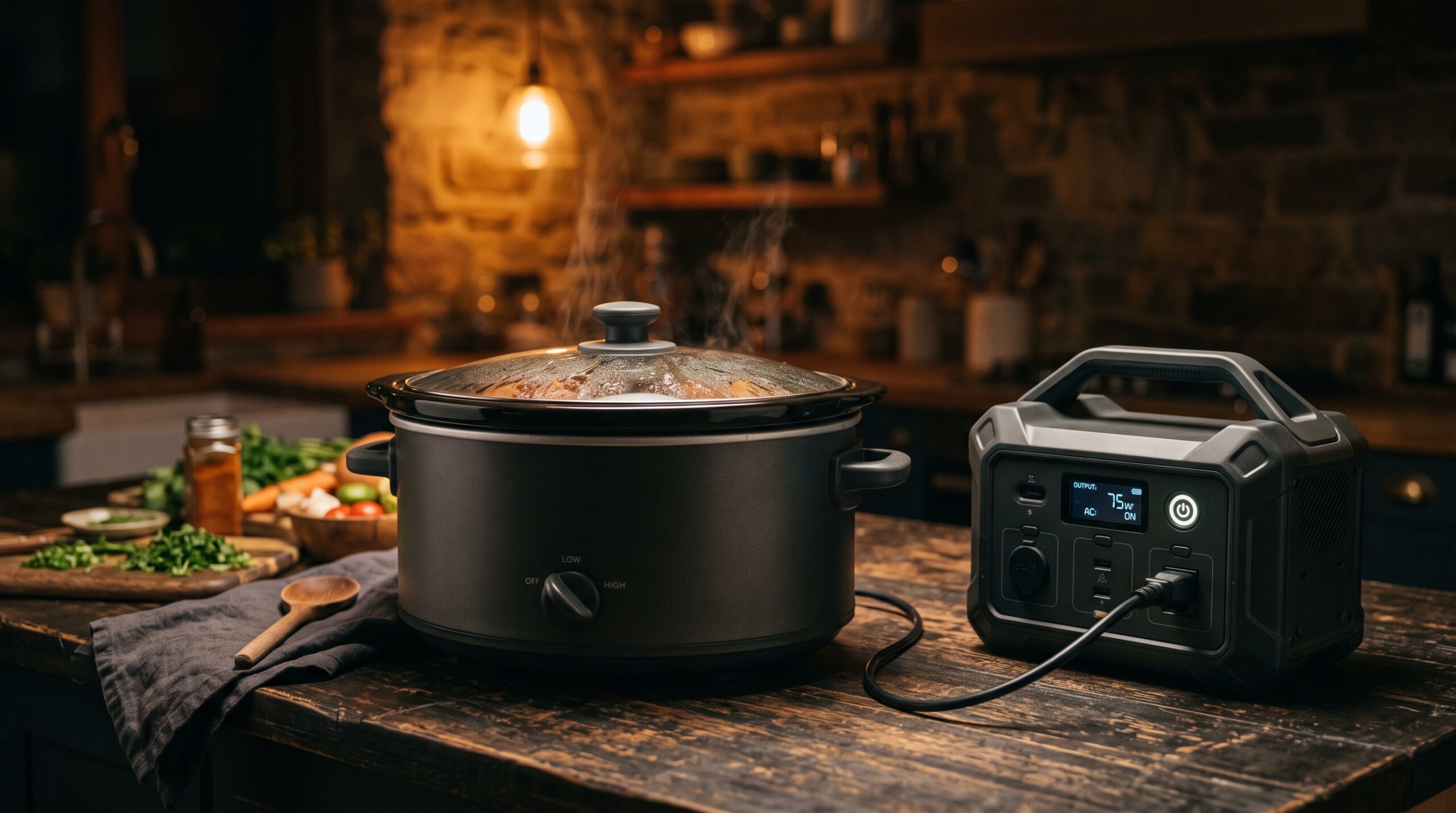
A crock pot is one of the lowest-watt cooking appliances in your kitchen: most pull about 75 to 150 watts on Low and 150 to 250 watts on High, with small 1.5-quart models near 80 watts and big 7- to 8-quart units topping out around 250 to 320 watts. Because they sip that small amount of power over many hours instead of spiking it all at once, the energy used for a full meal stays modest. That low, steady draw with no startup surge makes a slow cooker one of the best appliances to run on a portable power station during an outage.
How many watts a crock pot actually uses
A slow cooker is basically a low-power heating element wrapped around a ceramic crock. There is no motor and no fast-heating coil, so it never demands the kind of power a kettle or microwave does. The U.S. Department of Energy puts the typical range at roughly 75 to 250 watts, and most energy references list an average slow cooker at about 200 watts.
Two things move the number: size and setting. A small 1.5- to 3-quart cooker draws the least; a large 7- to 8-quart one draws the most. The Low setting sits at the bottom of the range and High at the top. Warm uses even less than Low. The exact figure for your unit is printed on the rating label on the base or in the manual, so it is worth checking before you plan around it.
Crock pot watts by size and setting
The table below shows typical running watts, the energy a steady 8-hour cook would use, and the power station size that can finish that cook. Real consumption is often a bit lower than these figures, because the thermostat cycles the element off once the food is at temperature.
| Size & setting | Typical running watts | Energy for an 8-hour cook | Power station to finish the cook |
|---|---|---|---|
| Small 1.5–3 qt, Low | ~75–90 W | ~0.6–0.7 kWh (600–720 Wh) | ~1,000 Wh runs it all day |
| Small 1.5–3 qt, High | ~120–150 W | ~1.0–1.2 kWh (1,000–1,200 Wh) | ~1,500 Wh |
| Medium 4–6 qt, Low | ~100–150 W | ~0.8–1.2 kWh (800–1,200 Wh) | ~1,500 Wh |
| Medium 4–6 qt, High | ~180–210 W | ~1.4–1.7 kWh (1,400–1,700 Wh) | ~2,000 Wh |
| Large 7–8 qt, Low | ~150–220 W | ~1.2–1.8 kWh (1,200–1,800 Wh) | ~2,000 Wh |
| Large 7–8 qt, High | ~250–320 W | ~2.0–2.6 kWh (2,000–2,600 Wh) | ~2,700–3,000 Wh |
How much energy a full cook really uses
Watts tell you the rate; watt-hours tell you the total. The math is simple: watts multiplied by hours, divided by 1,000, gives kilowatt-hours. A 200-watt cooker running for 6 hours uses 1.2 kWh; the same cooker on Low at about 100 watts for 8 hours uses roughly 0.8 kWh. If you are new to that unit, our explainer on what a watt-hour is walks through it.
That total is small compared with most cooking. A typical full slow-cook session lands somewhere between 0.6 and 1.7 kWh. By contrast, an electric oven runs at 2,000 to 5,000 watts and can burn through that much energy in well under an hour. Spreading a low wattage over a long time is exactly why a slow cooker stays cheap to run and easy to back up.
Why a crock pot is great for backup cooking
When the grid is down, the appliances that cause trouble are the ones with motors or fast heating coils. They either spike a big startup surge or pull thousands of watts the moment you switch them on. A slow cooker does neither. The heating element is resistive, so it draws its modest wattage steadily with virtually no surge, which means even a small inverter handles it without strain.
- Low draw: 75 to 320 watts covers almost every model, well within what a mid-size power station can supply.
- No surge: nothing spins up, so there is no startup spike to size your inverter around.
- Steady, predictable load: easy to plan runtime against a fixed battery capacity.
- Hands-off: load it, set it, and let it run for hours while you deal with the outage.
For more ways to put food on the table without the grid, see our guide on how to cook without power.
What size power station you need
Size the battery by total watt-hours, not just watts. A power station’s rated capacity is the headline number, but inverter and conversion losses mean you typically get about 85 percent of that as usable energy. So a 1,000 Wh station gives you roughly 850 Wh to work with.
- A small-to-medium cooker on Low (about 100 watts) draws so little that a 1,000 Wh station can carry a full 7- to 9-hour cook.
- A medium cooker on High, or a large one on Low, is happier on a 1,500 to 2,000 Wh station for a full session.
- A large 7- to 8-quart cooker on High can use 2 kWh or more, so plan on a 2,700 Wh or larger unit, or shorten the cook.
A 1,000-watt station has plenty of headroom for the wattage itself; capacity is the real limit. See what a 1,000W power station can run for where a slow cooker fits among other appliances, and use the runtime calculator to match your exact cooker and battery.
Slow cooker vs. higher-watt cooking appliances
The contrast with other countertop appliances is stark. A microwave pulls roughly 600 to 1,200 watts, and an electric kettle 1,000 to 1,500 watts, both for short bursts that hit your inverter hard. A slow cooker trades that intensity for patience: a fraction of the wattage, stretched over hours. For backup planning that is the better trade, because a steady low load is far easier on a battery than a brief high one. If you want the comparison number, here is how many watts a microwave uses.
Frequently asked questions
Does a crock pot use a lot of electricity?
No. At 75 to 250 watts for most models, a slow cooker is one of the most efficient ways to cook. A full 8-hour cook on Low uses under 1 kWh, which costs only about 10 to 15 cents at average U.S. electricity rates.
Does Low or High use more power?
High pulls more watts at any moment, roughly 150 to 250 versus 75 to 150 on Low. But High often reaches cooking temperature faster and runs for fewer hours, so the total energy for a finished dish can be closer than the wattage suggests.
Can a power station run a crock pot all day?
Often, yes. A small-to-medium cooker on Low draws around 100 watts, so a 1,000 Wh station can run a full slow-cook session. Larger cookers or the High setting need 1,500 to 2,000 Wh or more for an all-day cook.
Will a slow cooker overload my inverter?
Very unlikely. The heating element is resistive and draws steady power with essentially no startup surge, so even a 300-watt cooker stays far below the limit of any 1,000-watt or larger inverter.
How do I find my crock pot’s exact wattage?
Check the rating label on the bottom or back of the unit, or the manual that came with it. It lists the wattage, often as a single figure for the highest setting. A plug-in energy meter will also show real draw as it cooks.