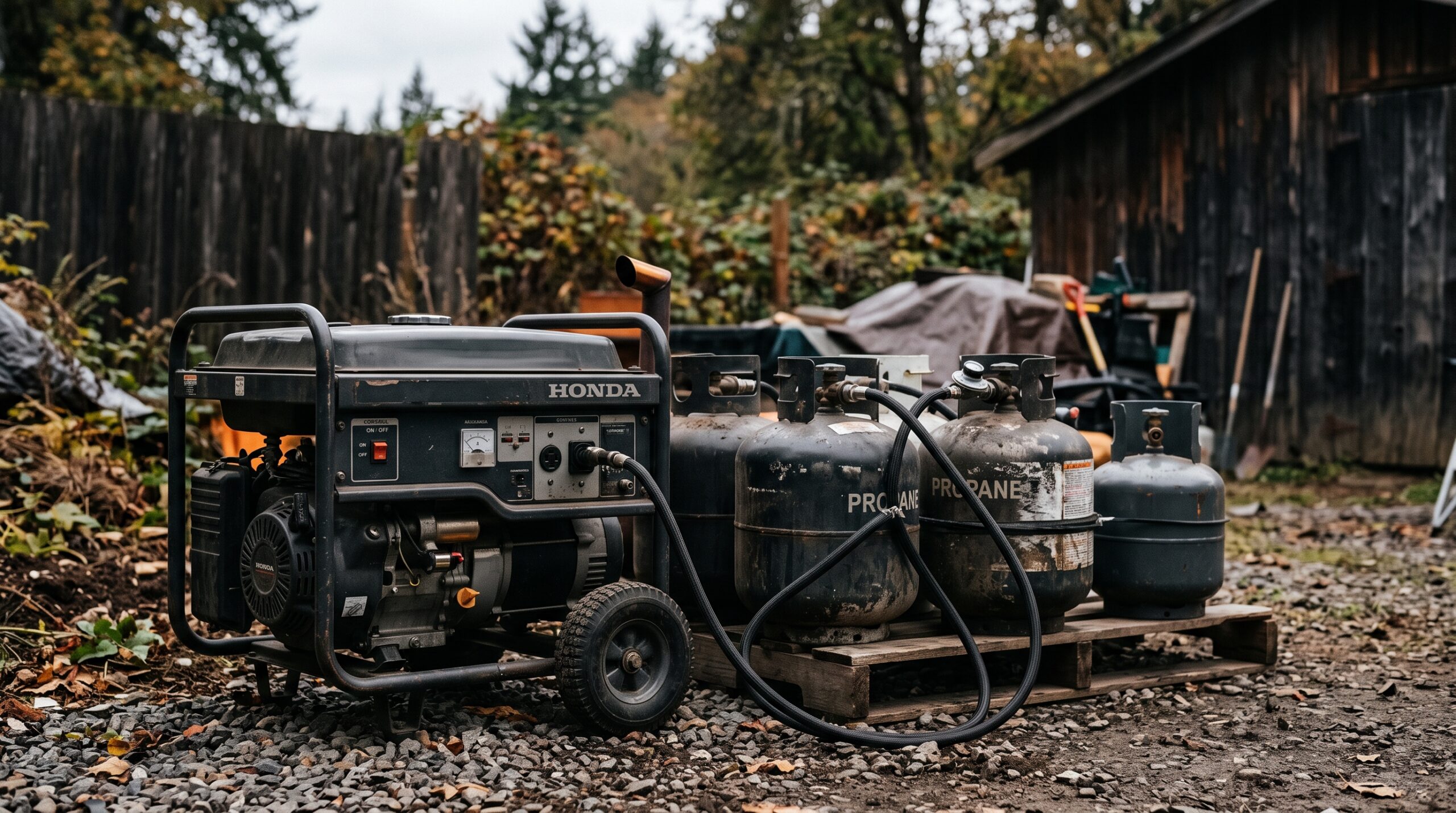
How much propane you need for an outage depends almost entirely on what you run it through. A propane or dual-fuel generator is the big drinker, burning roughly 2 pounds an hour at half load, so a single 20-pound grill tank lasts about 5 to 10 hours. An indoor-safe radiant heater sips fuel by comparison, and a camp stove uses almost nothing. Add up your daily burn by use, then multiply by the number of days you want to cover.
Start with the numbers that make the math work
Every propane estimate comes back to two facts. One gallon of propane weighs about 4.2 pounds and holds roughly 91,500 BTU of energy, per the U.S. Energy Information Administration. And the tanks you will actually use hold a known amount when filled to their safe 80 percent level:
- 1-pound cylinder (the green canister): about 0.24 gallons, roughly 21,700 BTU.
- 20-pound tank (a standard grill bottle): about 4.6 usable gallons.
- 100-pound tank: about 23.6 usable gallons, or roughly five grill tanks’ worth.
- 500-gallon tank (a buried or yard tank): about 400 usable gallons, which is multi-day or multi-week territory.
Appliances are rated in BTU per hour. Divide the tank’s BTU by the appliance’s BTU rating and you get rough run time. You do not have to do that math yourself, though, because the sections below convert it into pounds per hour and tank life for the gear most people actually own.
Propane generators are the biggest fuel draw
A generator running on propane goes through fuel faster than anything else on this list, and the rate climbs with engine size and load. Champion’s own spec sheets are a good anchor: its 4,250-watt dual-fuel unit burns about 0.45 gallons per hour at 50 percent load, which works out to roughly 1.9 pounds an hour and about 10 hours on a 20-pound tank. Step up to a 10,000-watt unit and propane use roughly doubles to about 0.94 gallons (around 4 pounds) per hour, cutting that same 20-pound tank to about 5 hours.
So for a mid-size backup generator, plan on a 20-pound grill tank lasting 5 to 10 hours at half load, and a 100-pound tank lasting roughly a day to two days. Propane burns a little less efficiently per gallon than gasoline, so a propane generator will run somewhat fewer hours on equivalent energy than a gas one. If you are weighing fuels, our guides on how much gas a generator uses and dual-fuel versus gas generators lay out the trade-offs.
Propane heaters run on BTU, and they sip fuel
Heaters are rated by heat output, so figure their fuel use from the BTU number. A popular indoor-safe radiant heater like the Mr. Heater Portable Buddy puts out 4,000 to 9,000 BTU per hour and, per the manufacturer, burns about 0.044 gallons per hour on low and 0.099 gallons per hour on high. That is only about 0.18 to 0.42 pounds an hour, far less than a generator.
In practice, that same heater runs about 3 hours on high or 6 hours on low off a single 1-pound cylinder, or roughly 2 to 4 days off a 20-pound tank with a hose adapter. Heat output scales with fuel, so a bigger 30,000-BTU heater on high burns several times faster. For the full warmth strategy, including layering and closing off rooms so you need less heat in the first place, see how to stay warm during a power outage.
Camp-stove cooking barely moves the needle
Cooking is the smallest line item. A typical single camp-stove burner runs around 10,000 BTU on high, which is about 0.46 pounds of propane per continuous hour. But you almost never run a burner flat-out for an hour straight. Real cooking is intermittent, so a single 1-pound cylinder commonly covers several meals, and a 20-pound tank can cover weeks of normal meal prep. Budget propane for heat and power first; cooking fuel is a rounding error by comparison.
Burn rate and tank-life cheat sheet
These are conservative, round-number estimates. Your real numbers depend on the specific appliance, the load, and the weather, so always check your equipment’s rating plate or manual. Generator figures assume roughly half load.
| Appliance and setting | Approx. burn rate | 20-lb tank lasts | 100-lb tank lasts |
|---|---|---|---|
| Generator, ~4–5 kW, half load | ~2 lb/hr (≈0.45 gal/hr) | ~10 hours | ~2 days |
| Generator, ~10–12 kW, half load | ~4 lb/hr (≈1.0 gal/hr) | ~5 hours | ~1 day |
| Indoor-safe radiant heater, low (~4,000 BTU) | ~0.18 lb/hr | ~4 days | ~3 weeks |
| Indoor-safe radiant heater, high (~9,000 BTU) | ~0.42 lb/hr | ~2 days | ~10 days |
| Camp-stove burner (~10,000 BTU, continuous high) | ~0.46 lb/hr | ~40 hrs of burn (weeks of real meals) | ~9 days of burn |
How much propane to store for X days
Build your estimate one appliance at a time, then stack the days. A worked example for a household running a mid-size generator part of each day:
- Generator, 8 hours a day at ~2 lb/hr = about 16 pounds a day, or close to one full 20-pound grill tank per day.
- Indoor-safe heater on low overnight, 10 hours at ~0.18 lb/hr = under 2 pounds a night, so a single tank covers many nights.
- Cooking = a pound or two over the whole outage.
Add it up and a typical 3-day outage with a part-time generator plus some heating and cooking lands around 3 to 4 grill tanks. If you expect longer or more frequent outages, a single 100-pound tank (about five grill tanks) or a permanently installed yard tank is cheaper per gallon and means fewer swaps. The honest answer for most homes: keep at least three full 20-pound tanks on hand, and more if a generator is your main plan. Pad the estimate, because cold weather, higher loads, and longer outages all push real use above the textbook numbers.
Store tanks outside and respect carbon monoxide
Propane is safe when it is stored and burned the way it is meant to be, and dangerous when it is not. The two rules that matter most during an outage:
- Store tanks outdoors, upright, and ventilated. Never keep propane cylinders inside the house, a basement, or an attached garage. Propane retailers including AmeriGas are explicit that tanks belong outside in a cool, shaded spot away from heat sources, never above 120°F and out of direct sun. Unlike liquid fuels, you do not store propane the way you would gasoline; if you also keep gas for a generator, follow separate rules in how to store gasoline safely.
- Only indoor-rated heaters go indoors, and only with ventilation and a CO alarm. An indoor-safe catalytic or radiant heater with a built-in oxygen depletion sensor is designed for tent and indoor use with a window cracked. A propane grill, an outdoor patio heater, or a generator is not. Running any of those inside a home or garage can produce lethal carbon monoxide fast.
Carbon monoxide is invisible and odorless, and a running generator is the classic cause of outage-season poisonings. Keep the generator far from the house with the exhaust pointed away, and put a battery-backup CO alarm on every level of your home. Our full carbon monoxide safety guide covers placement, symptoms, and what to do if an alarm sounds.
Frequently asked questions
How long will a 20-lb propane tank run a generator?
Roughly 5 to 10 hours at half load, depending on the generator’s size. A mid-size 4,000 to 5,000-watt unit gets close to 10 hours; a large 10,000-watt-plus unit drains the same tank in about 5. Higher loads shorten both figures.
How many propane tanks do I need for a 3-day outage?
If a generator is your main power source and you run it 8 or so hours a day, plan on roughly one 20-pound tank per day, so about 3 to 4 tanks for a 3-day event. If you are only running an indoor-safe heater and a stove, a single tank or two can stretch across all three days.
Can I use a propane heater indoors during an outage?
Only a heater that is specifically labeled indoor-safe and has an oxygen depletion sensor, and even then with a window cracked and a working CO alarm in the room. Never bring a propane grill, a torpedo/forced-air heater, or an outdoor patio heater inside. Those are outdoor-only and can flood a room with carbon monoxide.
Is it safe to store propane tanks in the garage?
No. Propane tanks should be stored outdoors, upright, in a ventilated spot away from heat and direct sun. A leak in an enclosed garage can pool and ignite, and an attached garage shares air with your living space. Keep them outside, full or empty.
Does propane go bad in storage?
The fuel itself does not degrade, which is a big advantage over gasoline for long-term outage prep. The tank and its valve can corrode or fail over the years, so inspect cylinders for rust, dents, and the rotten-egg smell of a leak, and have older tanks recertified or replaced.
Sources
- U.S. Energy Information Administration – Energy units and calculators (propane energy content)
- Mr. Heater – Portable Buddy heater specifications (BTU output, fuel use, ODS)
- Champion Power Equipment – 4250W dual-fuel generator (propane runtime and consumption)
- AmeriGas – Propane tank storage safety
- Suburban Propane – How many BTUs are in a gallon of propane