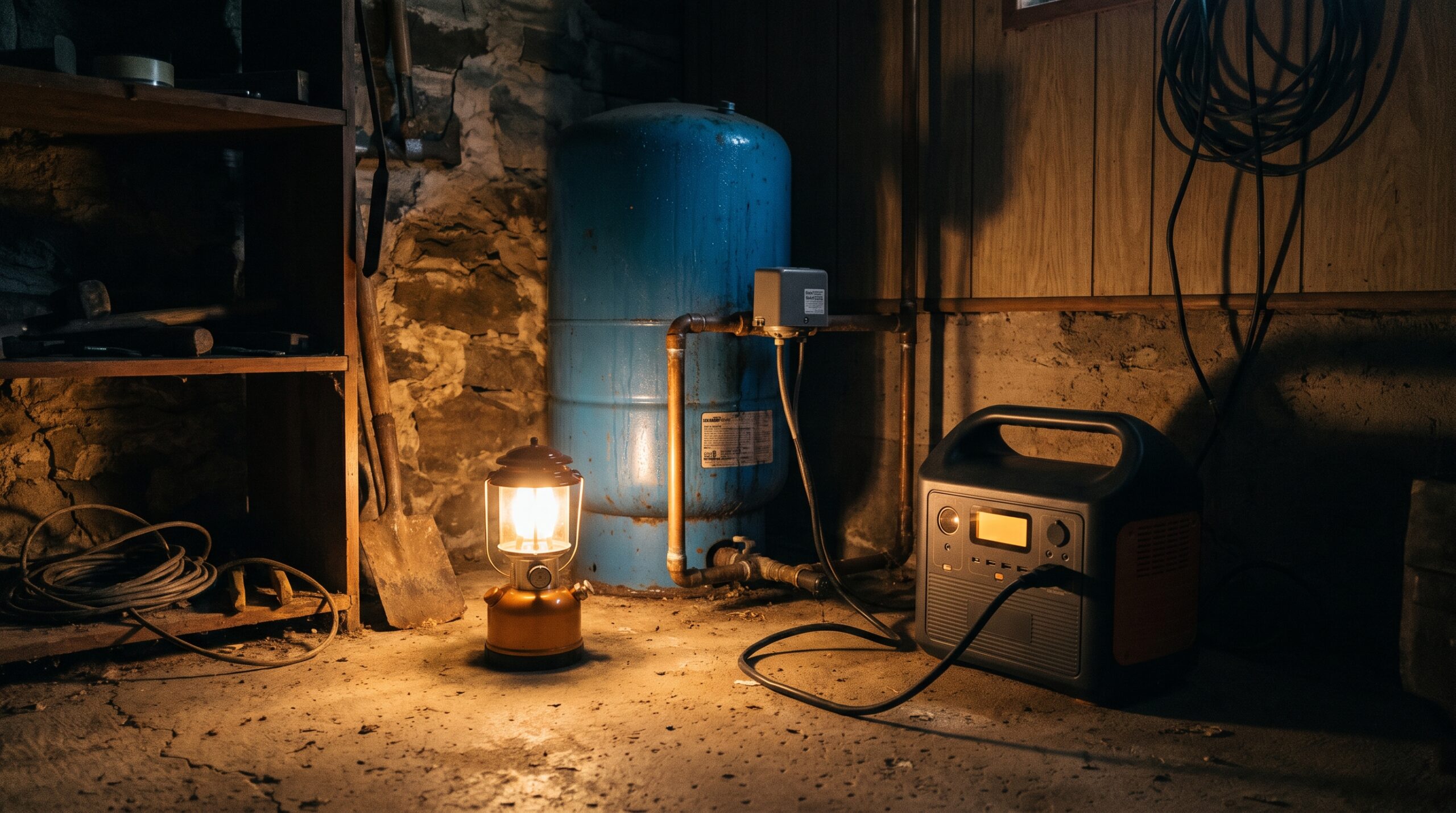
A well pump’s starting surge, not its running watts, decides which power station can run it. Franklin Electric’s motor tables list a 1/2 HP, 230V 2-wire submersible at 960 W at maximum load but 32.2 locked-rotor amps, about 7,400 VA for the instant it starts. That is why a 2,000W station that easily runs a refrigerator usually trips on a well pump (Franklin Electric AIM Manual).
The EPA estimates that more than 23 million U.S. households rely on private wells for drinking water (EPA, Private Drinking Water Wells). When the grid goes down, so does the pump. Below, pump motors are matched to power-station classes using Franklin Electric’s motor data and the station makers’ specs. For the water-safety side, see power outages and well water.
Quick picks by pump type
| Your pump | Starting demand (calculated) | Power-station class | Examples (maker spec) |
|---|---|---|---|
| 1/2 HP, 115V (2-wire) | ≈7,400 VA | 120V, 3,600W continuous / 7,200W surge. Borderline on paper, so confirm with the station maker | Jackery HomePower 3000, EcoFlow DELTA 3 Ultra |
| 1/2–3/4 HP, 230V, 3-wire | ≈5,300–7,900 VA | 240V output, 7,680–8,000W surge | EcoFlow DELTA Pro 3, Bluetti Apex 300 |
| 1/2–3/4 HP, 230V, 2-wire | ≈7,400–9,400 VA | 240V output; at or above the surge rating of these stations, so confirm with the maker | EcoFlow DELTA Pro 3 (marketed for a 1 HP water pump) |
| 1 HP, 230V | ≈9,600–11,200 VA | Above the listed surge of the stations here. Ask the maker, or use a generator | See what size generator for a well pump |
| 1.5 HP and up | ≈15,200 VA and up | Generator territory | Franklin minimum: 5 kW (7.5 kW for 2-wire) |
“Starting demand” is the motor’s locked-rotor amps × rated volts, our calculation from Franklin Electric’s Table 29. It is the worst case, at full voltage, for the fraction of a second the motor takes to start. A station whose surge rating is below it will usually shut down on overload.
Starting demand by motor size (Franklin Electric data)
| 4-inch submersible motor | Max-load watts | Locked-rotor amps | Starting demand (LRA × volts) | Franklin min. generator |
|---|---|---|---|---|
| 1/2 HP 2-wire, 115V | 960 W | 64.4 A | ≈7,400 VA | 2 kW (3 kW for 2-wire) |
| 1/2 HP 2-wire, 230V | 960 W | 32.2 A | ≈7,400 VA | 2 kW (3 kW for 2-wire) |
| 1/2 HP 3-wire, 230V | 960 W | 23 A | ≈5,300 VA | 2 kW |
| 3/4 HP 2-wire, 230V | 1,310 W | 40.7 A | ≈9,400 VA | 3 kW (4.5 kW for 2-wire) |
| 3/4 HP 3-wire, 230V | 1,310 W | 34.2 A | ≈7,900 VA | 3 kW |
| 1 HP 2-wire, 230V | 1,600 W | 48.7 A | ≈11,200 VA | 4 kW (6 kW for 2-wire) |
| 1 HP 3-wire, 230V | 1,600 W | 41.8 A | ≈9,600 VA | 4 kW |
| 1.5 HP 2-wire, 230V | 2,280 W | 66.2 A | ≈15,200 VA | 5 kW (7.5 kW for 2-wire) |
Source: Franklin Electric AIM Manual, Table 29 (4-inch single-phase motors, 3450 RPM) and Table 3 (generator minimum rating, externally regulated; 2-wire motors need 50% more). Your pump’s nameplate or control box shows HP, volts and whether it is 2-wire or 3-wire. A 3-wire pump has a separate control box near the pressure tank.
The power stations that fit, by spec
| Model | Capacity | Continuous | Surge | 240V output | UPS switchover |
|---|---|---|---|---|---|
| EcoFlow DELTA Pro 3 | 4,096Wh (expandable to 48kWh) | 4,000W | 8,000W | Yes (L14-30R, 6-20R), not 120V and 240V at the same time | 10 ms |
| Bluetti Apex 300 | 2,764.8Wh (expandable) | 3,840W | 7,680W | Yes, 120V and 240V at the same time | 0 ms (per Bluetti listing) |
| Jackery HomePower 3000 | 3,072Wh | 3,600W | 7,200W | No (120V only, TT-30) | ≤20 ms |
| EcoFlow DELTA 3 Ultra | 3,072Wh | 3,600W | 7,200W | No (120V) | <10 ms |
Specs are from each maker’s product page or official Amazon listing, checked November 3, 2026. EcoFlow markets the DELTA Pro 3 as able to run “a 1 HP water pump”. Treat that as the maker’s claim and confirm it for your motor and wire count. Jackery says the HomePower 3000 is not recommended for medical or life-critical devices.
How to choose, step by step
- Read the pump nameplate or control box. Write down HP, voltage (115V or 230V), 2-wire or 3-wire, and locked-rotor amps if listed.
- Work out starting demand. Locked-rotor amps × volts. If the nameplate doesn’t list LRA, use the Franklin table above for the closest motor.
- Match voltage first. A 230V pump needs a station with 240V output (DELTA Pro 3, Apex 300). A 120V-only station cannot run it at all.
- Match surge to starting demand. The station’s surge rating should be at or above the starting demand. If it is borderline, ask the station maker before you buy.
- Size the battery for the water you need. Watt-hours used ≈ running watts × pump-hours. See the runtime example below.
- Plan the connection. Most well pumps are hard-wired. You need a transfer switch or a maker-approved home panel, installed by a licensed electrician.
- Test before the storm. Run the pump from the station on a clear day and watch for overload shutdowns.
⚠️ Panel, transfer switch, and interlock work: hire a licensed electrician
Installing a transfer switch, a generator interlock kit, a power inlet box, or any connection to your home’s electrical panel is a job for a licensed electrician, and most areas require a permit and inspection. Never backfeed a generator or power station through a wall outlet: it can energize utility lines and electrocute line workers. Power Outage Planner is not an electrical contractor, and this page is general information, not installation advice.
How long will a power station run a well pump?
A pump only runs when the pressure tank calls for water, so runtime depends on how many minutes a day it actually runs. Example: a 1/2 HP pump at its 960 W maximum-load figure that runs a combined 1 hour a day uses about 960Wh. A 4,096Wh DELTA Pro 3 at an assumed 85% inverter efficiency (4,096 × 0.85 ≈ 3,480Wh usable) covers about 3.6 pump-hours before recharging. Every other load on the station cuts into that.
Our Power-Station Sizing calculator adds the pump to the rest of your list. For the pump’s own numbers, see how many watts a well pump uses and can a power station run a well pump.
When a generator makes more sense
For 1 HP and larger pumps, or for days of outage, a fuel generator sized from Franklin’s table is usually the more practical tool. Franklin’s minimum for a 1 HP motor is 4 kW, and 6 kW if it is 2-wire. See what size generator for a well pump and our best portable generator for home use.
⚠️ Carbon monoxide: run fuel-burning equipment outdoors only
Generators, grills, camp stoves, and other gasoline-, propane-, or charcoal-burning devices give off carbon monoxide, an odorless, colorless gas that can kill within minutes. Never use them inside your home, garage, carport, or basement, or near doors, windows, or vents, even with doors and windows open. Keep a portable generator outdoors at least 20 feet from the house with the exhaust pointed away, and install battery-operated or battery-backup CO alarms. If an alarm sounds or anyone feels dizzy, weak, or sick, get to fresh air right away and call 911. Read our carbon monoxide safety guide (based on CDC and U.S. CPSC guidance).
Frequently asked questions
Can a 2,000W power station run a well pump?
Usually not. A 1/2 HP submersible draws under 1,000 W while running, but Franklin Electric lists 32.2 to 64.4 locked-rotor amps for 1/2 HP 2-wire motors, about 7,400 VA at start-up. That is far above the surge rating of most 2,000W stations. Many deep-well pumps also need 240V, which most 2,000W stations don’t provide.
Does my well pump need 240V?
In Franklin Electric’s 4-inch single-phase motor table, 115V appears only at 1/2 HP. Its 3/4 HP and larger motors are 230V. The motor nameplate or control box shows the voltage. A 230V pump needs a station with 240V output, such as the EcoFlow DELTA Pro 3 or Bluetti Apex 300.
What is the difference between a 2-wire and 3-wire well pump?
A 2-wire pump has its starting components inside the motor. A 3-wire pump has a separate control box above ground. Franklin’s data shows 3-wire motors draw fewer locked-rotor amps (23 A vs 32.2 A at 1/2 HP, 230V), so they are easier to start on a battery or small generator.
Can I plug my well pump into a power station?
Only if the pump has a plug, which is rare. Most are hard-wired to a pressure switch and breaker. Connecting a station to that circuit needs a transfer switch or a maker-approved home panel installed by a licensed electrician. Never backfeed through a wall outlet.
How long will a power station run a well pump?
It depends on pump-hours, not clock hours. At an assumed 85% efficiency, a 4,096Wh station gives about 3,480Wh usable, roughly 3.6 hours of pumping for a 1/2 HP pump at its 960 W maximum-load figure. Use the sizing calculator to add your other loads.
Sources
- Franklin Electric, AIM Manual: Submersible Motors (Table 3 generator sizing; Table 29 motor specs)
- EPA, Private Drinking Water Wells
- EcoFlow, DELTA Pro 3 specifications
- Jackery, HomePower 3000 specifications
- Ready.gov, Power Outages
Run your own numbers
Add the pump and the rest of your outage list to see the battery size and surge rating you need.